Top 10 Money Mistakes Students Make (And How to Avoid Them)
Most financial mistakes college students make aren’t caused by carelessness or bad intentions. They’re caused by nobody ever explaining how money actually works. You didn’t get a personal finance class. Neither did most of your classmates. So you figured it out as you went — and “figuring it out” usually means making the same expensive mistakes everyone else does.
Here are the 10 most common ones — and more importantly, exactly what to do instead.
This is the most common and most costly mistake on the list. Without a budget, spending decisions happen by feel — and feelings are notoriously bad at math. You think you have money because your bank account isn’t empty. Then it is.
Aisha, a junior studying education, went three semesters without a budget. She wasn’t reckless — just untracked. When she finally added everything up, she found she’d been spending $340 a month on food and dining out, not the $150 she estimated. That $190 gap added up to nearly $1,200 in unexpected spending over a semester.
Spend 20 minutes on the first day of each month writing down your income and assigning every dollar to a category. Use the 50/30/20 rule as your starting framework. Free apps like YNAB, Copilot, or even a Google Sheet get the job done. Need a full walkthrough? See our beginner’s guide to personal finance for students.
A credit card is a powerful financial tool — until it isn’t. The mistake most students make isn’t getting a credit card. It’s treating it like bonus money instead of a payment method for money they already have.
When you carry a balance on a card with 24% APR, every $100 you don’t pay off costs you $24 in interest per year — and that compounds monthly. A $500 balance you carry for two years can quietly turn into over $750 owed.
Use your credit card for regular purchases you’d make anyway — groceries, gas, subscriptions. Set up autopay for the full balance every month, not the minimum. Never charge what you can’t already afford to pay off from your checking account.
Out of sight, out of mind — until graduation hits and a repayment notice lands in your inbox for an amount that takes your breath away. Many students borrow year after year without ever logging into StudentAid.gov to check their running total.
On unsubsidized federal loans, interest accrues from day one — even while you’re still in school. If you borrow $8,000 in freshman year at 6.5%, by the time you graduate four years later you already owe roughly $10,200 before you’ve made a single payment.
Log into StudentAid.gov today and find your exact balance. If your loans are unsubsidized, consider making small interest-only payments while in school — even $25 to $50 a month prevents interest from capitalizing and inflating your principal.
Life doesn’t wait for a convenient time to break down. Your car needs a new tire. Your laptop dies the night before finals. Your hours get cut at work. Without a financial cushion, any small crisis immediately becomes a credit card charge — and debt you’ll spend months paying off.
An emergency fund isn’t about having a lot of money saved. It’s about having a buffer between normal life and financial disaster. Even $300 to $500 changes the equation entirely.
Open a separate high-yield savings account and label it “Emergency Fund.” Transfer a fixed amount each month — even $20 or $30 — until you hit $500. Once you’re there, aim for one month of expenses. This account is not for sales, trips, or concert tickets. Emergencies only.
You get a pay raise, a bigger financial aid package, or start a higher-paying job — and almost immediately your spending rises to match it. New apartment, nicer restaurants, upgraded phone. This is lifestyle creep, and it’s one of the quietest wealth-killers there is.
Students who earn more tend to feel financially ahead — until they realize they’re saving the same zero dollars they were before the raise. The extra income evaporated into a slightly more expensive version of the same life.
Every time your income increases, direct at least 50% of the increase to savings or debt payoff before adjusting your lifestyle. Give yourself a small upgrade as a reward — but make the majority work for your future self, not your current comfort.
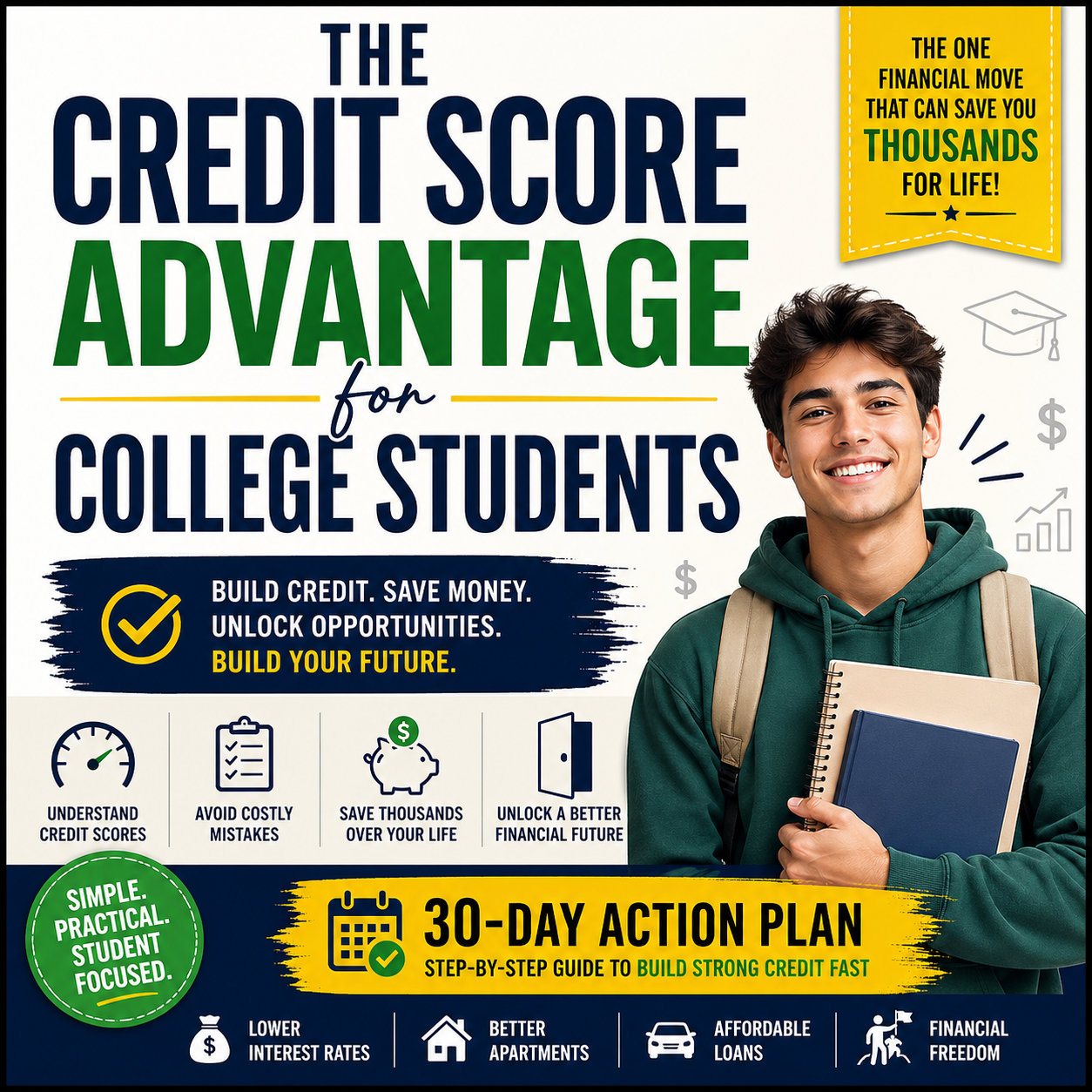
Build Your Credit Before You Graduate
A simple 30-day plan to help students build credit, avoid costly mistakes, and save thousands.
The minimum payment on a credit card is designed to keep you in debt as long as possible — not to help you pay it off. On a $1,500 balance at 22% APR, paying only the minimum of around $35/month means you’ll be paying for over five years and will have paid nearly $800 in interest alone.
This is one of the most expensive financial habits a student can form — and it’s completely invisible on a monthly basis because the minimum payment always feels affordable.
Always pay more than the minimum — even an extra $20 or $30 a month makes a significant difference. Use the avalanche method: list all debts by interest rate and put every extra dollar toward the highest rate first, while paying minimums on the rest.
Streaming services, gym memberships, app subscriptions, meal kit trials that converted to paid plans — they’re each small, they auto-renew quietly, and together they add up to a number most students would be genuinely shocked by.
The average college student has 4 to 6 active subscriptions at any given time, often including at least one they completely forgot about. At $10 to $15 each, that’s easily $50 to $80 a month — over $900 a year — disappearing before they even check their balance.
Do a subscription audit right now: pull up your bank or credit card statement and highlight every recurring charge. Cancel anything you haven’t used in the last 30 days. Tools like Rocket Money or your bank’s subscription tracker can automate this going forward.
This is the most overlooked financial mistake on the list — and it can be the most catastrophic. Your landlord’s insurance covers the building. It does not cover your laptop, your bike, your furniture, or any of your belongings if there’s a fire, flood, theft, or break-in.
Renter’s insurance costs between $10 and $20 per month and covers your personal property for losses up to $20,000 or more. Most students skip it because they think they “don’t have enough stuff” to insure — until they do the math on what it would cost to replace everything.
Get renter’s insurance. Today. Lemonade, State Farm, and most major insurers offer policies for students starting around $8 to $12 per month. It takes about 5 minutes to set up online and it’s one of the best dollars-per-protection purchases available.
“I’ll start investing when I have a real job.” This is the single most expensive sentence in personal finance. Every year you wait to start investing costs you far more than the amount you would have invested — because of compound growth.
A student who invests $50 a month starting at 20 will have significantly more at retirement than someone who invests $200 a month starting at 35. The math is brutal and it’s irreversible — time you don’t invest can never be bought back. We break this down in detail in Why Financial Literacy Matters More Than Your GPA.
Open a Roth IRA at Fidelity, Vanguard, or Schwab — all free, no minimums. Invest as little as $25 to $50 a month in a total market index fund. Set it to auto-invest so you never have to think about it. Start this month, not next year.
Social media shows you the vacation, the new car, the apartment upgrade, the dinner out — not the credit card bill that funded it. Comparing your financial situation to curated highlight reels is a fast path to bad spending decisions made for the wrong reasons.
Some of the most financially healthy students on any campus are also some of the least visibly “balling.” They drive older cars, pack lunch, and say no to expensive weekend trips. Their future selves will have the receipts — in the form of a paid-off loan and a growing investment account.
Compare yourself to your own previous month, not to other people’s social media. Set one financial goal per month — pay off $100 extra debt, add $50 to savings, cancel one subscription — and measure progress against that. Your financial story is the only one that matters.
“Financial mistakes aren’t a sign of failure. They’re a sign of never being taught. Now you know — and knowing is the only thing that separates a mistake you make once from one you keep making forever.”
The good news about all ten of these mistakes? Every single one is fixable. Most take less than an hour to address. You don’t need a perfect financial past to build a strong financial future — you just need to start making slightly better decisions than you made last month.
Your 10-Point Action Checklist
- Set up a monthly budget using the 50/30/20 rule
- Set credit card autopay to full balance every month
- Log into StudentAid.gov and check your exact loan balance
- Open a separate high-yield savings account for emergencies
- Save at least 50% of any future income increases before lifestyle adjustments
- Pay more than the minimum on any debt you’re carrying
- Audit your subscriptions and cancel anything unused
- Get renter’s insurance — takes 5 minutes, costs less than a pizza
- Open a Roth IRA and start with as little as $25/month
- Stop comparing your finances to social media — build your own scorecard
This is Issue 03 of The Campus Ledger Financial Literacy Series. Missed the earlier issues? Read Issue 01: Why Financial Literacy Matters More Than Your GPA and Issue 02: Personal Finance for Students — A Complete Beginner’s Guide on our site.