Why Financial Literacy Matters More Than Your GPA
You’ve pulled all-nighters for exams, stressed over your GPA, and maybe cried over a calculus midterm. Fair. Your grades matter. But here’s a truth nobody puts in the syllabus: a 4.0 won’t automatically protect you from a debt spiral, a predatory lease, or an empty bank account two weeks before graduation.
Financial literacy — knowing how money actually works — is the class you never took but desperately need. And unlike organic chemistry, this one has real, immediate consequences.
What Financial Literacy Actually Means
Let’s clear something up. Financial literacy isn’t about being rich or having a finance degree. It’s knowing enough to make smart decisions: how to budget, understand interest rates, avoid bad debt, and start building wealth early — even on a ramen budget.
Think of it like this: your GPA gets you in the door. Financial literacy keeps you in the house.
Marcus, Junior — Computer Science
Marcus got his first credit card freshman year. He used it for takeout, concert tickets, and a new laptop. The limit was $2,000. He only paid the minimum each month — around $35.
By junior year, Marcus owed $1,900. Because of 24% APR interest, he was paying more in interest every month than he was reducing the balance. He didn’t understand how compound interest worked against him.
The Compound Interest Argument
Here’s the most powerful sentence in personal finance: time is the ingredient money can’t buy later. If you invest just $100 a month starting at 20, you’ll have significantly more by retirement than someone who invests $300 a month starting at 35 — simply because of compound growth.
“Compound interest is the eighth wonder of the world. He who understands it, earns it. He who doesn’t, pays it.”
Your GPA has a shelf life. An employer looks at it for your first job, maybe your second. But the financial habits you build right now — good or bad — compound for decades. A student loan you ignore doesn’t disappear. A Roth IRA you start at 21 becomes extraordinary by 60.
Priya, Senior — Communications
Priya worked 15 hours a week at the campus library. After expenses, she had about $80 left over each month. Instead of spending it, she opened a Roth IRA and invested that $80 monthly into a low-cost index fund starting at age 20.
She wasn’t rich. She didn’t have a finance degree. She’d just spent one Sunday afternoon reading about retirement accounts.
The Skills Your Professors Won’t Teach You
Nobody in lecture hall is covering how to negotiate your first salary (hint: never accept the first offer), how to read a lease before you sign it, or how a credit score affects your ability to rent an apartment, get a car loan, or even land certain jobs.
These aren’t soft skills. They’re survival skills.
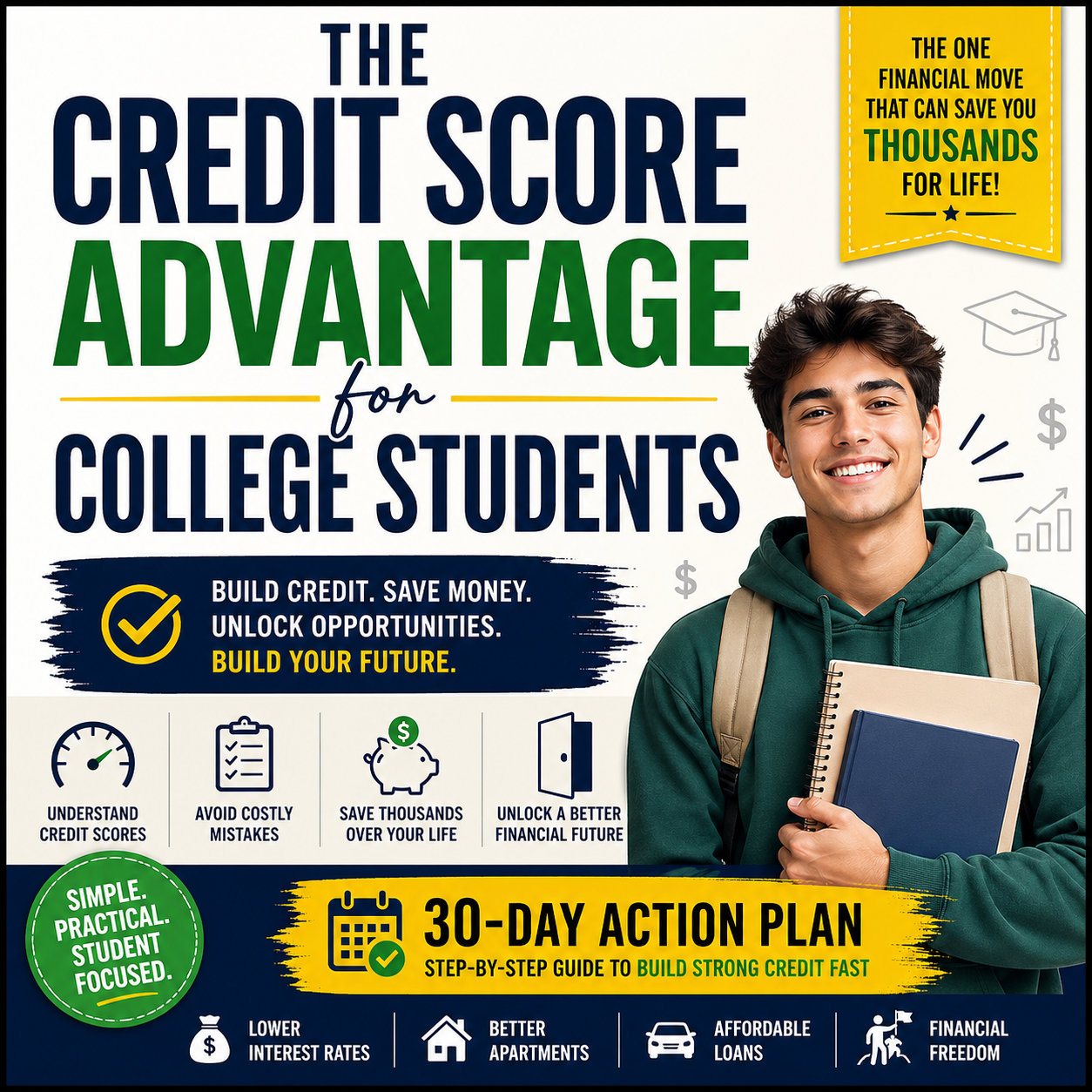
Build Your Credit Before You Graduate
A simple 30-day plan to help students build credit, avoid costly mistakes, and save thousands.
The 5 Financial Basics Every College Student Should Know
- How to build a simple monthly budget using the 50/30/20 rule (needs / wants / savings)
- What your credit score is, and how to check it for free
- The difference between good debt (student loans, mortgages) and bad debt (high-interest credit cards)
- What an emergency fund is and why $500–$1,000 is a reasonable starting goal
- How to open a Roth IRA and why starting now beats starting later — every single time
A 3.8 GPA and Broke at 30
Jordan, Recent Graduate — Pre-Law
Jordan graduated with honors, a strong GPA, and $62,000 in student loan debt. He landed a $58,000 starting salary at a law firm, which felt like a victory — until he did the math. After taxes, rent, loan payments, and a car payment he couldn’t really afford, Jordan had less than $200 left at the end of each month.
He’d never made a budget. He’d never learned about income-driven repayment options on his loans. He didn’t know his car loan had a 17% interest rate — predatory, but he’d signed without reading.
So, What Do You Do Now?
You don’t need to become a finance expert. You need to become financially literate — and that’s actually achievable in a weekend. Read one good personal finance book (try I Will Teach You to Be Rich by Ramit Sethi or The Total Money Makeover by Dave Ramsey). Download a budgeting app. Check your credit score. Know what you owe and to whom.
Your GPA is a number on a transcript. Your financial literacy is a living, breathing skill that shapes every decade of your adult life — your career choices, your freedom, your stress levels, your relationships.
Start small. Start now. Your future self — the one with options instead of anxiety — is counting on you.
The best time to learn how money works was when you got your first paycheck. The second best time is today.