Credit card debt is revolving unsecured debt accumulated through purchases or cash advances charged to credit cards and not paid in full by statement due dates—creating compounding high-interest obligations typically ranging 15-29.99% APR that dramatically increase total costs through daily interest calculation on unpaid balances. Representing most common and expensive form of consumer debt affecting 45%+ of American households carrying average balances $6,000-8,000, credit card debt traps millions in perpetual payment cycles where minimum payments (typically 1-3% of balance) barely cover accruing interest causing balances to persist for decades—$5,000 balance at 18% APR with $150 minimum payments requires 15+ years and $6,000+ interest to repay versus aggressive $300 monthly eliminating debt in 19 months with $580 interest demonstrating minimum payment trap deliberately designed maximizing issuer profits through interest accumulation. Unlike productive debt financing appreciating assets or income generation, credit card debt almost universally represents destructive borrowing funding consumption (dining, shopping, entertainment, vacations) creating obligations without corresponding value, though emergency usage for essential unexpected expenses (car repairs enabling employment, medical costs) can represent necessary borrowing requiring rapid repayment preventing interest accumulation making credit card debt literacy essential for avoiding wealth destruction through high-interest consumption spending creating payment burdens consuming 10-20% income for purchases long-forgotten impossible without understanding interest mechanics, minimum payment mathematics, and strategic elimination approaches.
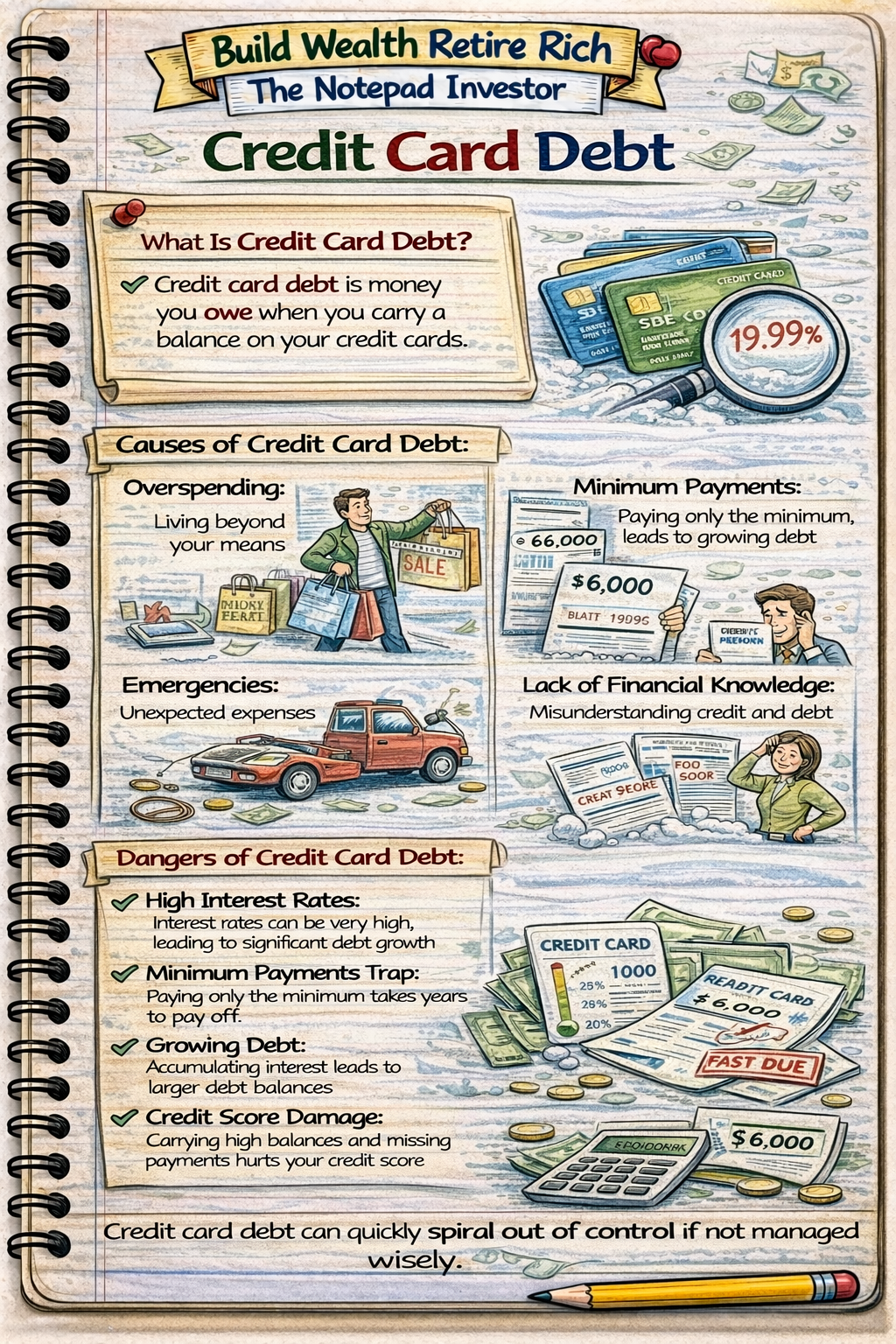
This article is designed for anyone carrying credit card balances wanting elimination strategies, individuals considering using credit cards for purchases, or those confused by APRs, minimum payments, and repayment options. You do not need financial expertise to understand credit card debt—fundamental concepts accessible through clear explanations of interest calculation, payment mechanics, elimination strategies, and prevention approaches, though requires honest spending assessment identifying whether charges represent genuine emergencies versus lifestyle inflation beyond income capacity, disciplined commitment to aggressive repayment eliminating balances rapidly preventing years of interest accumulation, and behavioral changes preventing future debt cycles through budget alignment and emergency fund establishment addressing root causes not merely symptoms of spending exceeding earnings.
Understanding credit card debt matters because high interest rates create $3,000-10,000+ unnecessary costs on typical balances when minimum payments perpetuate debt for decades, compound interest mathematics means small balances grow dramatically when not addressed aggressively making $2,000 problem become $5,000 burden over 3-4 years through continued spending and insufficient payments, and opportunity costs of debt payments prevent wealth building through lost investment returns and forced saving capacity—while credit-card-debt-literate individuals recognize minimum payment trap avoiding multi-year repayment timelines, implement aggressive elimination strategies (debt avalanche, balance transfers, spending freezes) eliminating balances in 12-24 months saving thousands in interest, and prevent future accumulation through budget discipline and emergency reserves, versus irresponsible users perpetually carrying $5,000-15,000 balances paying $1,000-3,000 annually in interest for purchases consumed years prior creating permanent payment obligations preventing wealth accumulation through interest costs exceeding any credit card rewards or convenience benefits.
Educational disclaimer: This article provides general educational information about credit card debt. Individual debt situations, appropriate elimination strategies, and repayment timelines vary based on circumstances including income, expenses, total debt, and available resources. This is not financial advice or recommendation of specific debt elimination approaches. Credit card debt carries risks including continued interest accumulation, potential collections, and credit score damage. Some strategies like balance transfers or debt settlement have specific requirements and potential consequences. Consult qualified credit counselors or financial professionals for personalized guidance matching individual situations.
Credit Card Debt Mechanics
How Credit Card Interest Works
Interest calculation method:
- Daily periodic rate: APR ÷ 365 days
- Applied to average daily balance each day
- Compounds daily creating accelerating costs
- Billed monthly based on statement cycle
Example calculation:
- Balance: $3,000
- APR: 18%
- Daily rate: 18% ÷ 365 = 0.0493% per day
- Daily interest: $3,000 × 0.000493 = $1.48
- Monthly interest (30 days): $1.48 × 30 = $44.40
- Annual interest if balance unchanged: $533
Compound effect demonstration:
- Month 1: $3,000 balance, $44 interest added = $3,044 new balance
- Month 2: $3,044 balance, $45 interest added = $3,089
- Month 3: $3,089 balance, $46 interest added = $3,135
- After 12 months with no payments: $3,587 (balance grew $587 through interest alone)
The Grace Period
How grace periods work:
- Time between statement closing and payment due date
- Typically 21-25 days
- No interest charged IF full balance paid by due date
- Lost when carrying any balance (interest starts immediately on new purchases)
Grace period example:
- Statement closes: January 15, balance $1,200
- Payment due: February 9 (25-day grace period)
- Pay $1,200 in full by February 9: $0 interest charged (grace period maintained)
- Pay $400 by February 9: Interest charged on $800 balance retroactive to purchase dates, grace period lost on future purchases
Regaining grace period:
- Pay balance to zero for at least one full statement cycle
- Next cycle begins with restored grace period
- Requires two consecutive months of full payment typically
Minimum Payment Structure
How minimum payments calculated:
- Greater of: Fixed dollar amount ($25-35 typical) OR percentage of balance (1-3%)
- Example: $5,000 balance, 2% minimum = $100 monthly
- As balance decreases, minimum decreases creating extended timeline
Why minimum payments trap borrowers:
- Deliberately low maintaining borrower ability to pay indefinitely
- Early payments mostly interest with minimal principal reduction
- Declining minimums as balance shrinks extends timeline further
- Designed to maximize issuer profit through interest accumulation
Minimum payment timeline example ($5,000 at 18% APR):
- Minimum payment: $150 initially (3% of balance)
- Month 1: $150 payment = $75 interest, $75 principal, new balance $4,925
- Month 6: $138 minimum = $73 interest, $65 principal, balance $4,566
- Month 24: $98 minimum = $58 interest, $40 principal, balance $3,908
- Month 60: $50 minimum = $24 interest, $26 principal, balance $1,614
- Total timeline: 183 months (15+ years)
- Total paid: $11,068 ($5,000 principal + $6,068 interest)
- Interest represents 121% of original balance
Aggressive payment comparison (same $5,000, pay $300 monthly):
- Timeline: 19 months
- Total paid: $5,580 ($5,000 + $580 interest)
- Savings: $5,488 in interest, 164 months faster

Common Causes of Credit Card Debt
Emergency Spending Without Emergency Fund
Typical scenario:
- Car repair: $1,200 unexpected expense
- No emergency savings available
- Charge to credit card “temporarily”
- Unable to pay full balance following month
- Interest begins accumulating
- Additional emergencies compound problem
Prevention strategy:
- Build $1,000 starter emergency fund
- Prevents 80%+ of emergency credit card usage
- Grow to 3-6 months expenses over time
- Save $50-100 monthly until reached
Lifestyle Inflation and Overspending
Spending exceeds income pattern:
- Monthly spending: $4,200
- Monthly income: $4,000
- Deficit: $200 charged to credit card monthly
- After 12 months: $2,400 balance accumulated
- After 24 months: $5,000+ (including interest and continued deficit)
Root cause indicators:
- Never paying full balance despite intention
- Balance grows month over month
- Unable to identify specific emergency causing debt
- Regular categories driving charges (dining, shopping, entertainment)
Solution requirements:
- Track spending revealing actual categories
- Identify discretionary reductions (dining out, subscriptions, shopping)
- Align spending with income creating surplus
- Aggressive debt elimination using created surplus
Major Life Events
Common debt-creating events:
- Job loss requiring living expenses on credit during unemployment
- Medical emergency with high deductibles and uncovered expenses
- Divorce creating duplicate housing and separation costs
- Major home repairs (roof, HVAC, foundation) exceeding savings
- Family emergency requiring travel or financial support
Strategic response:
- Use credit for genuine emergency needs
- Minimize charges to essential expenses only
- Begin aggressive repayment immediately when income stabilizes
- Consider 0% balance transfer to prevent interest during repayment
Rewards Chasing and Convenience Spending
The rewards trap:
- Card offers 2% cash back on all purchases
- Charges $2,000 monthly earning $40 rewards
- Pays $1,800 monthly leaving $200 unpaid
- $200 at 18% APR = $36 monthly interest
- Net result: $40 rewards – $36 interest = $4 monthly “benefit”
- Over time: Balance grows to $5,000, interest $75 monthly far exceeding $40 rewards
Convenience spending creep:
- Small purchases add up: Daily $6 coffee, $12 lunches, $30 weekend charges
- Individual charges seem insignificant
- Monthly total: $600+ in convenience spending
- Creates balance when not tracked carefully
Key insight:
- Credit card rewards valuable ONLY when paying in full monthly
- Any carried balance interest exceeds rewards dramatically
- Convenience benefit not worth debt accumulation
Credit Card Debt Elimination Strategies
Debt Avalanche Method (Mathematically Optimal)
How it works:
- List all credit cards from highest to lowest APR
- Pay minimums on all cards
- Apply all extra payment to highest APR card
- When paid off, roll payment to next highest APR
- Minimizes total interest paid
Example implementation:
- Card A: $3,000 at 24% APR, $90 minimum
- Card B: $5,000 at 18% APR, $125 minimum
- Card C: $2,000 at 15% APR, $60 minimum
- Total available: $600 monthly
- Allocation: $90 Card A + $125 Card B + $60 Card C + $325 extra to Card A (highest APR)
- Card A paid in 8 months, roll $415 to Card B
- Card B paid in additional 10 months, roll $540 to Card C
- Card C paid in additional 4 months
- Total timeline: 22 months, total interest: $1,850
Debt Snowball Method (Psychologically Optimal)
How it works:
- List all cards from smallest to largest balance (ignore APR)
- Pay minimums on all
- Apply extra payment to smallest balance
- When eliminated, roll payment to next smallest
- Creates quick wins and momentum
Same example with snowball:
- Attack Card C first (smallest $2,000 balance)
- Allocation: $90 Card A + $125 Card B + $60 + $325 to Card C = $385 to Card C
- Card C paid in 6 months (quick win!)
- Roll $385 to Card A (next smallest), paying $475 monthly
- Card A paid in additional 7 months
- Roll $475 to Card B, paying $600 monthly
- Card B paid in additional 10 months
- Total timeline: 23 months, total interest: $1,950
- Extra cost vs avalanche: $100 for psychological benefit
Balance Transfer Strategy
How balance transfers work:
- Transfer high-interest balances to 0% promotional APR card
- Promotional period: 12-21 months typically
- Transfer fee: 3-5% of transferred amount
- Save on interest during promotional period
- Requires aggressive repayment before promotion ends
Example balance transfer:
- Current: $8,000 at 20% APR
- Paying $400 monthly: 25 months, $2,000 interest
- Transfer to 0% for 18 months with 3% fee ($240)
- Pay $450 monthly for 18 months = $8,100 total
- Total cost: $8,240 ($8,000 + $240 fee)
- Savings: $1,760 versus original plan
Balance transfer warnings:
- Must pay off before promotion ends (reverts to 18-25% APR)
- New purchases typically no grace period (start accruing interest immediately)
- Payments applied to promotional balance first (new purchases accrue interest)
- Missing payment can cancel promotion
- Requires discipline—not solution for chronic overspending
Debt Consolidation Loan
How consolidation works:
- Take personal loan at lower rate than credit cards
- Use proceeds to pay off all credit cards
- Single payment at fixed rate and term
- Typical rates: 8-18% depending on credit
Example consolidation:
- Current: $12,000 across 3 cards averaging 20% APR
- Minimum payments: $360, timeline 8+ years, $10,000+ interest
- Consolidation loan: $12,000 at 12% APR, 48 months
- Payment: $316 monthly (lower than minimums)
- Total interest: $3,168
- Savings: $6,832 in interest
Consolidation risks:
- Temptation to reuse cleared credit cards creating double debt
- Extending term can increase total costs despite lower rate
- Origination fees (5-8%) reducing savings
- Must address spending habits or perpetuates problem
Success requirements:
- Close or freeze paid-off credit cards preventing reuse
- Budget discipline ensuring spending aligned with income
- Extra payments when possible accelerating payoff
Accelerating Debt Elimination
Spending Freeze Strategy
Temporary extreme discipline:
- 30-90 day period of zero discretionary spending
- Essential only: Housing, utilities, groceries, transportation
- Eliminate: Dining out, entertainment, shopping, subscriptions
- Redirect 100% of discretionary budget to debt
Example spending freeze:
- Normal discretionary: $800 monthly (dining, entertainment, shopping)
- Freeze period: $50 monthly (essential only)
- Freed up: $750 monthly
- Applied to $5,000 debt: Eliminated in 7 months versus 19 months normal
- Interest saved: $300+
Income Increase Tactics
Temporary income boost strategies:
- Side gig: DoorDash, Uber, Instacart ($500-1,500 monthly 15-20 hours weekly)
- Overtime at primary job (if available)
- Selling unused items (garage, storage, closets)
- Freelance skills (writing, design, tutoring)
- Seasonal work (tax season, holidays)
Example side income application:
- DoorDash 15 hours weekly: $800 monthly
- 100% to debt for 12 months = $9,600
- Eliminates $8,000 balance in 10-12 months
- Temporary sacrifice for permanent debt freedom
Windfall Application
Directing windfalls to debt:
- Tax refunds ($2,000-3,000 typical)
- Work bonuses
- Gifts (birthdays, holidays)
- Inheritance or unexpected payments
- Selling large items (vehicles, equipment)
Windfall impact example:
- $6,000 debt at 18%, paying $200 monthly = 40 months
- $2,500 tax refund applied to principal
- New balance: $3,500
- Remaining timeline: 20 months at $200 monthly
- Saved: 20 months, $600+ interest
Preventing Future Credit Card Debt
Emergency Fund Priority
Building financial buffer:
- Phase 1: $1,000 starter fund (prevents 80% of emergency charging)
- Phase 2: 3-6 months expenses (complete protection from most scenarios)
- Timeline: $100-200 monthly reaches $1,000 in 5-10 months
Emergency fund vs credit cards:
- $1,200 car repair with $1,000 emergency fund: Use savings, replenish over 2-3 months, $0 interest
- Same repair on credit card: $1,200 at 18% for 12 months = $1,320 total ($120 interest)
- Savings benefit: $120 plus avoid debt stress
Strategic Credit Card Use
Using cards without debt:
- Charge only what budgeted and affordable
- Pay full statement balance monthly (maintain grace period)
- Automate full payment preventing missed due dates
- Track spending ensuring alignment with budget
- Treat like debit card (only spend available cash)
Example strategic usage:
- Monthly budget: $3,000
- Charge $3,000 to 2% cash back card
- Pay $3,000 in full by due date
- Benefits: $60 cash back annually ($720), fraud protection, purchase protections
- Costs: $0 interest, $0 fees
- Net benefit: $720 annually
Budget and Tracking Discipline
Preventing overspending:
- Monthly budget creation allocating every dollar
- Weekly spending tracking comparing actual to budget
- Category limits preventing lifestyle creep
- Savings automation before discretionary spending
Red flag monitoring:
- Unable to pay full balance monthly
- Balance increasing month over month
- Unsure where money went (tracking breakdown)
- Using credit for routine expenses (budget mismatch)
- Minimum payment focus (debt accumulation signal)
Card Reduction Strategy
Minimizing temptation:
- Keep 1-2 cards maximum for emergencies and strategic use
- Close unnecessary store cards and high-limit cards
- Remove cards from wallets (keep at home for online purchases only)
- Delete saved card information from retailer websites
- Friction creates pause preventing impulse purchases
Why Understanding Credit Card Debt Matters
Without understanding credit card debt mechanics, individuals fall into minimum payment trap paying $6,000+ interest on $5,000 balances over 15 years through insufficient payments barely covering accruing interest, miss strategic elimination opportunities (debt avalanche, balance transfers) potentially saving $2,000-5,000 through accelerated repayment or 0% transfers, and perpetuate debt cycles through continued spending without addressing root overspending causes—while credit-card-debt-literate individuals recognize compound interest danger attacking balances aggressively eliminating debt in 12-24 months saving thousands in interest, implement strategic approaches optimizing repayment mathematics, and prevent future accumulation through emergency fund establishment and budget discipline, creating dramatically different outcomes where strategic eliminators become debt-free redirecting $300-600 monthly from debt payments to wealth building versus perpetual debtors paying $1,000-3,000 annually in interest indefinitely for purchases consumed years prior impossible to escape without understanding interest mechanics, minimum payment mathematics, and elimination strategy implementation.
Understanding credit card debt enables individuals to:
- Calculate true costs revealing $6,000+ interest on typical $5,000 balance with minimum payments
- Recognize minimum payment trap deliberately designed maximizing issuer profits
- Implement elimination strategies (avalanche, snowball, transfers) optimizing repayment
- Accelerate payoff through spending freezes, side income, windfall application
- Prevent future debt through emergency fund priority and strategic card usage
- Identify root causes (overspending, emergency gaps) addressing problems not symptoms
- Use credit cards strategically for rewards without debt when paying full balances
Credit card debt knowledge transforms debt elimination from hopeless perpetual payment into strategic rapid elimination saving thousands through aggressive repayment, prevents future accumulation through budget discipline and emergency preparation, and enables strategic card usage capturing rewards without interest costs impossible without understanding compound interest mathematics, minimum payment traps, and elimination strategy optimization.
Common Misunderstandings
Many people believe making minimum payments represents responsible debt management avoiding default. In reality, minimum payments deliberately designed keeping borrowers in debt for decades maximizing issuer profits—$5,000 at 18% with minimums requires 15+ years and $11,000+ total paid versus aggressive $300 monthly eliminating debt in 19 months for $5,580 total, proving minimums create illusion of responsibility while enriching issuers through $5,500 unnecessary interest demonstrating minimum-only approach represents sophisticated trap not sound financial strategy despite appearing manageable and responsible.
Another common misconception is credit card rewards justify carrying balances earning points or cash back. In practice, any carried balance interest costs vastly exceed rewards—2% cash back on $3,000 monthly spending earns $60 monthly but $3,000 balance at 18% costs $45 monthly interest, and balance inevitably grows beyond single month creating $75+ monthly interest far exceeding $60 rewards, proving rewards valuable only when paying full balances monthly with any carried balance transforming beneficial tool into wealth-destroying trap through interest costs exceeding rewards 2-5x depending on balance size and APR.
Some believe closing paid-off credit cards helps prevent future debt and improves credit scores. However, closing cards reduces total available credit increasing utilization percentage on remaining cards potentially dropping scores 20-50 points, plus eliminates credit history length damaging scores further, proving optimal strategy keeping cards open with $0 balances (freeze or remove from wallet preventing use) maintaining available credit and history length while eliminating temptation through physical inaccessibility not account closure damaging credit metrics unless annual fees justify closure despite score impact.
How Credit Card Debt Understanding Fits Into Financial Success
Credit card debt understanding enables rapid elimination saving $3,000-10,000 in interest through aggressive strategic repayment versus minimum payment perpetuation, prevents future accumulation through emergency fund establishment and budget discipline eliminating reactive high-interest borrowing for routine expenses, and allows strategic card usage capturing $500-1,000 annual rewards without debt costs when balances paid in full—making credit card debt literacy essential component of wealth building requiring honest spending assessment identifying overspending patterns, disciplined elimination commitment attacking highest rates aggressively, and behavioral changes preventing future cycles through aligned budgets and emergency reserves, transforming credit cards from wealth-destroying high-interest traps perpetuating payment obligations into strategic tools providing convenience, protection, and rewards when used without debt impossible without understanding compound interest mathematics, minimum payment trap mechanics, and elimination strategy optimization.
For example, two coworkers both age 30 earning $55,000 both accumulate $8,000 credit card debt age 28. Person A lacks debt understanding, makes $240 minimum payments monthly believing this responsible approach, doesn’t track where money goes, continues normal spending patterns. After 2 years: Balance $7,200 (minimal reduction despite $5,760 in payments), paid mostly interest with little principal reduction. Gets frustrated, considers debt normal part of life, continues minimums. After 10 years age 40: Finally paid off cards after 144 months, total paid $15,800 ($8,000 + $7,800 interest), decade of constant $240 payment preventing any wealth building. Meanwhile could have invested $240 monthly at 8% return = $43,800 over same 10 years, opportunity cost of debt approach = $43,800 forfeited retirement wealth. Person B understands credit card mathematics, researches elimination strategies immediately. Creates aggressive plan: Implements 90-day spending freeze redirecting $600 monthly discretionary to debt, picks up DoorDash side gig 15 hours weekly earning $700 monthly applying 100% to debt, applies $2,200 tax refund to balance. Results: Month 1 payment $1,540 ($240 regular + $600 freeze + $700 side income) destroying principal, receives tax refund month 3 applying $2,200, balance drops to $3,200 after 3 months. Continues aggressive approach: Ends spending freeze but maintains $400 monthly plus $700 side income = $1,100 monthly. Final payoff: 7 months total, $8,560 paid ($8,000 + $560 interest). Immediately redirects $1,100 monthly to investments building wealth. After 10 years age 40: Invested $1,100 monthly for 9.5 years (114 months) at 8% = $190,000 accumulated. Plus avoided $7,240 interest Person A paid (saved through 7-month payoff versus 144-month). Total advantage: $190,000 investments + $7,240 interest savings = $197,240 better outcome from identical $8,000 starting debt. Difference: Person A’s lack of debt understanding created $43,800 opportunity cost ($15,800 paid preventing investment) plus zero wealth accumulation, Person B’s credit card debt literacy created $190,000+ wealth building through rapid 7-month elimination enabling immediate investment redirection demonstrating $234,040 wealth difference ($43,800 Person A opportunity cost + $190,000 Person B investment growth) from understanding minimum payment trap, implementing aggressive elimination, and redirecting payments to wealth building impossible without credit card debt mathematics comprehension and strategic elimination execution.
Credit card debt understanding separates rapid eliminators building wealth through aggressive repayment and investment redirection from perpetual minimum payers enriching issuers through decades of interest payments preventing wealth accumulation, requiring mathematical comprehension revealing true costs, strategic elimination implementation, and behavioral changes preventing future cycles impossible without credit card debt literacy.
Recent Updates and Trends
In recent years, average credit card APRs have increased from 15-17% to 20-22% following Federal Reserve rate adjustments making existing balances more expensive and accelerating interest accumulation, though fundamental mathematics unchanged requiring aggressive elimination regardless of specific APR making high balances increasingly costly but not altering strategic approach of rapid payoff through increased payments and spending discipline.
Buy-now-pay-later services have proliferated as credit card alternatives offering 0% short-term installment payment options at checkout, though creating similar risks through payment stacking across multiple services and potential overspending beyond capacity despite interest-free marketing obscuring cash flow impacts and late fee risks when payments missed requiring similar budget discipline preventing accumulation regardless of specific product format.
Balance transfer promotional periods have shortened slightly from 18-21 months typical to 12-18 months more common, though 0% transfers remain valuable elimination tool when used strategically with aggressive repayment completing payoff before promotion ends making compressed timelines require disciplined payment amounts ensuring full elimination preventing reversion to 18-25% regular APRs negating savings from insufficient monthly payments.
Minimum payment percentages have decreased slightly from 2-3% typical to 1-2% at some issuers extending repayment timelines further and increasing total interest paid, though fundamental trap mechanics unchanged requiring fixed aggressive payments ignoring declining minimums eliminating debt rapidly regardless of minimum payment percentage changes designed maximizing issuer profits through extended payment timelines.
Fundamental credit card debt principles remain timeless: compound interest creates $6,000+ costs on $5,000 balances through minimum payments perpetuating debt for decades, aggressive fixed payments eliminate debt in 12-24 months saving thousands in interest, emergency funds prevent future accumulation by addressing reactive high-interest borrowing for unexpected expenses, and strategic usage paying full balances monthly captures rewards without debt costs—regardless of APR increases, BNPL proliferation, promotional period changes, or minimum payment percentage adjustments, understanding compound interest mathematics, minimum payment trap mechanics, and aggressive elimination strategies produces superior outcomes through rapid debt freedom and wealth building redirection impossible without credit card debt literacy enabling strategic elimination and prevention.
3 Things You Can Do Today
Ready to eliminate credit card debt strategically? Here are three simple steps you can take right now:
1. Calculate exact payoff timeline and total interest cost at current minimum payment revealing shocking true costs – List all credit cards: Balance, APR, current minimum payment for each. Use online credit card payoff calculator entering each card’s data. Record devastating results: Minimum-only timeline (often 10-20 years), total amount will pay (principal + interest typically 150-200% of balance), total interest dollars (often 50-100% of original balance). Example calculation: $5,000 at 18% APR, $150 minimum = 15+ years timeline, $11,068 total paid, $6,068 wasted interest. Calculate aggressive alternative: Same $5,000, $300 monthly = 19 months, $5,580 total, saves $5,488 interest and 164 months versus minimums. Create comparison showing: CURRENT PATH (minimums): $X total interest, Y years. AGGRESSIVE PATH ($Z monthly): $A total interest (saves $B), C months (saves D months). Visual shock: “$6,068 interest over 15 years versus $580 interest over 19 months” creates urgency impossible when focusing only on minimum payment affordability. Write commitment: “Current minimum path wastes $X in interest over Y years. Will pay $Z monthly eliminating debt in C months saving $B.” Takes 15 minutes per card creating mathematical awareness driving behavior change through visible cost revelation.
2. Implement debt avalanche or snowball method TODAY establishing strategic elimination plan with specific monthly allocations – Choose method: Avalanche (highest APR first, saves most interest) or Snowball (smallest balance first, psychological wins). List cards by method: Avalanche = highest to lowest APR. Snowball = smallest to largest balance. Calculate total available monthly: Sum all minimum payments PLUS any extra available from budget cuts or income increases (example: $275 minimums + $225 extra = $500 total monthly). Allocate strategically: Pay minimum on all except target card, apply remainder to target. Example avalanche: Card A $3,000 at 24% ($90 min), Card B $5,000 at 18% ($125 min), Card C $2,000 at 15% ($60 min), total $500 available. Allocations: $90 Card A, $125 Card B, $60 Card C, $225 extra to Card A (highest APR) = $315 attacking Card A. When Card A eliminated (10 months), roll entire $315 to Card B creating $440 monthly payment. When Card B eliminated, roll $440 to Card C creating $500 final payment. Set up: Create automatic payments at minimums for non-target cards preventing missed payments, manual payment to target card allowing extra amounts, set calendar reminders 1st of month “Make extra $X payment to Card Y.” Track progress: Spreadsheet or app showing balance reduction monthly creating motivation. Takes 30 minutes establishing complete elimination plan transforming vague “pay off debt” into specific strategic approach with exact monthly allocations and predicted payoff dates impossible when making ad-hoc payments without systematic method.
3. Identify $300-500 monthly through spending freeze or side income redirecting 100% to debt creating rapid elimination – Spending analysis: Review 3 months bank/card statements, categorize every expense, identify discretionary spending (dining out, entertainment, shopping, subscriptions). Calculate discretionary total: Often $400-800 monthly for moderate spenders. Implement 60-90 day spending freeze: Zero discretionary spending except absolute essentials, example cuts: $200 dining out eliminated, $100 entertainment eliminated, $80 shopping eliminated, $50 subscriptions canceled = $430 monthly freed. Alternative/additional side income: DoorDash/Uber 15 hours weekly = $600-800 monthly, selling unused items (garage, storage, closets) = $500-2,000 one-time, overtime at primary job if available, freelance skills evenings/weekends. Application commitment: 100% of freed spending or side income directly to debt, no exceptions, temporary sacrifice (60-90 days) creating permanent debt freedom. Example impact: $8,000 debt, current $300 monthly = 32 months. Add $500 from freeze + side income = $800 total monthly = 11 months, saves 21 months and $1,200+ interest. Set up execution: Cancel discretionary subscriptions TODAY, remove dining/entertainment from budget next 90 days, sign up for side gig app completing background check, list 20 items for sale online, create “debt destruction fund” transferring freed money immediately to debt payment preventing spending temptation. Track transformation: Weekly balance checks showing rapid principal reduction creating addiction to progress. Takes 2 hours implementing creating $3,000-6,000 acceleration through temporary extreme measures impossible when continuing normal spending patterns without intentional aggressive intervention period.
These actions create credit card debt elimination momentum within 3 hours—calculated shocking true costs revealing $5,000-10,000 unnecessary interest from minimum payments driving urgency, implemented strategic elimination method (avalanche or snowball) with specific allocations creating systematic approach, and identified $300-500 monthly through freeze or income redirecting to debt creating rapid 12-24 month elimination timeline—transforming credit card debt from hopeless perpetual burden into conquerable challenge with specific timeline and savings impossible without mathematical cost awareness, strategic method implementation, and aggressive payment acceleration through spending cuts or income increases.
Quick FAQ
How long does it take to pay off credit card debt?
Depends on balance, APR, and monthly payment but minimum payments require 10-20 years while aggressive payments eliminate debt in 12-24 months: Minimum payment timeline—$5,000 at 18% paying minimums ($150 initially, declining as balance shrinks) = 15+ years, $11,000+ total paid. $8,000 at 20% minimums = 17+ years, $16,000+ total. Aggressive payment timeline—$5,000 at 18% paying $300 monthly = 19 months, $5,580 total. $8,000 at 20% paying $500 monthly = 18 months, $9,280 total. General guideline: Paying 5-10% of balance monthly eliminates debt in 12-24 months, paying 2-3% minimums requires 10-20 years. Calculation factors: Higher APR extends timeline dramatically (18% versus 24% adds years), larger balances need proportionally aggressive payments, declining minimums perpetuate debt versus fixed aggressive amounts. Strategic approach: Use online calculator entering balance, APR, desired monthly payment to see exact timeline, set aggressive payment goal eliminating debt in 18-24 months maximum, never rely on minimums accepting 10+ year timeline and doubled costs. Example: $10,000 total debt across cards, $600 monthly aggressive payment = 20 months debt-free, versus minimums $300 initially = 12+ years. Reality: Most carrying $5,000-10,000 balances could eliminate in 18-24 months with $400-600 monthly payments but perpetuate through minimum-only approach accepting decade+ timelines and thousands in unnecessary interest.
Should I use debt avalanche or debt snowball method?
Avalanche saves most money mathematically (attack highest APR first), snowball provides psychological wins (attack smallest balance first), choose based on personality and motivation needs: Avalanche advantages—Minimizes total interest paid through mathematical optimization, saves $500-2,000 typical versus snowball on $10,000-15,000 total debt, fastest mathematical payoff, best if motivated by numbers and savings. Avalanche example—$3,000 at 24%, $5,000 at 18%, $2,000 at 12%, attack 24% first despite larger balance = lowest total interest. Snowball advantages—Quick wins creating momentum (eliminate cards faster initially), psychological boost from seeing accounts closed, better adherence for those motivated by progress not math, costs $100-500 more in interest but prevents giving up. Snowball example—Same balances, attack $2,000 first (smallest) = closed in 6 months creating motivation surge. Decision framework—Choose avalanche if: financially disciplined, motivated by mathematics and savings, comfortable delayed gratification, high interest rate gaps (24% versus 12% makes avalanche clearly superior). Choose snowball if: need motivation through quick wins, history of giving up on financial goals, relatively similar interest rates (18% versus 15% makes method difference minimal), value psychological boost over slight interest savings. Hybrid approach—Snowball first small balance under $1,000 for quick win, then avalanche remaining by APR combining psychological benefit with mathematical optimization. Key insight: EITHER method vastly superior to minimum payments—$500 method difference trivial versus $5,000+ saved eliminating debt in 18 months versus 15 years, making primary goal aggressive payment amount not perfecting method selection.
Is a balance transfer worth it?
Yes if can pay off balance during 0% promotional period (typically 12-18 months) and avoid reusing cards, saving $1,000-3,000 in interest: Balance transfer benefits—0% APR promotional period eliminating interest accumulation, saves $1,000-3,000 typical on $8,000-10,000 transfer, 100% of payment attacks principal accelerating elimination, predictable payoff timeline. Transfer costs—3-5% transfer fee ($240-400 on $8,000 transfer), high APR after promotion ends (18-25% if not paid off), annual fee some cards ($0-95), temptation to reuse cleared cards creating double debt. Example analysis—$8,000 at 20% APR paying $450 monthly: Without transfer = 21 months, $9,450 total ($1,450 interest). With 0% transfer 18 months, 3% fee: 18 months, $8,240 total ($240 fee), saves $1,210. Worth it if: Can pay off during promotional period ($8,000 ÷ 18 months = $445 minimum monthly payment required), won’t reuse cleared cards (close or freeze preventing spending), have discipline avoiding new purchases on transfer card (no grace period, accrues interest immediately). NOT worth if: Cannot pay off in 18 months (reverts to 18-25% APR negating savings), will reuse cards creating larger debt problem, poor payment discipline risking late payment canceling promotion. Requirements for success—Calculate required monthly payment (balance ÷ promotional months), ensure affordable within budget, set automatic payment preventing missed due dates, close or freeze cleared cards, make NO new purchases on transfer card, mark calendar when promotion ends. Alternative—If cannot afford required payment during promotion, debt consolidation loan at fixed 10-15% better than balance transfer reverting to 25% when promotion ends unpaid.
Should I close credit cards after paying them off?
Generally NO—keep cards open with $0 balances preserving credit history and available credit unless annual fees justify closure: Keeping cards open advantages—Maintains credit utilization ratio ($10,000 total limits, $2,000 balance = 20% utilization healthy versus $5,000 limits, $2,000 balance = 40% hurting scores), preserves credit history length (15% of FICO score), no negative credit impact, free emergency backup if needed. Closing cards disadvantages—Reduces available credit increasing utilization (drops scores 20-50 points typical), loses credit history shortening average account age (damages scores), permanent credit report mark (closed by consumer), harder to reopen if needed future. Strategy: Keep cards open but prevent use—Remove from wallet storing securely at home, delete saved information from retailer websites, set small recurring charge ($5 Netflix) with automatic full payment preventing closure due to inactivity, check statements quarterly ensuring no fraudulent charges. Close cards only if: Annual fee not justified by benefits ($95-550 fees common premium cards), temptation too strong despite physical removal (compulsive spending issues), many cards making management difficult (keep 2-3 oldest, close newest). Closing procedure minimizing damage: Close newest cards first preserving oldest for history length, pay to $0 before closing preventing closure with balance, request closure in writing, verify closure on credit report within 60 days. Example: 5 credit cards, 3 with annual fees $95+ not using benefits, keep 2 oldest fee-free cards (opened 8 and 12 years ago) preserving history, close 3 newer fee cards saving $285-500 annually in fees justifying minor score impact. Key insight: $0 balance card costs nothing to maintain (no fees no-fee cards) while preserving credit metrics making closure generally inadvisable unless fees charged or compulsive spending risk outweighs credit score benefits.
What if I can’t afford more than minimum payments?
Emergency requiring immediate action through income increase or expense reduction as minimum-only approach perpetuates debt indefinitely costing thousands: Immediate assessment—Calculate minimum-only timeline and total cost revealing impossibility (example: $8,000 at 20% minimums = $16,000+ paid over 15+ years), recognize current trajectory unsustainable requiring intervention. Income increase options—Side gig 10-15 hours weekly (DoorDash, Uber) = $400-800 monthly, sell unused items generating $500-2,000 immediate, overtime at primary job, freelance skills evenings, seasonal work (tax season, holidays), temporary second job even 6-12 months creating debt elimination momentum. Expense reduction options—Analyze spending last 3 months categorizing everything, cut all discretionary (dining out, entertainment, subscriptions) freeing $300-600 typical, reduce semi-discretionary (cheaper phone plan, insurance shopping, housing roommate) = $100-300, temporary extreme cuts (pause retirement contributions while eliminating high-interest debt, reduce 401k to employer match minimum only) freeing cash flow. Combination approach—$400 side income + $300 spending cuts = $700 monthly versus $200 minimums transforms 15-year timeline into 14-month elimination saving $13,000+ making temporary sacrifice worthwhile. If truly cannot increase payment—Debt consolidation loan converting 18-25% to fixed 10-15% reducing payment while maintaining progress, nonprofit credit counseling (NFCC.org) potentially negotiating lower rates or payment plans, balance transfer to 0% preventing interest accumulation during income increase efforts. WARNING: If cannot afford minimums without additional debt—Financial crisis requiring professional help (credit counselor, bankruptcy attorney consultation), may indicate unsustainable situation needing debt settlement or bankruptcy versus perpetual minimum struggle. Key: Minimum-only NOT viable long-term strategy requiring action through income increase, expense reduction, or professional help making “can’t afford more” unacceptable acceptance requiring immediate intervention not resignation to decade+ debt imprisonment.
Explore More in Money Basics
Disclosure
This article provides general educational information about credit card debt and elimination strategies. Individual debt situations, appropriate strategies, payoff timelines, and outcomes vary significantly based on circumstances including total debt, income, expenses, credit, and discipline. This is not financial advice or recommendation of specific debt elimination approaches. Credit card debt carries risks including continued interest accumulation, potential collections, credit score damage, and financial stress. Minimum payment timelines and interest calculations represent typical scenarios based on standard issuer policies—actual amounts vary by specific card terms and balance behavior. Debt avalanche and snowball methods represent general frameworks—individual optimization depends on complete financial picture and psychological factors. Balance transfer offers vary by creditworthiness and issuer—promotional terms, transfer fees, and post-promotional rates differ significantly across cards. Balance transfers carry risks including failed payoff during promotion, temptation to reuse cleared cards, and new purchase complications. Debt consolidation loans require qualification and carry origination fees and potential extended terms—not suitable for all situations. Side income projections represent potential ranges not guarantees—actual earnings vary by location, time commitment, and market conditions. Spending freeze strategies require individual assessment—essential expenses vary by situation. Credit card closure decisions affect credit scores—impacts vary by individual credit profiles. Nonprofit credit counseling services offer legitimate assistance—research credentials and avoid debt settlement scams charging high fees. Some debt situations may require professional intervention beyond self-help strategies. Consult qualified credit counselors, financial advisors, or bankruptcy attorneys for personalized guidance matching individual circumstances. Focus on addressing root spending issues alongside debt elimination preventing future cycles. Advertisements or sponsored content may appear within or alongside this content. All information presented independently for educational purposes only.