Auto loans are secured installment debts specifically for purchasing vehicles where the car itself serves as collateral enabling lenders to repossess if borrowers default—typically featuring shorter repayment terms (36-72 months common, 84 months increasingly prevalent), moderate interest rates (4-12% depending on creditworthiness), and borrowing amounts ranging from $15,000 for used economy cars to $60,000+ for new luxury vehicles. Unlike mortgages creating wealth through appreciation, auto loans finance rapidly depreciating assets losing 20-30% value first year and 60-70% over five years creating underwater scenarios where loan balance exceeds vehicle worth—new $30,000 car worth $21,000 after one year but owing $27,000 creates $6,000 negative equity trapping owners unable to sell or trade without bringing cash to transaction. Understanding auto loan mechanics, interest calculation methods, term length impacts, new versus used financing considerations, and total cost of ownership including depreciation, insurance, maintenance, and fuel determines whether vehicle financing strategic necessity enabling employment and transportation or financial destruction through excessive borrowing on luxury vehicles creating payments consuming 15-20% income for depreciating assets providing zero wealth building unlike productive debt financing appreciating investments making auto loan literacy essential for second-largest debt most people incur after mortgages.
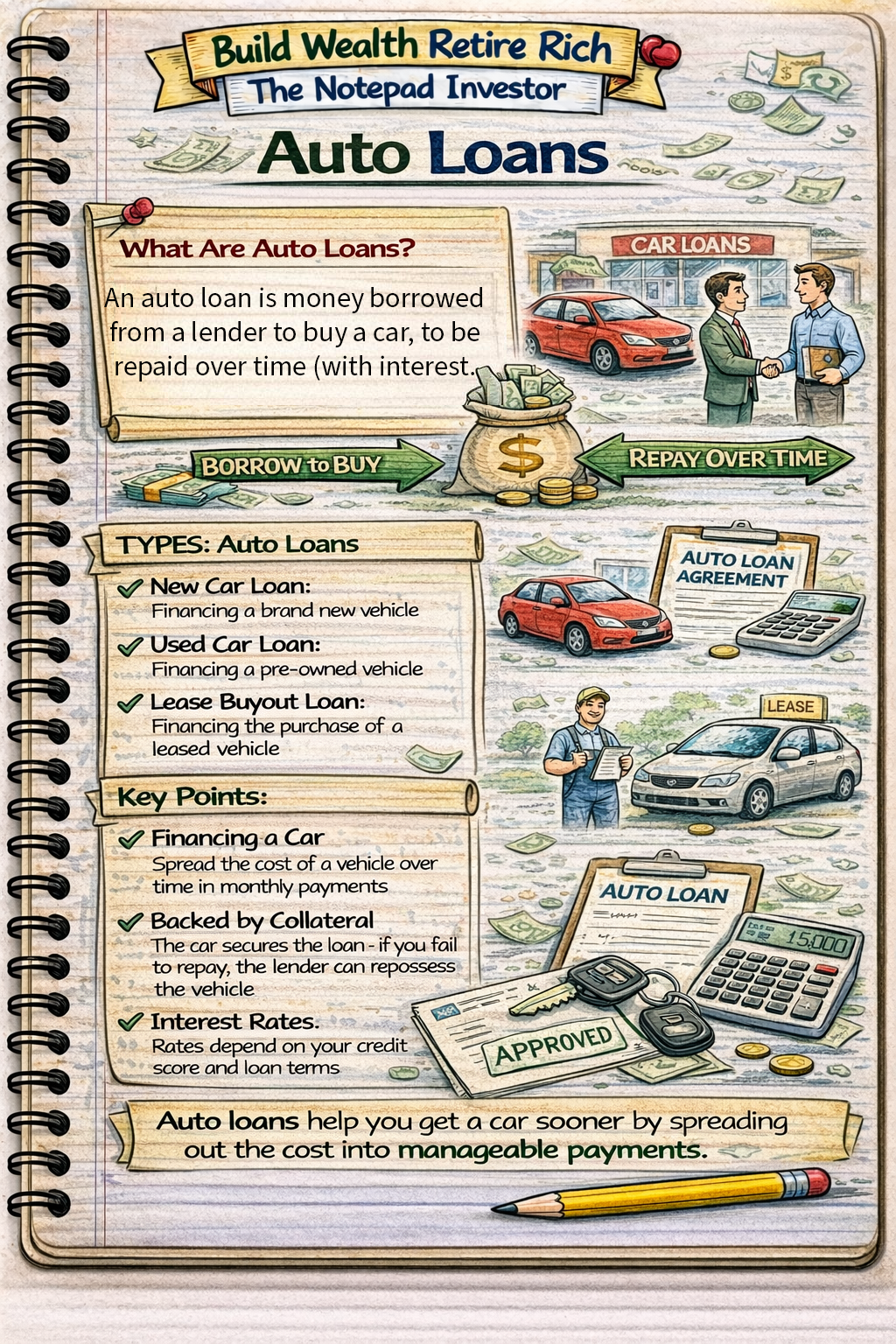
This article is designed for anyone considering vehicle purchase, current auto loan holders wanting refinancing understanding, or those confused by dealer financing tactics and loan structuring. You do not need financial expertise to understand auto loans—fundamental concepts accessible through clear explanations of loan mechanics, rate determinants, term implications, and strategic considerations, though requires honest needs assessment distinguishing between reliable transportation necessity and luxury status symbol, realistic budget evaluation ensuring payment affordable within 10-15% gross income preventing transportation-poor existence sacrificing other financial goals, and disciplined resistance to dealer pressure extending terms creating seemingly affordable payments masking total costs doubling vehicle prices through interest and extended depreciation exposure creating guaranteed underwater scenarios impossible to exit without substantial loss.
Understanding auto loans matters because term length decisions create $5,000-15,000 interest differences on identical vehicles, credit score optimization saves $3,000-8,000 through rate reductions, and new versus used strategic selection prevents $10,000-20,000 depreciation losses in first three years—while auto-loan-literate individuals finance reliable used vehicles 2-3 years old capturing 30-40% depreciation savings, limit terms to 48-60 months preventing underwater scenarios, and maintain payments under 10% gross income preserving financial flexibility, versus irresponsible borrowers financing new luxury vehicles with 72-84 month terms creating perpetual negative equity cycles trading underwater vehicles rolling thousands in negative equity into new loans compounding debt burden through successive transactions impossible to escape without cash infusion or driving worthless vehicles for years eliminating payments impossible without understanding depreciation mathematics, term implications, and strategic vehicle selection aligned with transportation needs not emotional wants.
Educational disclaimer: This article provides general educational information about auto loans and vehicle financing. Individual loan terms, interest rates, qualification requirements, and appropriate borrowing amounts vary based on circumstances including credit, income, vehicle type, and lender. Auto loan rates and programs subject to market changes. This is not financial advice or guarantee of loan approval. Vehicles depreciate significantly and rapidly creating potential negative equity. Consult qualified financial professionals for personalized guidance matching individual situations.
Auto Loan Basics and How They Work
Core Auto Loan Mechanics
Key components:
- Principal: Vehicle purchase price minus down payment
- Interest rate: APR ranging 4-20% based on credit and vehicle age
- Term: Repayment period (36-84 months common)
- Monthly payment: Fixed amount covering principal and interest
- Collateral: Vehicle securing loan (lender can repossess if default)
Standard auto loan transaction:
- Step 1: Determine budget and get pre-approved (bank, credit union, online lender)
- Step 2: Shop for vehicle within approved amount
- Step 3: Compare pre-approval versus dealer financing
- Step 4: Sign purchase agreement and loan documents
- Step 5: Make monthly payments until fully repaid (36-84 months)
- Step 6: Receive title when loan satisfied
Simple Interest Calculation
How auto loan interest works (simple interest, not compound like mortgages):
- Interest calculated daily on remaining principal balance
- Monthly rate: APR ÷ 12
- Each payment: Interest calculated first, remainder reduces principal
- Early payments reduce principal faster (save interest)
Example calculation:
- Loan: $25,000 at 6% APR, 60 months
- Monthly payment: $483
- Month 1: Balance $25,000 × (6% ÷ 12) = $125 interest, $358 principal
- Month 2: Balance $24,642 × 0.005 = $123 interest, $360 principal
- Month 30: Balance $13,500 × 0.005 = $68 interest, $415 principal
- Month 60: Balance $480 × 0.005 = $2 interest, $481 principal
- Total paid: $28,980 ($483 × 60)
- Total interest: $3,980
The Depreciation Challenge
Typical vehicle depreciation:
- Moment driven off lot: 10-11% loss (immediate depreciation)
- End of year 1: 20-30% total depreciation
- End of year 3: 40-50% depreciation
- End of year 5: 60-70% depreciation
New $30,000 vehicle depreciation example:
- Purchase price: $30,000
- After 1 year: $21,000 value (30% depreciation = $9,000 loss)
- After 3 years: $16,500 value (45% depreciation = $13,500 loss)
- After 5 years: $10,500 value (65% depreciation = $19,500 loss)
Loan balance versus value creating underwater scenario:
- Purchase: $30,000 with $3,000 down, finance $27,000 at 6%, 72 months
- After 1 year: Owe $23,500, vehicle worth $21,000 = $2,500 underwater
- After 3 years: Owe $14,200, vehicle worth $16,500 = $2,300 equity finally
- After 5 years: Owe $4,800, vehicle worth $10,500 = $5,700 equity
- Problem: Underwater years 1-2 trapping owner unable to trade/sell without loss

New vs Used Vehicle Financing
New Vehicle Financing
Advantages:
- Lower interest rates (4-7% for excellent credit)
- Manufacturer incentives (0-3% promotional financing occasional)
- Warranty coverage (3-5 years bumper-to-bumper typical)
- Latest safety and technology features
- Easier approval (less lender risk with new)
Disadvantages:
- Maximum depreciation exposure (30% year 1)
- Higher purchase price ($30,000-45,000 typical new)
- Higher insurance costs (full coverage on higher value)
- Larger loan amounts and monthly payments
- Guaranteed underwater first 1-3 years
Total cost of new vehicle ownership (5 years):
- Purchase price: $32,000
- Down payment: $5,000
- Financed: $27,000 at 5%, 60 months = $509 monthly
- Total payments: $30,540
- Insurance: $1,800 annually × 5 = $9,000
- Maintenance: $3,000 (minimal under warranty)
- Fuel: $7,500 (assuming $1,500 annually)
- Total 5-year cost: $55,040
- Vehicle value year 5: $11,200
- Net cost: $43,840 ($55,040 – $11,200)
- Annual cost: $8,768
Used Vehicle Financing
Advantages:
- Lower purchase price (2-3 year old = 40-50% less than new)
- Avoided worst depreciation (30% first year already absorbed)
- Lower insurance costs (reduced vehicle value)
- More vehicle for same payment (can buy higher trim used vs base new)
- Smaller loan amounts
Disadvantages:
- Higher interest rates (6-12% typical, 2-5% above new rates)
- Limited or no warranty (may need to purchase extended)
- Unknown history (maintenance, accidents, prior issues)
- Potentially higher maintenance costs
- Shorter remaining useful life
Total cost of used vehicle ownership (same vehicle 3 years old, owned 5 years):
- Purchase price: $17,600 (45% depreciation from $32,000 new)
- Down payment: $3,000
- Financed: $14,600 at 7%, 48 months = $351 monthly
- Total payments: $16,848
- Insurance: $1,400 annually × 5 = $7,000
- Maintenance: $6,000 (higher, out of warranty)
- Fuel: $7,500
- Total 5-year cost: $40,348
- Vehicle value year 5 (8 years old): $6,400
- Net cost: $33,948
- Annual cost: $6,790
- Savings versus new: $9,892 over 5 years ($1,978 annually)
The Sweet Spot: 2-3 Year Old Certified Pre-Owned
CPO advantages:
- Significant depreciation already absorbed (30-40%)
- Manufacturer-backed warranty (typically 6-7 years total from original sale)
- Rigorous inspection and reconditioning
- Roadside assistance and benefits
- Lower rates than regular used (manufacturer incentives)
- Balance of depreciation savings and reliability
Optimal strategy:
- Purchase 2-3 year old CPO vehicle
- Finance 48 months maximum
- Drive 5-7 years total (to 7-10 years old)
- Captures depreciation savings while maintaining reliability
- Minimizes total ownership cost versus new or older used
Interest Rates and Credit Impact
Rate Ranges by Credit Score
New vehicle rates (2024 typical):
- Excellent credit (720+): 4-6% APR
- Good credit (660-719): 6-9% APR
- Fair credit (620-659): 9-14% APR
- Poor credit (580-619): 14-18% APR
- Subprime (below 580): 18-20%+ or denied
Used vehicle rates (typically 2-4% higher than new):
- Excellent credit: 6-8% APR
- Good credit: 8-11% APR
- Fair credit: 11-16% APR
- Poor credit: 16-20% APR
- Subprime: 20-25%+ or denied
Cost Impact of Credit Scores
$25,000 loan, 60 months, rate impact:
Excellent credit (5%):
- Monthly payment: $472
- Total paid: $28,320
- Total interest: $3,320
Good credit (8%):
- Monthly payment: $507
- Total paid: $30,420
- Total interest: $5,420
- Extra cost versus excellent: $2,100
Fair credit (12%):
- Monthly payment: $556
- Total paid: $33,360
- Total interest: $8,360
- Extra cost versus excellent: $5,040
Poor credit (18%):
- Monthly payment: $634
- Total paid: $38,040
- Total interest: $13,040
- Extra cost versus excellent: $9,720
Key insight: 720+ credit score saves $5,000-10,000 versus poor credit on typical auto loan
Improving Credit Before Purchase
Strategic 6-12 month credit optimization:
- Pay down credit card balances to under 10% utilization (30-60 point boost)
- Maintain perfect payment record (protect 35% of score)
- Avoid new credit applications (prevent inquiry damage)
- Dispute any credit report errors
- Become authorized user on old account if available
Example improvement:
- Starting score: 640 (qualifies for 12% rate)
- 6 months optimization: 710 score (qualifies for 7% rate)
- $25,000 loan savings: $3,600 over 5 years
- ROI: Delaying purchase 6 months saves $3,600
Manufacturer Promotional Rates
0-3% promotional financing:
- Manufacturer-subsidized rates on select models
- Typically new vehicles only
- Requires excellent credit (720-750+)
- Often mutually exclusive with cash rebates
- Limited term availability (36-60 months)
Promotional rate evaluation:
- $30,000 vehicle, choice of 0% financing OR $3,000 cash rebate
- Option A: 0% financing, $30,000 loan, 60 months = $500 monthly, $30,000 total
- Option B: $3,000 rebate, finance $27,000 at 5%, 60 months = $509 monthly, $30,540 total
- 0% saves $540 over rebate + market rate financing
- Generally: 0-1% promotional rates better than rebates, 2-3% depends on rebate amount
Loan Term Length: The Critical Decision
Common Term Lengths and Trade-offs
36-month term:
- Pros: Minimal interest paid, quickest equity building, shortest underwater period, vehicle retained longer debt-free
- Cons: Highest monthly payment, qualification more difficult, limits affordable vehicle price
48-month term (recommended maximum for used):
- Pros: Balance of payment affordability and interest minimization, reasonable equity building
- Cons: Moderate interest costs, 1-2 years underwater typical
60-month term (most common):
- Pros: Lower monthly payment, easier qualification, broader vehicle selection
- Cons: Higher interest costs, 2-3 years underwater, vehicle aging faster than payoff
72-month term (increasingly common, risky):
- Pros: Lowest monthly payment, maximum purchasing power
- Cons: Very high interest costs, 3-4 years underwater, vehicle aging quickly relative to loan, likely needs major repairs while still making payments
84-month term (avoid):
- Pros: Lowest possible payment enabling luxury vehicle affordability
- Cons: Massive interest costs, underwater 4-5 years, 7-year-old vehicle still being paid on, perpetual negative equity trap, very high total cost
Term Length Comparison ($25,000 loan at 7%)
36 months:
- Monthly payment: $773
- Total paid: $27,828
- Total interest: $2,828
- Paid off: 3 years, drive debt-free years 4+
48 months:
- Monthly payment: $599
- Total paid: $28,752
- Total interest: $3,752
- Extra cost versus 36 months: $924
60 months:
- Monthly payment: $495
- Total paid: $29,700
- Total interest: $4,700
- Extra cost versus 36 months: $1,872
72 months:
- Monthly payment: $426
- Total paid: $30,672
- Total interest: $5,672
- Extra cost versus 36 months: $2,844
84 months:
- Monthly payment: $377
- Total paid: $31,668
- Total interest: $6,668
- Extra cost versus 36 months: $3,840
- Interest costs 2.4x higher (84 vs 36 months)
The Underwater Trap of Long Terms
72-month loan on $30,000 vehicle example:
- Purchase: $30,000, $3,000 down, finance $27,000 at 7%
- Year 1: Owe $24,000, vehicle worth $21,000 = $3,000 underwater
- Year 2: Owe $20,700, vehicle worth $18,000 = $2,700 underwater
- Year 3: Owe $17,100, vehicle worth $16,500 = $600 underwater
- Year 4: Owe $13,200, vehicle worth $13,500 = $300 equity finally
- Problem: Trapped 3 years unable to trade/sell without bringing cash
Negative equity rollover cycle:
- Year 3 decide to trade (still underwater $600)
- New vehicle $32,000, roll $600 negative equity = $32,600 financed
- 72 months at 7% = $445 monthly
- Year 1 of new loan: Owe $29,200, new vehicle worth $22,400 = $6,800 underwater (worse than first loan)
- Perpetual cycle: Each trade rolls more negative equity compounding problem
Recommended Term Strategy
Term selection guidelines:
- New vehicles: Maximum 60 months, prefer 48 months
- Used vehicles (under 3 years old): Maximum 48 months
- Used vehicles (3-6 years old): Maximum 36-42 months
- Used vehicles (over 6 years old): Pay cash or avoid (loan term exceeds remaining useful life)
Never exceed rule:
- Loan term + vehicle age at purchase should not exceed 8-10 years
- Example: 3-year-old vehicle, maximum 60-month term = 8 years old at payoff
- Prevents paying for vehicle after it needs major repairs or replacement
Down Payments and Trade-Ins
Down Payment Strategy
Recommended minimums:
- New vehicles: 20% down (prevents immediate underwater)
- Used vehicles: 10-15% down minimum
- CPO vehicles: 10% down acceptable
Benefits of larger down payments:
- Lower monthly payments (smaller loan)
- Less interest paid (lower principal)
- Better interest rates (lower LTV ratio)
- Equity buffer preventing underwater
- Easier qualification
Comparison example ($28,000 vehicle):
$0 down (100% financing):
- Loan: $28,000 at 8%, 60 months
- Payment: $568
- Total interest: $6,080
- After 1 year: Owe $24,100, vehicle worth $19,600 = $4,500 underwater
$5,600 down (20%):
- Loan: $22,400 at 7% (better rate), 60 months
- Payment: $444
- Total interest: $4,240
- After 1 year: Owe $18,900, vehicle worth $19,600 = $700 equity
- Savings: $1,840 interest, $124 monthly, never underwater
Trade-In Considerations
Trade-in with positive equity:
- Vehicle worth: $15,000
- Loan balance: $11,000
- Equity: $4,000
- Applied as down payment on next vehicle
- Reduces new loan amount
Trade-in with negative equity (upside down):
- Vehicle worth: $12,000
- Loan balance: $15,000
- Negative equity: $3,000
- Options: Pay $3,000 cash to dealer OR roll into new loan
- Rolling negative equity compounds problem on new purchase
Negative equity rollover example:
- New vehicle price: $30,000
- Negative equity: $3,000
- Total financed: $33,000
- Starts new loan immediately underwater by $3,000
- After 1 year: Owe $28,500, vehicle worth $21,000 = $7,500 underwater
- Creates perpetual trap compounding with each trade
Avoiding negative equity trades:
- Keep vehicle longer until equity positive
- Pay extra to principal accelerating payoff
- Bring cash to cover negative equity
- Sell privately (often get more than dealer trade value)
Gap Insurance
What gap insurance covers:
- Difference between vehicle value and loan balance if totaled
- Example: Owe $22,000, vehicle worth $18,000, totaled in accident
- Regular insurance pays $18,000
- Gap insurance pays $4,000 difference
- Without gap: Owe $4,000 on vehicle you no longer have
When gap insurance makes sense:
- Less than 20% down payment (underwater risk)
- Terms over 60 months (extended underwater period)
- New vehicle purchase (rapid depreciation)
- Negative equity rolled into loan (starting underwater)
Gap insurance costs:
- Dealer: $500-700 (often overpriced)
- Insurance company: $20-40 annually (much cheaper)
- Duration: Typically needed only first 2-3 years
- Recommendation: Purchase through regular auto insurer not dealer
Dealer Financing vs Outside Financing
Getting Pre-Approved Before Shopping
Pre-approval sources:
- Credit unions: Often best rates (4-7% typical), member-focused
- Banks: Competitive rates (5-8%), relationship discounts possible
- Online lenders: Quick approval, competitive rates (5-9%)
- Dealer financing: Convenient but often not best rate unless manufacturer promotional
Pre-approval advantages:
- Know exact budget before shopping
- Negotiate as cash buyer (dealer discounts)
- Compare dealer financing offers against known alternative
- Faster purchase process
- Leverage for rate negotiation
Dealer Financing Tactics to Recognize
The monthly payment focus:
- Dealer asks: “What payment can you afford?”
- Danger: Focuses on payment not total cost
- Tactic: Extends term creating “affordable” payment on overpriced vehicle
- Example: $600 budget → dealer shows 84-month loan creating $600 payment on $35,000 vehicle paying $50,000 total
- Better: Negotiate total price first, then discuss financing
The four-square worksheet:
- Four numbers: Vehicle price, trade-in value, down payment, monthly payment
- Dealer manipulates all four obscuring actual deal
- Tactic: Gives on one (trade value up) while taking on another (price up, payment extended)
- Defense: Negotiate each component separately, get everything in writing
The “let me talk to my manager” tactic:
- Creates time pressure and authority confusion
- Wears down buyer resistance through lengthy process
- Defense: Be willing to walk away, don’t buy same day, shop multiple dealers
Dealer add-ons and products:
- Extended warranties: $1,500-3,000 (often poor value, negotiate or decline)
- Paint protection: $500-1,200 (DIY ceramic coating $50-200)
- Fabric protection: $300-800 (scotchgard yourself $20)
- Gap insurance: $500-700 (buy through regular insurer $20-40 annually)
- VIN etching: $200-400 (minimal theft prevention value)
- Total dealer add-ons: $3,000-6,000 markup on minimal-value products
Comparing Financing Offers
Evaluation criteria:
- APR (most important)
- Loan term
- Monthly payment
- Total amount paid (payment × months)
- Prepayment penalties (avoid loans with penalties)
- Origination fees
Example comparison:
Credit union pre-approval:
- $24,000 at 5.5%, 48 months
- Payment: $554
- Total paid: $26,592
Dealer financing:
- $24,000 at 6.9%, 60 months
- Payment: $475 (“lower payment!”)
- Total paid: $28,500
- Extra cost: $1,908 for “lower payment” through extended term
Best choice: Credit union (saves $1,908)
Strategic Auto Financing
The 20/4/10 Rule
Rule components:
- 20% down payment minimum
- 4-year (48-month) maximum term
- 10% gross income maximum for total transportation costs
Applying the rule ($60,000 annual income):
- 10% gross income: $6,000 annually = $500 monthly maximum
- Total transportation budget: $500 (payment + insurance + fuel + maintenance)
- Insurance estimate: $120 monthly
- Fuel estimate: $150 monthly
- Maintenance reserve: $80 monthly
- Available for payment: $150 monthly
- At 6%, 48 months: $150 supports $6,300 loan
- With 20% down: $6,300 ÷ 0.8 = $7,875 maximum purchase price
- Reality check: Most would exceed ignoring rule and buy $20,000-25,000 vehicle creating financial strain
When to Buy Cash vs Finance
Buy cash when:
- Have funds without depleting emergency reserves
- Interest rate over 7-8% (avoid high interest costs)
- Older used vehicle (lenders charge 12%+ on 7+ year old cars)
- Want debt freedom and payment simplicity
- Avoiding discipline challenges of monthly payments
Finance when:
- Promotional rates under 3% available (essentially free money)
- Can invest cash earning more than interest rate (5% loan vs 8% investments)
- Preserves emergency fund (maintain $10,000+ liquid)
- Builds credit history (if needed and disciplined)
- Employer offers low-rate financing benefit
Finance vs invest comparison:
- Have $25,000 cash, need $25,000 vehicle
- Option A (pay cash): $0 in interest, $0 in investments
- Option B (finance at 5%, invest cash at 8%):
- Finance: $25,000 at 5%, 48 months = $3,300 interest paid
- Invest: $25,000 at 8%, 4 years = $34,000 ($9,000 gain)
- Net benefit: $9,000 gain – $3,300 interest = $5,700 better than cash
- Requires: Discipline to actually invest and not spend, comfortable with debt, stable income
Accelerating Payoff
Extra payment strategies:
- Round up payments ($483 → $500 creating $17 extra monthly)
- Biweekly payments (26 half-payments = 13 full payments vs 12)
- Annual lump sum (tax refund, bonus to principal)
- Refinance to lower rate after credit improvement
Payoff acceleration example:
- Loan: $20,000 at 7%, 60 months, $396 monthly
- Standard payoff: 60 months, $3,760 interest
- Add $100 monthly ($496 total): 45 months, $2,680 interest
- Savings: $1,080 interest, 15 months faster
When to Refinance
Refinancing makes sense when:
- Credit score improved 50+ points since original loan
- Interest rates dropped 1-2% or more
- Current rate over 8% and qualify for under 6%
- At least 2 years remaining on loan
- Not underwater (owe more than vehicle worth)
Refinance example:
- Current: $18,000 balance at 10%, 36 months remaining, $581 monthly
- Refinance: $18,000 at 6%, 36 months, $548 monthly
- Savings: $33 monthly, $1,188 over remaining term
- Caution: Don’t extend term when refinancing (defeats interest savings)
Why Understanding Auto Loans Matters
Without understanding auto loans, individuals overpay $5,000-15,000 through extended terms creating affordable-appearing payments masking doubled costs, finance new vehicles accepting maximum depreciation losses of $10,000-15,000 in first three years versus strategic used purchases, and overextend on luxury vehicles consuming 15-20% income creating transportation-poor existence sacrificing retirement savings and emergency reserves—while auto-loan-literate individuals purchase reliable 2-3 year old certified pre-owned vehicles capturing 35-40% depreciation savings, limit terms to 48-60 months preventing perpetual underwater scenarios, and maintain total transportation costs under 10-15% gross income preserving financial flexibility, creating dramatically different wealth outcomes where strategic buyers save $20,000-30,000 per vehicle cycle through depreciation avoidance and interest minimization versus irresponsible buyers perpetually trapped in negative equity cycles rolling thousands into successive loans compounding debt burdens impossible to escape without understanding depreciation mathematics, term implications, and new-versus-used strategic selection.
Understanding auto loans enables individuals to:
- Calculate true costs including interest, depreciation, and total ownership expenses
- Optimize credit scores before purchase saving $3,000-8,000 through rate reductions
- Select appropriate terms balancing payments and total costs preventing underwater traps
- Evaluate new versus used strategically capturing depreciation savings of $10,000-20,000
- Recognize dealer tactics and negotiate effectively preventing overpriced purchases
- Apply 20/4/10 rule maintaining affordable transportation within overall budget
- Avoid negative equity cycles through disciplined term limits and down payments
Auto loan knowledge transforms vehicle purchase from emotional decision or dealer-manipulated transaction into strategic transportation investment minimizing total costs through informed term selection, depreciation awareness, and disciplined borrowing limits enabling reliable transportation without financial destruction impossible when extending terms for luxury purchases beyond sustainable income levels.
Common Misunderstandings
Many people focus exclusively on monthly payment affordability ignoring total cost. In reality, $400 monthly payment acceptable on 48-month $18,000 loan paying $19,200 total versus dangerous on 84-month $28,000 loan paying $33,600 total demonstrating identical payment can represent good or terrible deal depending on term and total cost, proving payment-only focus enables dealer manipulation extending terms creating “affordable” payments on overpriced vehicles costing thousands extra in interest making total cost calculation essential not monthly payment matching budget alone.
Another common misconception is new vehicles always better than used due to warranty and reliability. In practice, certified pre-owned 2-3 year old vehicles combine manufacturer warranties with 35-40% depreciation savings—$32,000 new car worth $19,000 after 3 years but still under warranty for 4+ years through CPO program, making CPO purchase saving $13,000 depreciation while maintaining warranty protection proving new vehicles financially inferior for most buyers despite psychological appeal of latest model and full warranty when depreciation costs vastly exceed potential repair savings especially given modern vehicle reliability improvements.
Some believe longer loan terms make expensive vehicles affordable through lower payments. However, 72-84 month terms on depreciating assets create guaranteed 3-5 year underwater periods trapping owners unable to trade without rolling negative equity compounding problem, vehicle aging faster than payoff creating repair costs while still making payments, and interest costs 2-3x higher than shorter terms proving extended terms create illusion of affordability while destroying wealth through interest waste and perpetual negative equity impossible to escape without cash infusion or driving worthless vehicles years eliminating payments.
How Auto Loan Understanding Fits Into Financial Success
Auto loan understanding prevents $20,000-40,000 wealth destruction per vehicle cycle through strategic used purchases avoiding new-car depreciation, term discipline preventing interest waste and underwater traps, and total cost awareness maintaining transportation expenses under 10-15% income—making auto financing literacy essential component preventing second-largest expense category (after housing) from sabotaging wealth building through excessive borrowing on depreciating assets, enabling reliable transportation supporting employment and life requirements without financial destruction through luxury vehicle overextension, and creating sustainable transportation strategy freeing cash flow for productive investments generating returns unlike vehicle depreciation guaranteeing losses impossible without understanding depreciation mathematics, term implications, and disciplined needs-versus-wants vehicle selection aligned with income not emotional desires.
For example, two individuals both age 28 earning $65,000 needing reliable transportation. Person A lacks auto loan understanding, visits dealership emotionally attracted to new $38,000 SUV. Dealer focuses on monthly payment: “What can you afford monthly?” Person A says “$500 maximum.” Dealer structures 84-month loan at 8%: $38,000 + taxes/fees $3,000 = $41,000 financed at $505 monthly (barely within stated budget). Person A excited about new vehicle, ignores total cost $42,420 over 7 years. Year 1: Vehicle worth $26,600 (30% depreciation), owes $38,100 = $11,500 underwater. Year 3: Worth $20,900, owes $30,800 = $9,900 underwater still. Year 5: HVAC system needs $1,200 repair (warranty expired), transmission issue $2,800, still owes $21,400 on vehicle worth $15,200. Wants to trade but $6,200 underwater forces rolling into new loan. Year 7 finally paid off: Vehicle worth $10,500, paid $42,420 total, net cost $31,920 for 7-year-old vehicle worth $10,500. Additionally: Insurance averaged $1,800 annually ($12,600 total), maintenance/repairs $8,000, fuel $10,500. Total 7-year transportation cost: $63,020 for vehicle now worth $10,500. Person B understands auto loans and depreciation, researches thoroughly determining needs (reliable commuter, $15,000-20,000 budget maximum). Finds 3-year-old CPO version of Person A’s vehicle for $21,000 (captured 45% depreciation), manufacturer warranty remaining 4 years. Down payment $3,000 (14%), finances $18,000 at 5% for 48 months = $415 monthly. Total paid $22,920. Year 1 of ownership (vehicle age 4): Worth $18,500, owes $14,800 = $3,700 equity (never underwater). Year 4 paid off: Vehicle age 7 worth $13,500, paid $22,920 total, drives debt-free 3+ years. Total 7-year cost: Purchase $22,920, insurance $1,400 annually ($9,800), maintenance $5,500 (higher than new but acceptable), fuel $10,500. Total: $48,720. Year 7: Vehicle worth $10,500 same as Person A but spent $48,720 versus $63,020. Difference: Person A’s poor auto loan understanding through new luxury purchase with 84-month term cost $14,300 more ($63,020 vs $48,720) for identical 7-year-old vehicle outcome plus suffered 5 years underwater stress, perpetual payment obligation, and major repairs while still making payments, Person B’s auto loan literacy through strategic CPO purchase and 48-month disciplined term created $14,300 savings, 3 years debt-free ownership, and never-underwater security through understanding depreciation, appropriate term selection, and needs-based vehicle choice versus emotional new-luxury purchase.
Auto loan understanding separates strategic transportation managers minimizing costs through depreciation awareness from perpetually-indebted luxury vehicle buyers trapped in negative equity cycles, requiring disciplined term limits, realistic needs assessment, and total cost calculation creating measurable wealth differences impossible without auto financing literacy.
Recent Updates and Trends
In recent years, average auto loan terms have extended dramatically with 72-84 month loans now representing 30%+ of new vehicle financing versus historical 48-60 month standard, though longer terms create guaranteed underwater periods and interest costs 2-3x higher making term extension financially destructive despite enabling “affordable” monthly payments on expensive vehicles beyond sustainable budgets.
Vehicle prices have increased substantially with average new car transaction price exceeding $48,000 (2024) versus $32,000 (2015) creating affordability crisis where median household income buyers cannot qualify for median-priced vehicles without extended terms or excessive debt-to-income ratios, though used vehicle strategy purchasing 2-3 year old certified pre-owned maintains affordability through depreciation capture despite new vehicle price inflation.
Interest rates have fluctuated with Federal Reserve policy seeing auto loan rates increase from 3-5% (2020-2021) to 7-12% (2023-2024) doubling monthly payments on identical vehicles, though fundamental auto financing principles unchanged requiring strategic used purchases, disciplined 48-60 month maximum terms, and credit optimization regardless of rate environment enabling optimal rates within current market conditions.
Electric vehicle adoption has grown creating new financing considerations including higher purchase prices offset by fuel savings and federal tax credits, battery degradation concerns affecting long-term value, and limited used market creating uncertainty about depreciation patterns, though same fundamental principles apply requiring realistic total cost calculations including charging infrastructure, insurance premiums, and technology obsolescence risks.
Fundamental auto loan principles remain timeless: purchase reliable transportation not luxury status symbols, capture depreciation through strategic used/CPO selection saving $10,000-20,000, limit terms to 48-60 months preventing perpetual negative equity, maintain total transportation costs under 10-15% gross income preserving financial flexibility—regardless of term extension trends, price inflation, rate environment changes, or EV adoption, understanding depreciation mathematics, disciplined term selection, and needs-based vehicle choice produces superior outcomes through strategic transportation management impossible when emotional purchases and dealer-extended terms create wealth destruction through interest waste and depreciation exposure exceeding transportation value provided.
3 Things You Can Do Today
Ready to optimize auto financing strategy? Here are three simple steps you can take right now:
1. Calculate affordable vehicle price using 20/4/10 rule preventing overextension and transportation-poor existence – Annual gross income: Note exact amount (example: $70,000). Calculate 10% maximum transportation budget: $70,000 × 10% = $7,000 annually = $583 monthly for ALL transportation (payment, insurance, fuel, maintenance). Estimate non-payment costs: Insurance $140 monthly (get actual quote for age/location), fuel $180 monthly (estimate based on commute), maintenance $80 monthly reserve (1% vehicle value annually ÷ 12). Calculate available for payment: $583 – $140 – $180 – $80 = $183 monthly maximum payment. Apply 4-year maximum term: $183 monthly at 6% over 48 months supports $7,900 loan amount. Apply 20% down payment requirement: $7,900 loan ÷ 0.80 = $9,875 affordable purchase price. Reality shock: Most earning $70,000 would attempt $25,000-30,000 vehicle (2.5-3x affordable amount) creating dangerous 18-20% income consumption. Alternative relaxed calculation allowing 15% transportation: $70,000 × 15% = $875 monthly total, minus $320 non-payment costs = $555 payment supports $24,000 loan with 20% down = $30,000 vehicle (more realistic but still requires discipline). Comparison shows: Strict 10% rule = $9,875 vehicle (used economy car), relaxed 15% = $30,000 vehicle (newer reliable sedan), dealer approval likely $40,000+ (72+ months, financial disaster). Takes 15 minutes preventing catastrophic overborrowing through honest affordability calculation impossible when using monthly payment matching instead of total transportation budget percentage methodology.
2. If considering vehicle purchase within 6-12 months, implement credit optimization potentially saving $3,000-8,000 through rate improvement – Check current credit score: Free through credit card issuer, Credit Karma, or Experian. Identify improvement opportunity: Below 660 (significant work needed), 660-719 (moderate improvement possible), 720+ (optimization minimal but maintains best rates). Calculate rate impact: $25,000 loan 60 months example—660 score gets 10% ($531 monthly, $31,860 total) versus 720+ gets 6% ($483 monthly, $28,980 total), difference $2,880 savings. Implement optimization strategy: (1) Pay down credit cards to under 10% utilization (biggest single impact, 30-60 points possible in 30-90 days if currently high), (2) Dispute any errors on credit reports (AnnualCreditReport.com checking all three bureaus), (3) Perfect payment record next 12 months protecting 35% of score, (4) Avoid new credit applications during optimization period, (5) Become authorized user on parent/spouse old account if available (instant history boost). Timeline: Start 6-12 months before planned purchase giving maximum optimization time, check score quarterly tracking progress, delay purchase if score improving rapidly (waiting 3-6 more months could save thousands). Example improvement: 670 score improves to 730 through $8,000 credit card paydown (reducing 55% utilization to 12% = 40-point boost) plus 12 months perfect payments (15-point boost) plus authorized user strategy (5-point boost) = 60-point improvement creating rate savings from 9% to 6.5% saving $2,400 on $25,000 loan. ROI: Delaying purchase for credit optimization saves multiple thousands making 6-12 month delay worthwhile investment. Takes 30 minutes initial setup plus 6-12 months execution creating $2,000-8,000 savings through strategic credit preparation impossible when purchasing immediately with poor credit permanently locking higher rate.
3. Calculate total cost comparison between new and strategic used purchase revealing $15,000-25,000 savings potential – Target vehicle: Identify specific make/model desired (example: Honda CR-V). Research three purchase options: NEW ($32,000), 2-YEAR-OLD CPO ($22,500), 4-YEAR-OLD USED ($17,000). Calculate total 5-year ownership cost for each: NEW—Purchase $32,000, down $6,400 (20%), finance $25,600 at 5% 60 months = $483 monthly payments ($28,980 total), insurance $1,600 annually ($8,000 total), maintenance $2,500 (under warranty), fuel $9,000, total cost $48,480, value year 5 $11,200, net cost $37,280 ($48,480 – $11,200). 2-YEAR CPO—Purchase $22,500 (30% depreciation captured), down $3,000, finance $19,500 at 6% 48 months = $458 monthly ($21,984 total), insurance $1,350 annually ($6,750), maintenance $4,000 (partial warranty), fuel $9,000, total $41,734, value year 5 (age 7) $10,000, net cost $31,734. 4-YEAR USED—Purchase $17,000 (47% depreciation captured), down $2,500, finance $14,500 at 7.5% 48 months = $353 monthly ($16,944), insurance $1,200 annually ($6,000), maintenance $6,500 (no warranty), fuel $9,000, total $38,444, value year 5 (age 9) $7,500, net cost $30,944. Comparison results: NEW net cost $37,280, CPO net cost $31,734 (saves $5,546 vs new), USED net cost $30,944 (saves $6,336 vs new, $790 vs CPO). Additional insight: CPO provides best value balance—saves $5,546 versus new while maintaining warranty protection and only $790 more than older used avoiding higher maintenance risk. Depreciation revelation: New vehicle loses $20,800 in 5 years ($32,000 – $11,200), CPO loses $12,500 ($22,500 – $10,000), demonstrating $8,300 depreciation savings from 2-year delay plus another $1,200 total cost savings creating $9,500 total advantage. Decision: CPO strategy optimal for most buyers balancing savings, reliability, warranty protection. Takes 30 minutes calculation revealing substantial savings impossible when emotional new vehicle purchase made without strategic used alternative analysis quantifying depreciation costs and total ownership comparison.
These actions create auto financing mastery within 90 minutes—calculated affordable vehicle price using 20/4/10 rule preventing overextension ($10,000-20,000 potential savings avoiding excessive purchase), implemented credit optimization saving $2,000-8,000 through rate improvement, and compared new versus used total costs revealing $5,000-10,000 strategic savings potential—transforming auto purchase from emotional decision or dealer-manipulated transaction into strategic transportation investment through disciplined affordability assessment, credit preparation, and depreciation-aware vehicle selection enabling reliable transportation without wealth destruction impossible without auto loan literacy.
Quick FAQ
What’s the longest car loan I should get?
Maximum 60 months for new vehicles, 48 months for used under 3 years old, 36-42 months for 3-6 year old used vehicles maintaining rule that loan term plus vehicle age at purchase should not exceed 8-10 years preventing paying for vehicle past useful life or requiring major repairs: Longer term dangers—72-84 month loans create 3-5 year underwater periods trapping owners unable to trade without rolling negative equity, interest costs 2-3x higher than 48-month terms ($6,000-8,000 versus $3,000-4,000 on $25,000 loan), vehicle aging faster than payoff creating repair needs while still making payments (7-year loan means still paying at year 6-7 when major maintenance needed). Example: $28,000 vehicle, 84-month term at 7% = underwater until year 4, total interest $6,668, vehicle needs $3,000 repairs year 6 while still owing $8,000. Better: 48-month term = underwater only year 1-2, total interest $3,752 (saves $2,916), paid off before major maintenance, own debt-free years 5-8. Recommendation: 48-month maximum creates optimal balance preventing excessive interest while maintaining affordable payments on appropriate vehicle price, 60-month acceptable for new if necessary but only with 20% down preventing extended underwater period, never exceed 60 months regardless of payment temptation as extended terms signal vehicle purchase beyond affordability requiring price reduction not term extension.
Should I buy new or used?
Used vehicles 2-3 years old provide superior financial value for most buyers through depreciation savings of $10,000-20,000 versus new while maintaining reliability and warranty protection especially certified pre-owned programs: New advantages—Latest technology and safety, full manufacturer warranty 3-5 years, lower interest rates (4-7%), no unknown history, maximum remaining useful life. New disadvantages—Maximum depreciation exposure (30% year 1, 50% year 3), highest purchase price, highest insurance costs, guaranteed underwater 1-3 years with standard financing. Used advantages—Avoided worst depreciation (buying 2-3 year old captures 35-45% savings), lower purchase price and payments, lower insurance, more vehicle for money (can afford higher trim/features used versus base new). Used disadvantages—Higher interest rates (add 2-4% versus new), limited or expired warranty (CPO programs mitigate), unknown history risks (CPO inspection programs minimize), potentially higher maintenance (age-dependent). Optimal strategy: Purchase 2-3 year old certified pre-owned vehicles combining substantial depreciation savings ($10,000-15,000) with manufacturer warranty (typically 6-7 years total coverage from original sale) and rigorous inspection creating best value balance. Example: $32,000 new vehicle versus $19,000 CPO 3-year-old same model—save $13,000 purchase price, still have 4+ years warranty remaining, slightly higher rate offset by much smaller loan ($19,000 at 7% versus $32,000 at 5% = $368 vs $604 monthly), total ownership cost $8,000-12,000 less over 5 years demonstrating CPO strategy financial superiority for disciplined buyers prioritizing value over new-car psychology.
How much should I put down on a car?
Minimum 20% on new vehicles preventing immediate underwater scenario, 10-15% on used vehicles acceptable especially certified pre-owned with lower depreciation risk: Larger down payment benefits—Prevents negative equity (underwater) situations trapping owners, lowers monthly payments through smaller loan amount, reduces total interest paid on lower principal, qualifies for better interest rates (lower loan-to-value ratio), easier approval, sells/trades easier if needed. Lower down payment risks—Immediate underwater on new vehicles (20-30% depreciation year 1 versus 10% down = 10-20% negative equity), higher monthly payments straining budget, more interest paid, harder qualification, perpetual negative equity if trading before equity positive. Strategic analysis: $26,000 vehicle example—$0 down (100% financing) = $26,000 loan, after 1 year owe $23,000 but worth $18,200 = $4,800 underwater. $5,200 down (20%) = $20,800 loan, after 1 year owe $18,200 but worth $18,200 = break-even, never underwater. $7,800 down (30%) = $18,200 loan, after 1 year owe $15,800 but worth $18,200 = $2,400 equity immediately providing trade flexibility. Recommendation: Always 20% minimum on new vehicles (non-negotiable), 15% minimum on newer used (2-4 years old), 10% acceptable on older used or CPO with strong warranty, never 0% down unless promotional manufacturer financing at 0-2% APR making minimal down acceptable through interest savings offsetting underwater risk. If cannot afford 20% down on new vehicle, signals vehicle price too high requiring either cheaper vehicle or continued saving before purchase preventing guaranteed underwater trap from insufficient down payment on rapidly depreciating asset.
Should I buy or lease?
Buy for most people creating equity ownership and financial flexibility, lease only for specific business use or unusual personal situations requiring frequent new vehicles despite higher long-term costs: Buying advantages—Builds equity through ownership, no mileage restrictions, can modify or customize, cheaper long-term (own asset after payoff), can keep indefinitely, can sell/trade anytime, investment in asset. Buying disadvantages—Higher monthly payments than lease, responsible for all maintenance after warranty, depreciation risk (though mitigated by long ownership), requires down payment. Leasing advantages—Lower monthly payment (paying depreciation only not full value), always under warranty, new vehicle every 2-3 years, potentially tax deductible if business use. Leasing disadvantages—Never builds equity (perpetual payment without ownership), strict mileage limits (10,000-15,000 annually, $0.25-0.30/mile overage), cannot modify, early termination penalties expensive, wear-and-tear charges at return, more expensive long-term (paying depreciation repeatedly). Cost comparison 9 years: BUY $28,000 vehicle finance 60 months at 6%, own 9 years = Payments 5 years ($31,920 total), own debt-free years 6-9, vehicle worth $8,000 year 9, net cost $23,920. LEASE $28,000 vehicle three consecutive 3-year leases at $350/month = $12,600 per lease × 3 = $37,800 total payments, own nothing year 9, net cost $37,800. Buying saves $13,880 over 9 years plus owns $8,000 asset versus nothing. Recommendation: Buy for 95% of people building wealth through ownership and eliminating payments after payoff, lease only if business tax deduction significant (50%+ payment offset) or genuinely need new vehicles every 2-3 years accepting higher cost for convenience, never lease thinking it’s “cheaper” than buying when long-term math clearly favors ownership.
What credit score do I need for a good auto loan rate?
720+ credit score qualifies for best rates saving $3,000-8,000 versus fair-poor credit on typical auto loan: Score ranges and rates (2024 typical)—Excellent 760+ gets 4-6% new, 6-8% used. Good 700-759 gets 6-8% new, 8-10% used. Fair 660-699 gets 8-11% new, 10-13% used. Poor 620-659 gets 11-15% new, 13-17% used. Subprime below 620 gets 15-20% or denied. Cost impact example $24,000 loan 60 months—760+ at 5% = $452 monthly, $27,120 total. 680 at 9% = $498 monthly, $29,880 total (+$2,760). 630 at 14% = $560 monthly, $33,600 total (+$6,480 versus excellent credit). Strategic optimization: If score below 720, delay purchase 6-12 months optimizing credit potentially saving thousands: Pay credit cards to under 10% utilization (30-60 point boost typical if currently high), perfect payment record 12 months (15-30 point boost), dispute errors, authorized user strategy if available. Example: 660 score improves to 725 through aggressive credit card paydown plus perfect payments over 9 months, qualifies for 7% instead of 11% saving $3,200 on $24,000 loan making 9-month delay worthwhile investment. Minimum viable: 620 generally minimum for approval but rates very high (14-16%), below 620 often denied or subprime specialty lenders at 18-22% (nearly credit card rates, avoid if possible). Best practice: Target 720+ before auto loan application through 6-12 month credit optimization strategy, delay purchase if needed as rate savings vastly exceed any vehicle price appreciation during preparation period, never accept high-rate loan thinking “I’ll refinance later” as future refinance not guaranteed if underwater or credit doesn’t improve as expected.
Explore More in Money Basics
Disclosure
This article provides general educational information about auto loans and vehicle financing. Individual loan terms, interest rates, qualification requirements, down payment options, and appropriate borrowing amounts vary significantly based on circumstances including credit, income, vehicle type, age, and lender policies. Auto loan rates and programs subject to frequent changes and lender discretion. This is not financial advice or guarantee of loan approval or specific terms. Vehicles depreciate rapidly and substantially creating significant financial loss and potential negative equity situations. Depreciation rates vary by make, model, market conditions, and vehicle condition. Total cost calculations and ownership comparisons represent typical scenarios with assumptions about depreciation, interest rates, insurance, maintenance, and fuel costs—actual results vary substantially. The 20/4/10 rule represents conservative guideline not universal requirement—individual budgets and circumstances vary. Credit score impacts on rates represent typical scenarios—individual pricing adjustments vary by complete credit profile and lender. Manufacturer promotional rates subject to qualification, vehicle availability, and program changes. Certified pre-owned programs and warranty coverage vary by manufacturer—verify specific program terms. Consult qualified auto finance professionals and financial advisors for personalized guidance matching individual situations. Focus on conservative affordability assessment within total transportation budget rather than maximizing approval amounts creating financial vulnerability. Buy versus lease analysis contains assumptions about ownership duration, mileage, maintenance, and residual values—individual results vary. Advertisements or sponsored content may appear within or alongside this content. All information presented independently for educational purposes only.