Mortgage loans are secured debts specifically for purchasing or refinancing real estate where property serves as collateral enabling lenders to foreclose if borrowers default—typically featuring long repayment terms (15-30 years standard), lower interest rates (6-8% currently) than unsecured debt through collateral security, and substantial borrowing amounts ($100,000-$1,000,000+ depending on property value and borrower qualifications). Representing largest debt most Americans ever incur, mortgages enable homeownership impossible for 90%+ of buyers through cash purchase alone—median home prices $400,000+ nationally requiring $80,000 down payment plus $320,000 financed at 7% creating $2,128 monthly payments over 30 years totaling $766,080 paid including $446,080 interest demonstrating massive long-term costs while simultaneously building $400,000+ equity through principal reduction and appreciation making mortgages simultaneously most expensive and most wealth-generating debt when property appreciates and payments affordable. Understanding mortgage mechanics, qualification requirements, loan types (conventional, FHA, VA, USDA), interest rate impacts, down payment strategies, and total cost calculations determines whether homeownership creates wealth through equity accumulation and forced savings versus financial destruction through overextension, foreclosure risk, or underwater scenarios where home value drops below loan balance trapping owners unable to sell without bringing cash to closing making mortgage literacy essential for largest financial decision most people ever make.
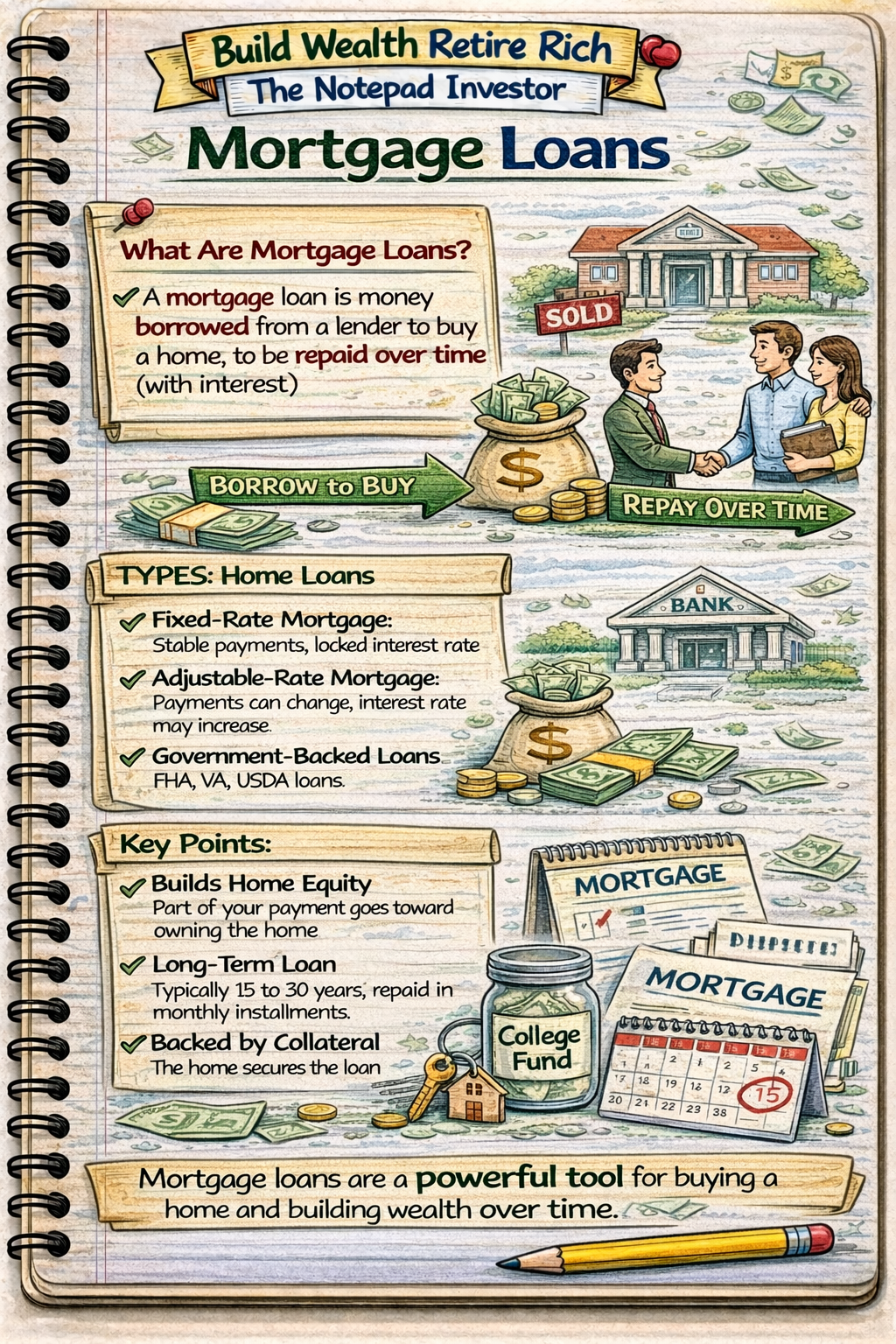
This article is designed for anyone considering home purchase, current homeowners wanting refinancing understanding, or those confused by mortgage terminology and qualification processes. You do not need financial expertise to understand mortgages—fundamental concepts accessible through clear explanations of loan mechanics, types, qualification criteria, and strategic considerations, though requires honest income assessment ensuring payment affordability within 28-30% gross income guidelines, realistic home price evaluation preventing overextension through emotional buying, and long-term commitment recognition that mortgages create 15-30 year obligations survived only through disciplined payment prioritization and stable income maintenance preventing foreclosure destroying credit and forfeiting down payment investment plus equity through inability to sustain payments during income disruption or unexpected expenses.
Understanding mortgage loans matters because single home purchase decision determines $200,000-500,000+ wealth creation through equity versus rent expense building landlord’s wealth, quarter-point interest rate difference costs $50,000-100,000+ over 30-year term making rate optimization critical, and appropriate versus excessive borrowing separates comfortable homeownership from financially-stressed house-poor existence—while mortgage-literate individuals qualify for optimal rates through excellent credit and stable employment, limit borrowing to affordable amounts maintaining emergency reserves and retirement contributions, and understand total costs including interest, taxes, insurance, and maintenance creating realistic ownership budgets, versus irresponsible borrowers maxing approval amounts leaving zero financial cushion, neglecting total cost calculations focusing only on monthly payments, and overextending through houses beyond sustainable income levels creating foreclosure risk and financial destruction impossible to recover from without strategic mortgage understanding enabling informed borrowing aligned with long-term wealth building not emotional home selection.
Educational disclaimer: This article provides general educational information about mortgage loans. Individual loan terms, qualification requirements, interest rates, and appropriate borrowing amounts vary significantly based on circumstances including credit, income, property type, location, and lender. Mortgage rates and programs subject to market changes and lender discretion. This is not financial advice, mortgage lending advice, or guarantee of loan approval. Real estate carries risks including property value decline, market downturns, and potential foreclosure. Consult qualified mortgage professionals and real estate advisors for personalized guidance matching individual situations.
Mortgage Basics and How They Work
Core Mortgage Mechanics
Key components:
- Principal: Loan amount borrowed (home price minus down payment)
- Interest: Cost of borrowing expressed as APR (6-8% typical currently)
- Term: Repayment period (30 years most common, 15 years second)
- Monthly payment: Principal + interest + property taxes + homeowners insurance (PITI)
- Collateral: Property securing loan (lender can foreclose if default)
Standard mortgage transaction:
- Step 1: Pre-approval (lender evaluates income, credit, debt qualifying buyer for amount)
- Step 2: Home search within pre-approved budget
- Step 3: Offer accepted, full mortgage application submitted
- Step 4: Property appraisal confirming value supports loan amount
- Step 5: Underwriting approval reviewing all documentation
- Step 6: Closing (sign documents, transfer funds, receive keys)
- Step 7: Monthly payments for 15-30 years until fully repaid
Amortization: How Payments Work
Amortization definition:
- Gradual loan payoff through scheduled payments
- Early payments mostly interest, later payments mostly principal
- Same payment amount monthly but composition changes
- Builds equity slowly initially, accelerates over time
30-year $300,000 mortgage at 7% example ($1,995 monthly payment):
Payment 1 (Month 1):
- Total payment: $1,995
- Interest: $1,750 (goes to lender)
- Principal: $245 (reduces loan balance, builds equity)
- Remaining balance: $299,755
Payment 60 (Year 5):
- Total payment: $1,995
- Interest: $1,644
- Principal: $351
- Remaining balance: $281,534
Payment 180 (Year 15, halfway point):
- Total payment: $1,995
- Interest: $1,199
- Principal: $796
- Remaining balance: $205,360 (paid $360,000 but only $94,640 principal reduction)
Payment 300 (Year 25):
- Total payment: $1,995
- Interest: $513
- Principal: $1,482
- Remaining balance: $87,702
Payment 360 (Final payment):
- Total payment: $1,995
- Interest: $12
- Principal: $1,983
- Remaining balance: $0
Total paid over 30 years: $718,200 ($1,995 × 360 months)
Total interest paid: $418,200 ($718,200 – $300,000)
Interest as percentage of original loan: 139%
Why Mortgages Enable Homeownership
Median home purchase scenario:
- Median U.S. home price: $400,000
- 20% down payment: $80,000 (requires years of saving for most)
- Mortgage amount: $320,000
- Monthly payment: $2,128 at 7% (30 years)
Alternative without mortgage (all-cash purchase):
- Save $400,000 before buying
- At $2,000 monthly savings: 16.7 years to save full amount
- By then home likely costs $600,000+ (5% annual appreciation)
- Effectively impossible for median-income buyers
Mortgage advantage:
- Homeownership achieved with $80,000 (doable in 3-4 years saving)
- Building equity immediately through payments
- Benefiting from appreciation while paying off
- Fixed housing cost versus rising rent

Types of Mortgage Loans
Conventional Mortgages
Characteristics:
- Not government-insured (backed by Fannie Mae or Freddie Mac)
- Minimum credit score: 620 typical, 740+ for best rates
- Down payment: 3-20% (under 20% requires PMI)
- Loan limits: $766,550 (2024) in most areas, higher in expensive markets
- Best rates for well-qualified borrowers
Private Mortgage Insurance (PMI):
- Required when down payment under 20%
- Cost: 0.3-1.5% of loan amount annually
- Example: $300,000 loan, 0.8% PMI = $2,400 annually ($200 monthly)
- Removable once equity reaches 20% (request removal or automatic at 22%)
- Increases total monthly payment until removed
Conventional loan example:
- Purchase price: $350,000
- Down payment: $35,000 (10%)
- Loan amount: $315,000
- Interest rate: 7% (good credit)
- Principal + interest: $2,095 monthly
- PMI: $200 monthly (0.76% annually)
- Total: $2,295 monthly until 20% equity reached
FHA Loans (Federal Housing Administration)
Characteristics:
- Government-insured enabling lower credit and down payment requirements
- Minimum credit score: 580 for 3.5% down, 500-579 requires 10% down
- Down payment: 3.5% minimum
- Loan limits: Similar to conventional ($498,257 in most areas 2024)
- Easier qualification for first-time buyers or lower credit
FHA Mortgage Insurance:
- Upfront premium: 1.75% of loan amount (financed into loan)
- Annual premium: 0.45-1.05% depending on loan terms
- Cannot be removed (except refinance to conventional once 20% equity)
- Permanent for loans over 90% LTV, life of loan
FHA loan example:
- Purchase price: $300,000
- Down payment: $10,500 (3.5%)
- Base loan: $289,500
- Upfront premium: $5,066 (1.75%)
- Total loan: $294,566
- Interest rate: 7%
- Principal + interest: $1,959
- Annual MI: $245 monthly (0.85% annually)
- Total: $2,204 monthly (MI permanent)
VA Loans (Veterans Affairs)
Characteristics:
- Available to eligible veterans, active duty, National Guard/Reserves
- No down payment required (0% down possible)
- No mortgage insurance required
- Competitive interest rates (often 0.25-0.5% lower than conventional)
- No loan limits for qualified borrowers
- Funding fee: 1.4-3.6% (can be financed, waived for disabled veterans)
VA loan advantages example:
- Purchase price: $350,000
- Down payment: $0 (0% down)
- Funding fee: $9,100 (2.6% first-time use)
- Total loan: $359,100
- Interest rate: 6.5% (lower than conventional)
- Monthly payment: $2,270
- No PMI/MI (saves $200-300 monthly versus conventional)
- Best option for eligible veterans
USDA Loans (Rural Development)
Characteristics:
- For rural and suburban properties in designated areas
- Income limits apply (varies by location, typically under 115% area median)
- No down payment required (100% financing)
- Mortgage insurance: 1% upfront, 0.35% annual
- Property must be in USDA-eligible area and primary residence
Jumbo Loans
Characteristics:
- Exceed conforming loan limits ($766,550 in most areas)
- Not backed by Fannie Mae/Freddie Mac
- Higher credit requirements (700+ minimum, 740+ for best rates)
- Larger down payments (10-20% typical)
- Higher interest rates (0.25-0.75% above conforming)
- Stricter qualification (reserves, debt-to-income, documentation)
Fixed-Rate vs Adjustable-Rate Mortgages
Fixed-Rate Mortgages (Most Common)
Characteristics:
- Interest rate locked for entire loan term
- Monthly principal + interest payment never changes
- Predictable budgeting advantage
- Protection against rising rates
- Typical terms: 30-year, 15-year, 20-year
30-year fixed pros and cons:
- Pros: Lowest monthly payment, maximum affordability, payment stability
- Cons: Highest total interest paid, slowest equity building, highest rates (vs 15-year)
15-year fixed pros and cons:
- Pros: Lower interest rate (typically 0.5% less than 30-year), massive interest savings, faster equity building, debt-free 15 years sooner
- Cons: Higher monthly payment (60-70% higher), reduced cash flow flexibility, qualification more difficult
Comparison example ($300,000 loan):
30-year at 7%:
- Monthly payment: $1,995
- Total paid: $718,200
- Total interest: $418,200
15-year at 6.5%:
- Monthly payment: $2,613 (31% higher)
- Total paid: $470,340
- Total interest: $170,340
- Savings versus 30-year: $247,860 in interest
Adjustable-Rate Mortgages (ARMs)
How ARMs work:
- Initial fixed period (3, 5, 7, or 10 years typical)
- After fixed period, rate adjusts periodically (annually typical)
- Adjustments based on index (SOFR, T-Bill) plus margin
- Rate caps limit adjustment amount (annual and lifetime)
- Lower initial rate than fixed-rate mortgages
Common ARM structures:
- 5/1 ARM: Fixed 5 years, then adjusts annually
- 7/1 ARM: Fixed 7 years, then adjusts annually
- 10/1 ARM: Fixed 10 years, then adjusts annually
ARM example (5/1 ARM):
- Loan: $300,000
- Initial rate: 6% (1% lower than fixed)
- Years 1-5: $1,799 monthly
- Year 6: Rate adjusts to 7% (max 2% annual increase) = $1,956 monthly
- Year 7: Could adjust to 9% if rates rise = $2,251 monthly
- Lifetime cap: Typically 5% above start (6% → 11% maximum)
When ARMs make sense:
- Confident selling/refinancing before adjustment (move in 3-7 years)
- Expect income growth covering potential payment increases
- Declining rate environment (benefit from adjustments down)
- Lower initial payment enables home purchase otherwise unaffordable
ARM risks:
- Payment shock when rates adjust upward
- Inability to refinance if home value drops (underwater)
- Staying longer than planned forcing adjustment exposure
- Budget uncertainty complicating financial planning
Qualifying for a Mortgage
Credit Score Requirements
Score ranges and loan access:
- 760+: Best rates, all loan types available, easiest approval
- 700-759: Good rates, most programs accessible, 0.25-0.5% higher than best
- 660-699: Fair rates, conventional possible, 0.5-1% higher rates
- 620-659: Higher rates, FHA best option, 1-1.5% above best rates
- 580-619: FHA only typically, 1.5-2% above best rates
- Below 580: Very difficult, FHA with 10% down or denied
Rate impact example ($300,000 loan, 30 years):
- 760+ score at 6.5%: $1,896 monthly, $682,560 total paid
- 680 score at 7.25%: $2,047 monthly, $736,920 total paid
- 620 score at 8%: $2,201 monthly, $792,360 total paid
- Cost of poor credit: $109,800 more paid (620 vs 760+ score)
Debt-to-Income Ratio (DTI)
Two DTI calculations:
Front-end DTI (housing ratio):
- Formula: Total monthly housing payment ÷ gross monthly income
- Includes: Principal, interest, taxes, insurance, HOA fees, PMI
- Conventional limit: 28% typically
- FHA limit: 31% typically
Back-end DTI (total debt ratio):
- Formula: All monthly debt payments ÷ gross monthly income
- Includes: Housing + car loans + student loans + credit cards + personal loans
- Conventional limit: 36-43%
- FHA limit: 43-50% with compensating factors
DTI qualification example:
- Gross monthly income: $8,000
- Proposed housing payment: $2,200 (PITI)
- Other debts: $600 (car $350, student loan $250)
- Front-end DTI: $2,200 ÷ $8,000 = 27.5% (acceptable)
- Back-end DTI: $2,800 ÷ $8,000 = 35% (acceptable)
- Qualified for conventional mortgage
DTI violation example:
- Gross monthly income: $6,000
- Proposed housing: $2,200
- Other debts: $800
- Front-end: $2,200 ÷ $6,000 = 36.7% (exceeds 28% limit)
- Back-end: $3,000 ÷ $6,000 = 50% (exceeds 43% limit)
- Denied conventional, may qualify FHA with strong compensating factors or require less expensive home
Down Payment Requirements
Minimum down payments by loan type:
- Conventional: 3% minimum (5-20% typical)
- FHA: 3.5% minimum
- VA: 0% (eligible veterans)
- USDA: 0% (eligible rural properties)
20% down payment advantages:
- No PMI requirement (saves $100-300 monthly)
- Better interest rates (lower risk for lender)
- Instant 20% equity (protection against value decline)
- Lower monthly payment (smaller loan amount)
- Stronger offers (sellers prefer larger down payments)
Low down payment trade-offs:
- PMI/MI costs ($100-300 monthly)
- Higher interest rates
- Limited equity creating underwater risk
- Higher monthly payments (larger loan)
- Qualification more difficult (higher LTV ratio)
Income and Employment Verification
Required documentation:
- 2 years tax returns (W-2s, 1099s)
- 2 recent pay stubs
- 2 months bank statements
- Employment verification (VOE)
- 2-year employment history
Self-employed additional requirements:
- 2 years business tax returns (full returns with schedules)
- Profit and loss statements
- Business bank statements
- CPA letter or business license
- Income calculated conservatively (net after expenses)
Reserves Requirements
Cash reserves definition:
- Liquid assets remaining AFTER down payment and closing costs
- Measured in months of PITI payments
- Conventional typically requires 2-6 months
- Jumbo loans require 6-12 months
Reserves example:
- Monthly PITI: $2,500
- Required reserves: 6 months
- Must have: $15,000 liquid ($2,500 × 6) AFTER down payment/closing
- Qualifying assets: Checking, savings, money market, taxable investments
- Non-qualifying: Retirement accounts (counted at 60-70%), home equity, personal property
Total Cost of Homeownership
Beyond the Mortgage Payment
PITI breakdown:
Principal and Interest (PI):
- $300,000 loan at 7%, 30 years = $1,995
Property Taxes (T):
- Varies by location (0.5-2.5% of home value annually)
- Example: $350,000 home, 1.2% rate = $4,200 annually ($350 monthly)
Homeowners Insurance (I):
- $1,000-$3,000 annually typical ($85-250 monthly)
- Higher in disaster-prone areas (hurricanes, earthquakes, floods)
- Example: $1,500 annually = $125 monthly
Total PITI example:
- PI: $1,995
- Taxes: $350
- Insurance: $125
- PMI (if under 20% down): $200
- Total: $2,670 monthly
Additional Ownership Costs
HOA fees (if applicable):
- $50-$500+ monthly depending on amenities
- Covers: Common area maintenance, amenities, insurance, reserves
- Can increase annually
Maintenance and repairs:
- Rule of thumb: 1-3% of home value annually
- $350,000 home: $3,500-$10,500 annually ($290-875 monthly budget)
- Covers: HVAC, roof, appliances, plumbing, electrical, landscaping
Utilities:
- Electric, gas, water, sewer, trash: $200-500 monthly typical
- Higher than apartment/rental typically (more space, lawn care)
Complete monthly ownership cost example:
- PITI: $2,670
- HOA: $150
- Maintenance reserve: $400
- Utilities: $300
- Total: $3,520 monthly ($42,240 annually)
One-Time Closing Costs
Typical closing cost range: 2-5% of purchase price
Breakdown ($350,000 purchase):
- Loan origination fee: $3,500 (1%)
- Appraisal: $500-700
- Credit report: $100
- Title insurance: $1,500-2,500
- Title search and exam: $400-800
- Survey: $400-600
- Attorney fees: $500-1,500
- Recording fees: $100-300
- Prepaid property taxes: $1,000-3,000
- Prepaid insurance: $1,000-2,000
- Homeowners association transfer: $200-500
- Total: $9,000-$15,000 typical
Total cash needed at purchase:
- Down payment: $70,000 (20%)
- Closing costs: $12,000
- Moving expenses: $2,000
- Immediate repairs/updates: $3,000
- Emergency reserve: $10,000 (2 months PITI + maintenance)
- Total: $97,000 for $350,000 home purchase
Buy vs Rent Analysis
30-Year Comparison
Homeownership scenario:
- Purchase: $350,000 home
- Down payment: $70,000 (20%)
- Mortgage: $280,000 at 7%, 30 years
- Monthly PITI: $2,345 ($1,863 PI + $350 tax + $132 insurance)
- Maintenance: $350 monthly average
- Total monthly: $2,695
- 30-year total paid: $970,200 ($2,695 × 360 months)
- Home value after 30 years: $910,000 (3.5% appreciation)
- Equity owned: $910,000 (mortgage fully paid)
- Net wealth: $910,000 home minus $970,200 paid + $70,000 down = Break-even considering appreciation
- Housing cost years 31+: $482 monthly (taxes + insurance + maintenance only, no mortgage)
Renting scenario:
- Initial rent: $2,200 monthly (comparable property)
- Rent increases: 3% annually average
- Year 1-10 average: $2,500 monthly
- Year 11-20 average: $3,300 monthly
- Year 21-30 average: $4,400 monthly
- 30-year total rent paid: $1,140,000
- Equity owned: $0
- Net wealth: -$1,140,000 (pure expense)
- Initial $70,000 invested instead: $540,000 at 7% return over 30 years
- Net position: $540,000 investments minus $1,140,000 rent = -$600,000
- Housing cost years 31+: $5,700 monthly (rent continues rising)
Wealth difference: $1,510,000 (homeowner $910,000 equity vs renter -$600,000 net position)
When Renting Makes Sense
Appropriate renting scenarios:
- Uncertain location (job relocation likely within 3-5 years)
- Insufficient down payment or emergency fund
- Credit repair needed (improving score 1-2 years for better rates)
- Income instability (unemployment risk, variable commission income)
- Very expensive market (rent-to-price ratio favorable to renting)
- Short-term stay (under 5 years, transaction costs exceed benefits)
Break-even timeline:
- Transaction costs (buying + selling): 8-10% of home value
- $350,000 home: $28,000-35,000 transaction costs
- Requires 3-5 years appreciation to recover costs
- Staying under 5 years often makes renting financially better
Strategic Mortgage Management
Accelerating Payoff
Extra payment strategies:
Strategy 1: Additional principal monthly
- $300,000 at 7%, standard payment $1,995
- Add $500 monthly to principal: $2,495 total
- Payoff: 16 years vs 30 years
- Interest saved: $283,000
- 14 years of payments eliminated
Strategy 2: Biweekly payments
- Pay half mortgage every 2 weeks instead of monthly
- 26 half-payments = 13 full payments vs 12 monthly
- One extra payment annually applies to principal
- Payoff: 24-25 years vs 30
- Interest saved: $60,000-80,000
Strategy 3: Lump sum applications
- Tax refunds, bonuses, inheritances applied to principal
- $10,000 lump sum payment year 5 saves $20,000+ interest
- Reduces balance faster in high-interest early years
Refinancing Considerations
When refinancing makes sense:
- Interest rates dropped 0.75-1%+ below current rate
- Improved credit score enabling better rates
- Reaching 20% equity eliminating PMI
- Cash-out refinance for home improvements adding value
- Switching from ARM to fixed rate for stability
Refinance example:
- Current: $280,000 balance at 8%, 25 years remaining, $2,156 monthly
- Refinance: $280,000 at 6.5%, 30 years, $1,770 monthly
- Monthly savings: $386
- Closing costs: $5,000
- Break-even: 13 months ($5,000 ÷ $386)
- Staying 5+ years: $23,160 savings ($386 × 60 – $5,000 costs)
Refinance warnings:
- Resetting to 30 years extends total payoff time
- Closing costs ($3,000-$8,000) must be recovered through savings
- Cash-out refinancing increases debt and payment
- PMI may be re-triggered if refinancing under 20% equity
Avoiding Foreclosure
Early intervention critical:
- Contact lender IMMEDIATELY when payment difficulty arises
- Options available BEFORE default unavailable after
- 30-day late payment damages credit, foreclosure destroys it
Loss mitigation options:
- Forbearance: Temporary payment pause/reduction (3-12 months)
- Repayment plan: Spread missed payments over 6-12 months
- Loan modification: Permanent term extension or rate reduction
- Short sale: Sell for less than owed with lender approval
- Deed in lieu: Transfer property to lender avoiding foreclosure
Foreclosure consequences:
- Credit score drops 200-300 points
- Foreclosure remains on credit 7 years
- Mortgage qualification impossible 3-7 years
- Down payment forfeited plus any equity
- Potential deficiency judgment if home sells below balance
- Tax consequences (forgiven debt treated as income)
Why Understanding Mortgages Matters
Without understanding mortgages, individuals overpay $50,000-100,000+ through poor credit preparation accepting higher rates, overborrow creating house-poor existence consuming 40-50% income leaving zero savings capacity, and miss strategic opportunities like 15-year terms saving $200,000+ interest or refinancing reducing payments $300-500 monthly—while mortgage-literate individuals optimize credit scores before applying capturing lowest rates, limit borrowing to 28% gross income maintaining financial flexibility and emergency reserves, and understand total costs including maintenance, taxes, insurance preventing shock from ownership expenses exceeding mortgage payments, creating dramatically different outcomes where strategic buyers build $500,000-1,000,000 equity over 30 years through affordable homeownership versus irresponsible buyers facing foreclosure through overextension or permanent renting through qualification failure missing wealth-building opportunity impossible without mortgage literacy enabling informed borrowing decisions.
Understanding mortgages enables individuals to:
- Calculate true affordability including all ownership costs beyond mortgage payment
- Optimize credit and debt-to-income ratios qualifying for best rates saving $50,000-100,000+
- Compare loan types (conventional, FHA, VA) selecting optimal program and terms
- Evaluate 15-year versus 30-year terms weighing payment affordability against interest savings
- Understand total costs including down payment, closing, maintenance, reserves required
- Make informed buy-versus-rent decisions based on timeframe and market conditions
- Implement strategic payoff acceleration or refinancing creating substantial savings
Mortgage knowledge transforms homeownership from emotional decision or feared impossibility into strategic wealth-building investment evaluating affordability, optimizing terms, and managing debt effectively creating substantial equity impossible without understanding qualification requirements, loan mechanics, and total cost calculations enabling informed decisions.
Common Misunderstandings
Many people assume monthly mortgage payment equals total housing cost. In reality, PITI (principal, interest, taxes, insurance) plus HOA fees, maintenance reserves, and utilities typically add 30-50% to base mortgage payment—$1,800 mortgage becomes $2,500-2,700 total monthly ownership cost including all factors, proving payment affordability calculations must include complete expenses not just principal and interest preventing surprise from property taxes ($200-500 monthly), insurance ($100-250), maintenance ($200-400), and utilities ($200-400) creating actual costs vastly exceeding quoted mortgage payment.
Another common misconception is 20% down payment required for all mortgages. In practice, conventional loans available with 3% down, FHA requires 3.5%, VA and USDA offer 0% down for eligible buyers, making homeownership accessible with $10,000-20,000 versus assumed $60,000-80,000 for 20% down though lower down payments require PMI adding $100-300 monthly and create limited equity risking underwater scenarios if property values decline, proving 20% down optimal but not required making homeownership possible sooner for disciplined buyers accepting PMI costs temporarily versus waiting years saving 20% down.
Some believe renting always “throwing money away” versus owning building equity. However, homeownership includes substantial costs beyond mortgage—property taxes, insurance, maintenance, HOA fees, transaction costs buying and selling (8-10% combined)—making renting financially superior for short timelines under 5 years or unstable situations where flexibility valuable, plus home appreciation not guaranteed with markets experiencing 20-40% declines in downturns creating losses exceeding rent paid, proving buy-versus-rent requires honest analysis of timeline, market conditions, and total costs not automatic assumption that ownership always superior regardless of circumstances.
How Mortgage Understanding Fits Into Financial Success
Mortgage understanding enables $500,000-1,000,000 wealth creation through homeownership building equity versus rent expense, prevents financial destruction through overextension creating foreclosure risk or house-poor existence, and optimizes borrowing costs saving $50,000-100,000+ through credit preparation and loan selection—making mortgage literacy essential component of wealth building requiring honest affordability assessment limiting housing to 28% gross income, strategic timing preparing credit and down payment before applying, and comprehensive cost evaluation including maintenance, taxes, insurance beyond mortgage payments, transforming homeownership from emotional dream or feared impossibility into calculated investment creating measurable wealth when appropriate house purchased with sustainable financing versus financial disaster when excessive home financed beyond income capacity creating impossible payment burden impossible without understanding qualification requirements, total costs, and strategic mortgage management.
For example, two couples both age 30 earning $90,000 combined deciding on housing. Couple A lacks mortgage understanding, emotionally attached to $450,000 home despite financial advisor recommendation for $350,000 maximum. Approved for $450,000 with 5% down FHA loan ($22,500 down), 7% rate, $2,847 PI payment plus $375 taxes, $150 insurance, $225 PMI, $200 HOA = $3,797 monthly (50% of $90,000 gross income). Stretches budget dramatically, zero emergency fund after closing costs. Year 2: HVAC failure $8,000, puts on credit card unable to pay cash (no reserves). Year 4: Job loss for one spouse, income drops to $55,000, cannot afford $3,797 payment, misses 2 payments damaging credit, forces desperate job acceptance at lower pay. Year 7: Still struggling with payments consuming 55% of now $82,000 income (raises minimal due to career setback), zero retirement savings (cannot afford), $25,000 credit card debt from emergencies and cash flow gaps, marriage stress from financial strain. Year 15: Refinance impossible (credit damage from late payments), home worth $550,000 but owe $390,000 = only $160,000 equity after 15 years. Retirement accounts $40,000 (minimal contributions). Net worth $200,000 minus lingering debt. Couple B understands mortgage mechanics, researches thoroughly before home search. Determines affordable payment 28% gross income = $2,100 housing maximum. Searches homes in $300,000-320,000 range. Purchases $310,000 home, 20% down ($62,000 saved over 3 years), 7% rate, $1,659 PI plus $260 taxes, $120 insurance = $2,039 monthly (27% income, comfortable). Maintains $25,000 emergency fund after purchase. Year 2: HVAC failure $8,000, pays cash from emergency fund, replenishes over 10 months. Year 4: Job loss, maintains payments from emergency fund while searching (6 months reserves), accepts comparable new position. Year 7: Payments comfortable 25% of income, retirement contributions $850 monthly, no consumer debt. Year 15: Home worth $480,000, owe $210,000 = $270,000 equity. Retirement accounts $240,000 from consistent contributions. Net worth $510,000. Difference: Couple A’s poor mortgage understanding through overextension created $310,000 wealth gap ($200,000 vs $510,000 net worth) plus 15 years financial stress, damaged credit, marriage strain from identical starting incomes through excessive home purchase consuming 50% income leaving zero cushion for emergencies or retirement, Couple B’s mortgage literacy through disciplined 28% housing limit enabled comfortable homeownership, wealth building through equity and retirement contributions, and financial stability surviving income disruption through maintained reserves demonstrating $310,000+ wealth difference from understanding affordable borrowing limits, total cost calculations, and strategic mortgage selection impossible when emotional home choice drives excessive borrowing.
Mortgage understanding separates wealthy homeowners building substantial equity through affordable strategic purchases from foreclosure victims or house-poor strugglers through overextension, requiring honest affordability assessment, comprehensive cost evaluation, and disciplined borrowing limits creating measurable wealth differences impossible without mortgage literacy.
Recent Updates and Trends
In recent years, mortgage rates have fluctuated dramatically with Federal Reserve policy changes seeing rates rise from 3% (2020-2021) to 7-8% (2023-2024) doubling monthly payments and reducing buyer purchasing power 30-40%, though fundamental mortgage principles unchanged requiring affordability assessment at current rates not historical lows creating false expectations about sustainable payment levels.
Home prices have appreciated significantly in most markets with median prices increasing 40-60% since 2019 creating affordability challenges where median home requiring median income percentage rising from 25% to 35-40% in many areas, though homeownership still produces superior long-term wealth outcomes versus renting despite higher entry barriers requiring larger down payments and higher incomes for qualification.
Alternative mortgage products have emerged including non-QM loans for self-employed or complex income borrowers, though featuring higher rates and requiring substantial documentation making traditional qualified mortgages preferable for W-2 employees with standard income despite seeming appeal of alternative products promising easier qualification often masking higher costs and risks.
First-time buyer programs have expanded in many states offering down payment assistance, reduced PMI, or favorable rates, though eligibility requirements and program availability vary requiring research into state housing finance agency offerings potentially saving $5,000-15,000 in down payment or closing costs making exploration worthwhile before conventional financing.
Fundamental mortgage principles remain timeless: limit housing to 28-30% gross income maintaining affordability and flexibility, optimize credit scores before applying capturing lowest rates saving tens of thousands, understand total costs beyond mortgage including taxes, insurance, maintenance preventing shock, and maintain emergency reserves surviving income disruption without foreclosure risk—regardless of rate environment changes, price appreciation, product innovation, or assistance program expansion, understanding qualification requirements, total cost calculations, and disciplined affordability limits produces superior outcomes through strategic homeownership building substantial wealth impossible when emotional decisions or poor preparation create overextension leading to foreclosure or permanent renting missing wealth-building opportunity.
3 Things You Can Do Today
Ready to optimize mortgage strategy? Here are three simple steps you can take right now:
1. Calculate true affordable home price using 28% gross income rule preventing overextension and house-poor existence – Current or expected gross annual income: Note exact amount (example: $85,000). Calculate 28% gross monthly income maximum housing payment: $85,000 ÷ 12 = $7,083 monthly gross, $7,083 × 28% = $1,983 maximum total housing payment (PITI). Subtract property taxes estimate: Research target area tax rates (example: 1.2% annually), estimate taxes on target price range ($350,000 home × 1.2% = $4,200 annually = $350 monthly). Subtract homeowners insurance: Estimate $1,200-1,800 annually ($100-150 monthly). Subtract HOA if applicable: Average $150 monthly in target neighborhood. Subtract PMI if under 20% down: Estimate $150 monthly if planning 10% down. Calculate maximum PI payment: $1,983 total minus $350 tax minus $125 insurance minus $150 HOA minus $150 PMI = $1,208 available for principal and interest. Use mortgage calculator determining affordable loan amount: $1,208 monthly at 7% over 30 years = $182,000 maximum affordable loan. Add down payment to determine maximum purchase price: $182,000 loan + $36,000 down (20% to avoid PMI) = $218,000 affordable purchase OR $182,000 + $18,000 down (10%) = $200,000 purchase if comfortable with PMI. Reality check: If target homes are $350,000 but calculation shows $200,000 affordable, either increase income, save larger down payment, or accept smaller/different location home preventing overextension. Example outcome: Income $85,000 affords $200,000-218,000 home comfortably NOT $350,000 desired creating payment $3,200+ (45% income, financial disaster). Takes 20 minutes preventing catastrophic overborrowing through honest affordability calculation impossible when using lender’s maximum approval (often 43% DTI) versus conservative 28% rule maintaining financial health.
2. If planning home purchase within 2 years, implement credit optimization strategy potentially saving $50,000-100,000 through rate improvement – Check current credit score: Free through Credit Karma, credit card issuer, or Experian. Identify current score range: Below 660 (needs significant improvement), 660-719 (moderate improvement), 720-759 (minor optimization), 760+ (optimal, maintain). Calculate rate impact: $300,000 loan example—660 score gets 7.75% ($2,151 monthly, $774,360 total paid) versus 760+ gets 6.75% ($1,946 monthly, $700,560 total), difference $73,800 over 30 years from 100-point score improvement. Implement optimization: (1) Pay down credit card balances to under 10% utilization (biggest impact, 30-60 points typical improvement in 30 days), (2) Set up automatic payments preventing any late payments next 12-24 months (protects 35% of score), (3) Keep all old accounts open preserving history length, (4) Avoid new credit applications 12 months before mortgage (prevents inquiry damage), (5) Dispute any credit report errors (AnnualCreditReport.com checking all three bureaus). Timeline: 12-24 months before purchase start optimization maximizing score improvement, 6 months before get pre-approved at optimized score. Example improvement: 680 score improves to 750 through utilization reduction (pay $8,000 to cards bringing 45% to 8% = 50-point boost) plus 12 months perfect payments (20-point boost) = 70-point total improvement creating rate savings $40,000-60,000 over loan life. Monitoring: Check score quarterly tracking improvement, adjust strategy if needed. Takes 30 minutes initial setup plus 12-24 months execution creating $40,000-100,000 savings through strategic credit optimization before mortgage application impossible when applying immediately with poor credit accepting permanently higher rate costing tens of thousands.
3. Calculate total monthly homeownership cost for target property including all factors beyond mortgage creating realistic budget – Target property: Identify specific home or price range (example: $350,000 home). Calculate complete monthly cost: Principal + Interest ($300,000 loan at 7% 30 years = $1,995 monthly). Property taxes ($350,000 × 1.2% annually = $4,200 ÷ 12 = $350 monthly, verify actual rate in target area). Homeowners insurance ($1,500 annually = $125 monthly, get quote for actual property). PMI if applicable ($240 monthly on $300,000 loan with 10% down at 0.8% annually). HOA fees ($150 monthly if applicable, verify actual for property). Utilities estimate ($300 monthly for 2,000 sq ft home—electric, gas, water, trash). Maintenance reserve (1% home value annually = $350,000 × 1% = $3,500 ÷ 12 = $290 monthly for HVAC, roof, appliances, plumbing). Landscaping/yard ($50-100 monthly if applicable). Total monthly cost: $1,995 PI + $350 tax + $125 insurance + $240 PMI + $150 HOA + $300 utilities + $290 maintenance + $75 yard = $3,525 total monthly ownership cost. Compare to current rent: If renting $1,800 monthly, homeownership costs $1,725 more monthly ($3,525 vs $1,800), requiring budget adjustment or income increase sustaining difference. Compare to 28% income rule: $3,525 monthly requires $150,000+ gross income ($3,525 ÷ 0.28 × 12) to stay within guidelines, if earning less property unaffordable requiring lower price target. Hidden insight: Many buyers focus only on $1,995 mortgage payment ignoring $1,530 in additional monthly costs creating budget shock and financial strain when actual ownership costs 77% higher than quoted mortgage payment. Reality adjustment: If complete calculation reveals unaffordable, reduce target price, increase down payment lowering PMI, or continue renting while increasing income/savings. Takes 30 minutes creating comprehensive realistic budget preventing surprise from total costs exceeding expectations by 50-100% when only considering mortgage payment impossible without complete calculation including all ownership factors.
These actions create mortgage mastery within 90 minutes—calculated true affordable home price preventing overextension ($50,000-150,000 potential savings from appropriate sizing), implemented credit optimization strategy potentially saving $40,000-100,000 through rate improvement, and determined complete monthly ownership costs creating realistic budget preventing shock from expenses exceeding mortgage by 50-100%—transforming mortgage decision from emotional home choice or feared impossibility into strategic wealth-building investment through informed affordability assessment, credit preparation, and comprehensive cost evaluation enabling homeownership creating substantial equity without financial destruction impossible without mortgage literacy.
Quick FAQ
How much house can I afford?
Conservative rule: Total monthly housing payment (PITI—principal, interest, taxes, insurance plus HOA, maintenance) should not exceed 28% of gross monthly income ensuring comfortable affordability maintaining emergency reserves and other financial goals. Calculation: $80,000 annual income = $6,667 monthly gross × 28% = $1,867 maximum total housing payment. Working backward: $1,867 minus estimated $300 taxes, $120 insurance, $100 HOA, $250 maintenance = $1,097 available for principal and interest, supports $162,000 mortgage at 7% plus down payment = $180,000-202,000 affordable purchase range depending on down payment percentage. Lender qualification different: Banks approve up to 43% debt-to-income ratio including all debts, often qualifying buyers for $250,000-300,000 homes on $80,000 income creating dangerous overextension consuming half income leaving zero financial cushion. Key insight: Qualification maximum not affordability maximum—lenders maximize loan amounts for profit, borrowers must self-impose conservative limits maintaining financial health. Warning signs of overextension: Payment exceeding 30% gross income, zero emergency fund after purchase, cannot maintain retirement contributions, using entire approval amount, stretching budget for “dream home” beyond comfortable range. Safe approach: Use 25-28% rule, maintain 6-month emergency fund, continue 15% retirement contributions, stay well below approval maximum creating financial flexibility surviving income disruption, unexpected expenses, or rate increases if ARM.
Is 15-year or 30-year mortgage better?
Depends on prioritizing payment affordability versus interest minimization, but 15-year dramatically superior if affordable: 15-year advantages—Lower interest rate (typically 0.5% less than 30-year), massive interest savings ($200,000-300,000 on typical mortgage), faster equity building, debt-free 15 years sooner enabling retirement flexibility. 15-year disadvantages—Higher monthly payment (50-70% more), reduced cash flow flexibility, difficult qualification (higher payment versus income ratio), less funds available for other investments. 30-year advantages—Lower monthly payment maximizing affordability, greater cash flow flexibility, easier qualification, extra funds potentially invested elsewhere. 30-year disadvantages—Higher interest rate, 2-3x total interest paid, slower equity building, 30-year obligation. Example comparison $300,000: 30-year at 7% = $1,995 monthly, $418,200 total interest. 15-year at 6.5% = $2,613 monthly (31% higher payment), $170,340 interest, saves $247,860. Decision framework: Choose 15-year if payment comfortable within 28% income rule AND maintains emergency fund and retirement contributions—provides massive interest savings and forced accelerated payoff. Choose 30-year if 15-year payment exceeds 28% income OR prevents emergency fund/retirement OR creates financial strain—take longer affordable payment, consider extra principal payments when possible but maintain flexibility. Hybrid approach: Take 30-year for flexibility but pay as 15-year when income allows, dropping to required payment during lean periods maintaining safety net impossible with locked 15-year commitment.
How much should I put down?
Trade-off between minimizing monthly payment and PMI versus preserving cash reserves and investment opportunities: 20% down advantages—No PMI requirement (saves $100-300 monthly), better interest rates, instant 20% equity cushion, stronger offers to sellers, lower monthly payment. 20% down disadvantages—Delays purchase while saving, ties up $60,000-80,000 in home versus investments, leaves less emergency reserves if stretching to reach 20%. Lower down (3-10%) advantages—Faster homeownership timeline, preserves cash for emergencies and opportunities, leverages appreciation with less capital. Lower down disadvantages—PMI costs ($100-300 monthly until 20% equity), higher interest rates, higher monthly payment, underwater risk if values decline, weaker offers. Strategic decision framework: 20% down optimal IF (1) have funds without depleting emergency reserves, (2) not delaying purchase years chasing target, (3) PMI costs concern outweighs investment opportunity, (4) want payment minimization. Lower down acceptable IF (1) maintains $10,000+ emergency fund after purchase, (2) PMI temporary (plan to reach 20% equity through appreciation + payments in 3-5 years or refinance eliminating), (3) strong income growth expected, (4) first-time buyer assistance programs available reducing effective cost. Example analysis: $350,000 home, have $50,000 saved. Option A: 14% down ($50,000), mortgage $300,000 with PMI $230 monthly, emergency fund $0 after closing (DANGEROUS). Option B: 10% down ($35,000), mortgage $315,000 with PMI $240, emergency fund $15,000 after closing (SAFER). Option C: Wait 18 months saving to $70,000, 20% down, no PMI, but risk prices increasing requiring larger down payment and delaying wealth building 18 months. Best choice depends on risk tolerance, market trajectory, income stability—generally prefer maintaining emergency reserves over rushing to 20% if requires complete depletion creating vulnerability.
Should I get a fixed-rate or adjustable-rate mortgage?
Fixed-rate safer and preferable for most borrowers providing payment certainty, ARM appropriate only for specific short-term situations: Fixed-rate advantages—Payment stability entire loan term (principal + interest never changes), protection against rising rates, simplified budgeting, refinance flexibility anytime without rate risk. Fixed-rate disadvantages—Higher initial rate than ARM (typically 0.5-1% more), no benefit if rates decline (must refinance to capture), less flexibility for short-term ownership. ARM advantages—Lower initial rate (saving $100-300 monthly during fixed period), beneficial if selling before adjustment, enables larger purchase initially, rate decreases possible if market declines. ARM disadvantages—Payment uncertainty after fixed period (can increase substantially creating budget shock), inability to refinance if underwater or credit damaged, stress from rate monitoring, complicated terms. When ARM makes sense: (1) Confident selling within fixed period (military relocation, job transfer, starter home strategy), (2) Expect significant income growth covering potential increases, (3) Declining rate environment (benefit from adjustments down), (4) Lower initial payment critical for purchase qualification. When fixed preferable: (1) Long-term ownership planned (10+ years), (2) Budget stability priority over rate savings, (3) Cannot sustain payment increases (income fixed), (4) Rising or uncertain rate environment, (5) Sleep-at-night peace of mind valuable. Current environment recommendation (7% rates 2024): Fixed-rate strongly preferable—rates historically elevated likely declining future, ARM initial savings minimal (6.5% vs 7%), adjustment risk significant if rates rise further, refinancing to fixed later may be impossible if underwater or credit damaged. Exception: Short-term ownership (under 5 years certain) may justify ARM capturing lower initial rate if savings substantial and exit strategy clear before adjustment period.
What credit score do I need for a mortgage?
Minimum varies by loan type but higher scores dramatically reduce costs through better rates: Score requirements—FHA minimum 580 (500-579 requires 10% down instead of 3.5%), Conventional minimum 620 typically, VA no official minimum but 620 practical floor, USDA 640 minimum typically, Jumbo 700+ minimum. Rate impact massive: $300,000 loan 30 years—760+ score gets 6.5% ($1,896 monthly, $682,560 total), 680 score gets 7.25% ($2,047 monthly, $736,920 total), 620 score gets 8% ($2,201 monthly, $792,360 total). Cost of poor credit: 620 versus 760 score = $305 monthly higher payment, $109,800 more paid over life of loan from 140-point score difference. Strategic approach: If score below 720, delay purchase 12-24 months optimizing credit potentially saving $40,000-100,000 through rate improvement vastly exceeding any home appreciation during delay. Rapid improvement possible: Pay down credit cards to under 10% utilization (30-60 points in 30 days), 12 months perfect payments (20-40 points), keep old accounts open, dispute errors. Example optimization: 650 score improves to 740 through aggressive credit card payoff ($12,000 paid reducing 60% utilization to 8% = 50-point boost) plus 18 months perfect payment history (30-point boost) plus authorized user on parent’s 15-year-old account (10-point boost) = 90-point improvement creating $60,000-80,000 lifetime savings through rate improvement from 7.5% to 6.75%. Key insight: Every 20 points matters creating measurable rate improvements—680 to 700 saves $10,000-15,000, 700 to 720 saves $15,000-20,000, 720 to 760 saves $20,000-30,000 making credit optimization highest-ROI preparation activity before mortgage application.
Explore More in Money Basics
Disclosure
This article provides general educational information about mortgage loans and homeownership. Individual loan terms, qualification requirements, interest rates, down payment options, and appropriate borrowing amounts vary significantly based on circumstances including credit, income, employment, property type, location, and lender policies. Mortgage rates, programs, and lending standards subject to frequent changes and lender discretion. This is not financial advice, mortgage lending advice, real estate advice, or guarantee of loan approval or specific terms. Real estate investment carries substantial risks including property value decline, market downturns, interest rate increases, job loss affecting payment ability, and potential foreclosure. Home appreciation not guaranteed—markets experience significant declines periodically. Total cost calculations and affordability guidelines represent general frameworks—individual budgets and circumstances vary requiring personalized analysis. Mortgage insurance requirements, costs, and removal terms vary by loan type and lender. Tax implications of homeownership depend on individual tax situations and current tax law subject to change. Closing cost estimates represent typical ranges—actual costs vary by location, lender, and transaction specifics. Buy-versus-rent analysis contains assumptions about appreciation, rent increases, investment returns, and tax treatment—actual results vary substantially from projections. Refinancing benefits depend on rate differential, closing costs, loan term remaining, and time to break-even. Credit score impacts on rates represent typical scenarios—individual pricing adjustments vary by complete credit profile and lender. Consult qualified mortgage professionals, real estate agents, attorneys, and tax advisors for personalized guidance matching individual situations and goals. Focus on conservative affordability assessment and maintaining emergency reserves rather than maximizing approval amounts creating financial vulnerability. Advertisements or sponsored content may appear within or alongside this content. All information presented independently for educational purposes only.