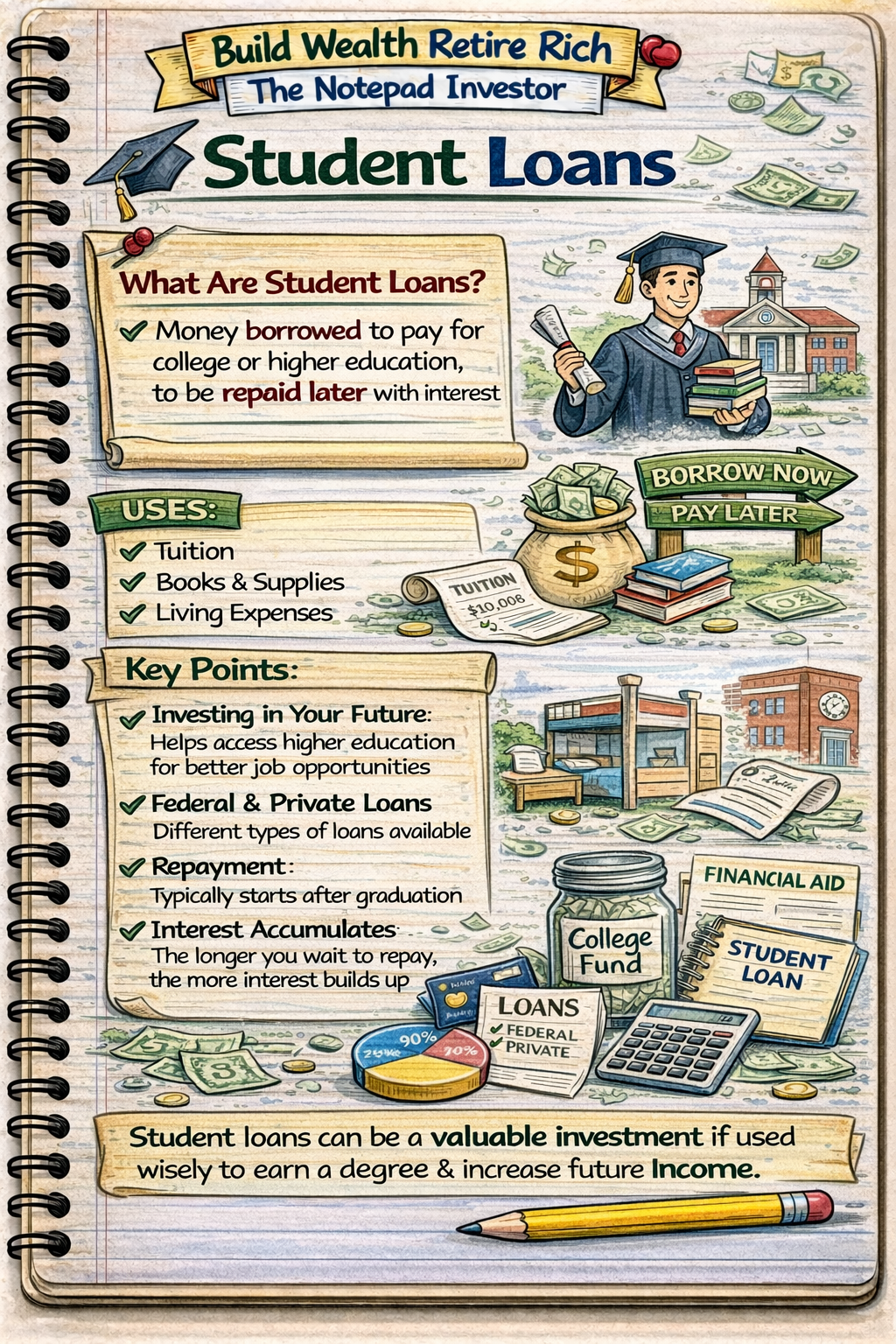
Student loans are borrowed funds specifically designated for education expenses including tuition, fees, books, housing, and living costs during college or graduate school—creating obligation to repay principal plus interest after graduation or leaving school, with repayment terms, interest rates, and borrower protections varying significantly between federal loans offering fixed rates (4-7% typical), income-driven repayment options, and potential forgiveness programs versus private loans through banks requiring credit checks, offering variable rates (7-14% typical), and providing fewer protections making federal borrowing generally preferable despite lower borrowing limits. Representing $1.7+ trillion national debt burden affecting 43+ million Americans, student loans enable education access impossible for most through cash payment alone—bachelor’s degree costing $40,000-$100,000+ at public universities and $120,000-$200,000+ at private institutions requires borrowing for majority of students, with appropriate loan usage financing high-ROI degrees generating $500,000-$2,000,000 additional lifetime earnings justifying debt costs while excessive borrowing for low-earning majors creates financial burdens consuming 20-40% of post-graduation income for decades making strategic borrowing decisions, realistic earning potential evaluation, and loan type understanding essential for education financing aligned with career goals rather than emotional college choice creating impossible repayment situations destroying financial futures through student debt exceeding earning capacity.
This article is designed for anyone considering student loans for self or dependents, current borrowers wanting repayment optimization, or those confused by federal versus private options and repayment strategies. You do not need financial expertise to understand student loans—fundamental concepts accessible through clear explanations of loan types, application processes, repayment options, and strategic considerations, though requires honest degree ROI evaluation distinguishing between passion pursuits and practical earning potential, realistic cost assessment comparing schools and financing options, and disciplined borrowing limiting debt to amounts sustainable on expected post-graduation income preventing common trap of following dreams to expensive institutions for low-earning degrees creating six-figure debt with five-figure salaries making repayment mathematically impossible without parent support or income-driven forgiveness relying on taxpayers subsidizing poor borrowing decisions.
Understanding student loans matters because single education financing decision determines whether degree investment produces positive or negative lifetime financial return, federal versus private loan choice creates $20,000-50,000+ difference in total repayment costs through interest rates and repayment flexibility, and strategic borrowing enables career advancement through education while irresponsible borrowing destroys financial futures through impossible debt burdens—while student-loan-literate individuals maximize federal borrowing before private, limit debt to 1x first-year salary maintaining affordable payments, and choose degrees with clear employment paths yielding incomes justifying debt costs, creating dramatically different outcomes where strategic borrowers achieve 10-40x ROI through increased lifetime earnings versus irresponsible borrowers struggling with payments consuming 30%+ of income for decades preventing wealth accumulation, homeownership, and financial security through education debt exceeding benefits received.
Educational disclaimer: This article provides general educational information about student loans. Individual loan terms, eligibility, interest rates, and appropriate borrowing amounts vary based on circumstances including credit, income, school choice, and degree pursued. Federal student loan programs and repayment options subject to legislative changes. This is not financial advice or recommendation of specific borrowing amounts or schools. Consult qualified financial aid advisors and education professionals for personalized guidance. Student loan debt carries serious long-term financial implications requiring careful consideration before borrowing.
Federal vs Private Student Loans
Federal Student Loans (Preferred Option)
Key characteristics:
- Funded by U.S. Department of Education
- Fixed interest rates set by Congress annually
- No credit check required (except PLUS loans)
- Income-driven repayment plans available
- Potential loan forgiveness programs
- Deferment and forbearance options during hardship
- Death and disability discharge provisions
Federal loan types:
Direct Subsidized Loans (undergraduates with financial need):
- Government pays interest while in school (minimum half-time enrollment)
- Annual limits: $3,500-$5,500 depending on year in school
- Interest rate: 5.50% for 2024-2025 academic year (fixed)
- Best federal option due to subsidized interest
Direct Unsubsidized Loans (all students regardless of need):
- Interest accrues from disbursement (even during school)
- Annual limits: $5,500-$7,500 undergrad, $20,500 graduate
- Interest rate: 5.50% undergrad, 7.05% graduate (2024-2025)
- Most common federal loan type
Direct PLUS Loans (parents and graduate students):
- Parent PLUS: Parents borrow for dependent undergraduates
- Grad PLUS: Graduate students borrow additional funds
- Credit check required (adverse credit disqualifies)
- Interest rate: 8.05% (2024-2025)
- Origination fee: 4.228%
- No aggregate limit (borrow up to cost of attendance)
Annual federal borrowing limits (dependent undergraduates):
- Freshman: $5,500 ($3,500 subsidized, $2,000 unsubsidized)
- Sophomore: $6,500 ($4,500 subsidized, $2,000 unsubsidized)
- Junior/Senior: $7,500 ($5,500 subsidized, $2,000 unsubsidized)
- Aggregate limit: $31,000 total ($23,000 subsidized)
Private Student Loans (Last Resort)
Key characteristics:
- Issued by banks, credit unions, online lenders
- Variable or fixed interest rates based on creditworthiness
- Credit check required (cosigner often needed for students)
- No income-driven repayment or forgiveness options
- Limited deferment/forbearance (lender discretion)
- No death or disability discharge typically
Private loan interest rates:
- Excellent credit (750+): 4-7% variable, 5-8% fixed
- Good credit (700-749): 7-10% variable, 8-11% fixed
- Fair credit (650-699): 10-12% variable, 11-13% fixed
- Poor credit: Often requires cosigner or denied
- Rates adjust with market (variable) creating payment uncertainty
Federal vs Private Comparison
$30,000 borrowed over 4 years, 10-year repayment:
Federal unsubsidized at 6.5% fixed:
- Monthly payment: $341
- Total paid: $40,920
- Total interest: $10,920
- Income-driven option if needed: Yes
- Forgiveness eligible: Yes (Public Service after 120 payments)
Private at 9% variable (starts, could increase):
- Monthly payment: $380
- Total paid: $45,600 (if rate stays 9%, increases if rates rise)
- Total interest: $15,600
- Income-driven option: No
- Forgiveness eligible: No
- Rate increase risk: Yes (could reach 12%+ = $430 monthly)
Cost difference: $4,680 more expensive for private loan, plus flexibility loss
Strategic Borrowing Priority
Recommended borrowing sequence:
- 1. Federal Direct Subsidized Loans (if eligible) – Best option, government pays interest during school
- 2. Federal Direct Unsubsidized Loans – Fixed rates, repayment flexibility, forgiveness options
- 3. Scholarships and grants (free money, prioritize aggressive searching)
- 4. Work-study and part-time employment (earn while learning)
- 5. Parent PLUS Loans (if parents willing and able, higher rates but federal protections)
- 6. Private student loans – ONLY after exhausting all federal options

How Much to Borrow: The ROI Calculation
The Critical Question: Debt vs Expected Income
Golden rule of student loan borrowing:
- Total student loan debt should not exceed first-year expected salary
- Example: Expect $50,000 starting salary → Borrow maximum $50,000 total
- Ensures manageable 10% of gross income payment on standard 10-year plan
- Exceeding this ratio creates unsustainable burden requiring income-driven plans
Calculation example:
- Degree: Bachelor’s in Computer Science
- Expected starting salary: $75,000 (research median for field)
- Maximum recommended debt: $75,000
- Payment on standard 10-year plan at 6%: $832 monthly
- Payment as percentage of gross income: 13% ($832 ÷ $6,250 monthly gross)
- Manageable within typical budget (under 15% threshold)
Degree ROI by Field
High-ROI degrees (debt-to-income under 1x easily achievable):
Engineering:
- Median starting salary: $70,000-$80,000
- Recommended maximum debt: $70,000-$80,000
- Lifetime earnings premium: $1.5-$2M vs high school diploma
- ROI: 20:1+ (borrow $60,000, earn $1.2M extra over career)
Nursing (BSN):
- Median starting salary: $60,000-$70,000
- Recommended maximum debt: $60,000
- Lifetime earnings premium: $1M+
- ROI: 15:1+ plus job security and advancement
Computer Science:
- Median starting salary: $75,000-$85,000
- Recommended maximum debt: $75,000
- Lifetime earnings premium: $1.5-$2.5M
- ROI: 20-30:1
Accounting/Finance:
- Median starting salary: $55,000-$65,000
- Recommended maximum debt: $55,000
- Lifetime earnings premium: $900,000-$1.2M
- ROI: 15-20:1
Low-ROI degrees (difficult to maintain debt-to-income under 1x):
Psychology (BA):
- Median starting salary: $35,000-$40,000
- Recommended maximum debt: $35,000 (difficult to achieve at many schools)
- Lifetime earnings premium: Limited without graduate degree
- Warning: $60,000 debt common but creates 60%+ debt-to-income ratio
Liberal Arts/Humanities:
- Median starting salary: $32,000-$38,000
- Recommended maximum debt: $32,000
- Reality: Private school costs create $80,000-$120,000 debt typical
- Outcome: 2.5-3.5x debt-to-income ratio creating financial crisis
Fine Arts:
- Median starting salary: $30,000-$35,000
- Recommended maximum debt: $30,000 maximum
- Challenge: Often requires expensive schools creating $100,000+ debt
- Outcome: 3-4x debt-to-income ratio, likely default or forbearance
Real-World ROI Examples
Positive ROI example:
- Degree: Bachelor’s in Mechanical Engineering from state university
- Total cost: $80,000 (tuition, fees, books over 4 years)
- Scholarships/grants: $20,000
- Family contribution: $15,000
- Work earnings: $10,000
- Student loans: $35,000 (stayed under starting salary expectation)
- Starting salary: $72,000
- Loan payment: $398 monthly (10-year plan at 5%)
- Payment as % of income: 6.6% (very manageable)
- Salary without degree: $35,000 (high school diploma manufacturing work)
- Income differential: $37,000 annually
- Lifetime benefit: $1.48M additional earnings over 40-year career
- ROI: 42:1 ($1.48M benefit vs $35,000 debt)
Negative ROI example:
- Degree: Bachelor’s in Art History from private university
- Total cost: $200,000 (expensive private school)
- Scholarships/grants: $40,000
- Family contribution: $30,000
- Work earnings: $8,000
- Student loans: $122,000 (3.5x starting salary expectation)
- Starting salary: $35,000 (museum assistant, retail management)
- Standard 10-year payment: $1,390 monthly (unaffordable = 47% of gross)
- Actual plan: Income-driven repayment $200 monthly (balance growing through insufficient payment)
- 25-year timeline: Balance grows to $180,000, forgiven with tax bomb, paid $60,000 over 25 years
- Salary without degree: $32,000 (similar retail work possible without degree)
- Income differential: $3,000 annually (minimal benefit)
- Lifetime “benefit”: $120,000 additional earnings over 40 years
- Cost: $60,000 paid + $50,000 forgiveness tax burden = $110,000
- Net result: Paid $110,000 for $120,000 benefit = Minimal ROI, 25 years financial stress
Repayment Plans and Options
Standard Repayment Plan
How it works:
- Fixed monthly payment over 10 years
- Automatic plan if no alternative selected
- Minimizes total interest paid
- Highest monthly payment but shortest timeline
Example:
- Debt: $40,000 at 6% APR
- Monthly payment: $444
- Total paid: $53,280
- Total interest: $13,280
Graduated Repayment Plan
How it works:
- Payments start lower, increase every 2 years
- 10-year term total
- Designed for borrowers expecting income growth
- Higher total interest than standard plan
Example (same $40,000):
- Years 1-2: $250 monthly
- Years 3-4: $350 monthly
- Years 5-6: $450 monthly
- Years 7-8: $600 monthly
- Years 9-10: $750 monthly
- Total paid: $57,000
- Total interest: $17,000 (vs $13,280 standard)
- Extra cost: $3,720 for payment flexibility
Income-Driven Repayment Plans
Four main types:
1. SAVE Plan (Saving on a Valuable Education, newest):
- Payment: 10% of discretionary income (income above 225% poverty line)
- Forgiveness: 20 years undergraduate, 25 years graduate
- Interest subsidy: Government covers unpaid interest preventing balance growth
- Best income-driven option for most borrowers
2. PAYE (Pay As You Earn):
- Payment: 10% of discretionary income
- Forgiveness: 20 years
- Eligibility: New borrowers after Oct 1, 2007
3. IBR (Income-Based Repayment):
- Payment: 10-15% of discretionary income depending on loan date
- Forgiveness: 20-25 years
- Available to most federal borrowers
4. ICR (Income-Contingent Repayment):
- Payment: Lesser of 20% of discretionary income or fixed 12-year plan amount
- Forgiveness: 25 years
- Least favorable income-driven option
Income-driven example:
- Debt: $60,000 at 6%
- Income: $40,000
- Poverty line (single): $15,000 (approximate)
- 225% poverty line: $33,750
- Discretionary income: $40,000 – $33,750 = $6,250
- SAVE payment: $6,250 × 10% ÷ 12 months = $52 monthly
- Standard payment would be: $666 monthly (unaffordable)
- Benefit: Manageable payment during low-earning years
- Drawback: Balance grows from insufficient payment, 20-year timeline
Public Service Loan Forgiveness (PSLF)
Eligibility requirements:
- Work full-time for qualifying employer (government, 501(c)(3) nonprofit)
- Make 120 qualifying payments (10 years) under income-driven plan
- Federal Direct Loans only (consolidate if needed)
- Remaining balance forgiven tax-free after 120 payments
PSLF strategic example:
- Degree: Master’s in Social Work, $80,000 debt
- Job: Nonprofit mental health center, $48,000 salary
- Plan: SAVE income-driven, $200 monthly payment
- 10 years: Paid $24,000 total ($200 × 120 months)
- Balance after 10 years: $85,000 (grew through insufficient payments)
- Forgiven: $85,000 tax-free through PSLF
- Total cost: $24,000 for $80,000 education (effective 70% discount)
- Alternative without PSLF: $90,000+ paid over 20-25 years
- Savings: $66,000 through strategic PSLF qualification
Strategic Student Loan Management
While In School
Minimize borrowing strategies:
- Choose in-state public university (60-70% less expensive than private)
- Live at home or off-campus (saves $10,000-$15,000 annually vs dorms)
- Work part-time 10-20 hours weekly ($5,000-$10,000 annually)
- Apply aggressively for scholarships (thousands available, most unclaimed)
- Complete degree in 4 years maximum (extra year = $20,000-$30,000+ additional debt)
- Take AP/CLEP credits reducing required courses
- Start at community college transferring junior year (save $20,000-$40,000)
Interest minimization for unsubsidized loans:
- Pay interest while in school preventing capitalization
- Example: $20,000 unsubsidized at 6% over 4 years
- Interest accrual: $100 monthly
- If unpaid: $4,800 interest capitalizes (adds to principal) = $24,800 balance at graduation
- If paid monthly: $20,000 balance at graduation, saved $4,800 future interest
- Even partial payments help: $50 monthly reduces capitalization by $2,400
After Graduation
Aggressive payoff strategy (when affordable):
- Pay more than minimum attacking principal
- Specify “apply to principal” not future payments when sending extra
- Target highest interest rate loans first (avalanche method)
- Refinance if excellent credit and stable income (lose federal protections, weigh carefully)
Payoff acceleration example:
- Debt: $35,000 at 6%
- Standard payment: $389 monthly, 10 years, $11,680 interest
- Aggressive $600 monthly: 6.5 years, $7,000 interest
- Savings: $4,680 interest plus 3.5 years faster
Income-driven strategy (when necessary):
- Enroll in SAVE or PAYE during low-earning years
- Recertify income annually (required for plan continuation)
- Track PSLF qualifying payments if eligible
- Understand forgiveness creates taxable income (except PSLF)
Refinancing Considerations
When refinancing makes sense:
- Excellent credit score (740+)
- Stable high income (debt-to-income under 20%)
- Current federal rate over 7% and can refinance to under 5%
- No intention to use income-driven plans or PSLF
- Emergency fund established (6+ months expenses)
Refinancing example:
- Current: $50,000 federal at 7%, $581 monthly, 10 years remaining
- Refinance: $50,000 private at 4.5%, $519 monthly, 10 years
- Monthly savings: $62
- Total savings: $7,440 over 10 years
- Trade-off: Lose income-driven repayment, forbearance flexibility, forgiveness eligibility
When refinancing risky:
- Job instability or income uncertainty
- Planning PSLF pursuit
- May need income-driven plans future
- Federal protections valuable (deferment, forbearance)
- Interest savings minimal (under 1.5% reduction)
Avoiding Default
Default consequences:
- Entire balance becomes immediately due
- Wages garnished up to 15% without court order
- Tax refunds seized
- Social Security benefits garnished (if receiving)
- Credit score destroyed (drops 100+ points)
- Collection costs added to balance (up to 25%)
- Federal employment ineligible
- Professional licenses jeopardized in some states
Prevention strategies if struggling:
- Contact servicer IMMEDIATELY when payment difficulty arises
- Switch to income-driven repayment (payment as low as $0 if very low income)
- Request deferment or forbearance (temporary payment pause, interest accrues)
- Consolidate defaulted loans into new Direct Consolidation Loan
- Rehabilitation program (9 on-time payments restores good standing)
Making the College Decision
Cost vs Value Analysis
Compare total 4-year costs:
In-state public university:
- Tuition: $10,000 annually
- Room/board: $12,000 annually
- Books/fees: $2,000 annually
- Total annual: $24,000
- 4-year total: $96,000
Private university:
- Tuition: $50,000 annually
- Room/board: $15,000 annually
- Books/fees: $2,000 annually
- Total annual: $67,000
- 4-year total: $268,000
Cost difference: $172,000
The critical question: Does private school create $172,000 additional lifetime value?
Same degree earning potential:
- Computer Science degree: $80,000 starting salary from either school
- Employers care about degree, skills, experience—rarely care about specific school for most majors
- ROI comparison: Public $96,000 investment = 1.2:1 cost-to-income. Private $268,000 = 3.4:1 cost-to-income
- Verdict: Public university superior financial choice for same career outcome
Different earning potential (rare exception):
- Ivy League or elite school opening doors to investment banking ($150,000+ starting)
- Top law school enabling BigLaw ($200,000+ starting)
- Elite connections network creating opportunity premium
- May justify higher cost IF pursuing these specific high-paying career paths
Alternative Education Paths
Community college → 4-year transfer:
- 2 years community college: $6,000 tuition ($3,000 annually)
- 2 years state university: $40,000 ($20,000 annually including room/board)
- Total: $46,000 for bachelor’s degree
- Same diploma as 4-year attendee
- Savings: $50,000 versus 4 years at state school
Trade schools and certificates:
- Electrician, plumber, HVAC: $5,000-$15,000 training
- Earning potential: $50,000-$80,000 with experience
- No student debt burden
- Start earning 18-24 months vs 4+ years
Employer-sponsored education:
- Major companies (Starbucks, Amazon, Walmart, UPS) offer tuition assistance
- Work part-time while attending school debt-free
- Takes longer but zero debt
Why Understanding Student Loans Matters
Without understanding student loans, individuals borrow blindly following emotional college choices creating six-figure debt for degrees yielding five-figure salaries making repayment impossible, choose private loans losing federal protections and paying $20,000-50,000 extra in interest, and miss strategic repayment options like PSLF potentially forgiving $50,000-100,000+ debt—while student-loan-literate individuals limit borrowing to 1x expected first-year salary ensuring manageable payments, maximize federal loans before private capturing lower rates and protections, and strategically pursue high-ROI degrees in engineering, nursing, computer science generating $1-2 million additional lifetime earnings justifying education costs, creating dramatically different outcomes where strategic borrowers achieve positive 10-40x ROI through education enabling career advancement versus irresponsible borrowers struggling with payments consuming 30-40% of income for decades preventing homeownership, retirement savings, and financial security through education debt exceeding benefits impossible to escape without default, forbearance, or 20-25 year forgiveness programs subsidizing poor borrowing decisions.
Understanding student loans enables individuals to:
- Calculate appropriate borrowing limits through debt-to-income ROI analysis
- Distinguish between federal and private loans maximizing favorable terms
- Evaluate degree earning potential determining sustainable debt levels
- Navigate repayment options matching income and career paths strategically
- Pursue PSLF when eligible potentially saving $50,000-100,000+
- Make informed school choices weighing costs versus career outcomes
- Avoid default consequences through proactive servicer communication and plan changes
Student loan knowledge transforms education financing from emotional college dreams into strategic career investment evaluating costs, expected returns, and repayment sustainability enabling wealth-building through appropriate education debt versus financial destruction through excessive borrowing for low-earning degrees impossible without understanding loan types, repayment mechanics, and degree ROI analysis.
Common Misunderstandings
Many people assume all college degrees equally valuable justifying any borrowing amount. In reality, degree ROI varies dramatically—engineering generating $1.5-2M lifetime earnings premium versus psychology BA creating $200,000-300,000 differential, making $60,000 debt excellent investment for engineering (paid back in 3-4 years from income differential) versus potentially devastating burden for psychology requiring 15-20 years repayment on lower income, proving degree field fundamentally determines whether student debt strategic investment or destructive burden requiring honest earning potential evaluation not assumption that any bachelor’s degree justifies unlimited borrowing based on generic “college graduates earn more” statistics obscuring massive variation by major.
Another common misconception is private student loans offer better rates than federal. In practice, federal rates (currently 5.50-8.05%) compare favorably to private loans requiring excellent credit (4-7% variable best-case, 8-13% typical), plus federal loans provide income-driven repayment, forbearance flexibility, potential PSLF forgiveness, and death/disability discharge worth $10,000-50,000+ in option value making federal loans superior even at slightly higher interest rates through protections impossible to replicate with private loans lacking safety nets creating default risk when income disrupted, proving federal borrowing should always be maximized before considering private loans despite marketing suggesting private loans competitive.
Some believe student loan debt dischargeable through bankruptcy like credit cards. However, student loans nearly impossible to discharge requiring “undue hardship” standard met only in extreme circumstances (permanent disability, decades of unsuccessful repayment attempts, zero prospect of future income) with under 1% of bankruptcy filers achieving student loan discharge, proving student debt follows borrowers for life unlike dischargeable consumer debt making student loan decisions permanent requiring careful consideration before borrowing versus false security believing bankruptcy provides escape route from excessive education debt.
How Student Loan Understanding Fits Into Financial Success
Student loan understanding enables strategic education financing creating 10-40x ROI through increased lifetime earnings, prevents financial destruction through excessive borrowing for low-earning degrees, and maximizes federal loan benefits through appropriate repayment plan selection—making student debt literacy essential component of career development requiring realistic degree ROI evaluation, disciplined borrowing limits maintaining debt under 1x first-year salary, and strategic repayment approach matching income trajectory, transforming student loans from feared burden or reckless spending into calculated investment enabling career advancement when borrowed appropriately for high-earning degrees versus creating impossible repayment situations when excessive debt finances passion majors yielding insufficient income justifying costs impossible without understanding degree earning potential, loan type differences, and repayment mechanics enabling informed education financing decisions.
For example, two high school seniors both age 18 considering college. Student A passionate about art history, emotionally attached to prestigious private university costing $60,000 annually ($240,000 total). Receives $10,000 annual scholarship, parents contribute $10,000 annually, borrows $40,000 annually in student loans (federal maxed, remainder private) totaling $160,000 debt upon graduation. Graduates age 22 with Bachelor’s in Art History, finds museum assistant position paying $34,000 annually. Student loan payment on standard 10-year plan: $1,845 monthly (unaffordable, 65% of gross income). Switches to income-driven repayment: $150 monthly but balance grows through insufficient payment. After 10 years age 32: Paid $18,000 total, balance grown to $195,000, still 15 years remaining on 25-year forgiveness timeline, career advanced to $42,000 (minimal growth), cannot afford home purchase (student debt prevents mortgage approval despite $30,000 saved), cannot save for retirement (payments plus living expenses consume income). After 25 years age 47: Paid $45,000 total ($150 × 300 months), $200,000 forgiven creating $70,000 tax liability (forgiveness treated as income), total education cost $115,000 for degree enabling $34,000-$48,000 career versus $30,000-$35,000 without degree, marginal lifetime benefit $200,000-$300,000 consumed by education costs and opportunity costs making net financial outcome negative. Student B researches degree earning potential, discovers engineering median starting salary $75,000, chooses in-state public university $25,000 annually total cost ($100,000 over 4 years). Receives $8,000 annual scholarship, parents contribute $10,000 annually, works part-time earning $5,000 annually, borrows $7,000 annually federal loans totaling $28,000 debt upon graduation (staying well under 1x starting salary guideline). Graduates age 22 with Bachelor’s in Mechanical Engineering, accepts position paying $74,000. Student loan payment standard 10-year: $318 monthly (comfortable, 5.2% of gross income). Aggressively pays $600 monthly eliminating debt by age 27 (5 years), total paid $32,600 ($28,000 + $4,600 interest). Age 32: Debt-free, salary advanced to $95,000, purchased home age 28 (excellent credit, manageable debt-to-income enabled mortgage), building equity $60,000, retirement accounts $85,000. Age 47: Home equity $250,000, retirement savings $780,000, total net worth $1.2M+ from strategic degree choice enabling high income. Difference: Student A’s poor student loan understanding through excessive borrowing for low-earning degree created $115,000 education cost for minimal career benefit requiring 25 years repayment preventing wealth building, Student B’s student debt literacy through limited borrowing for high-ROI degree created $32,600 education investment yielding $1.2M+ net worth by age 47 ($1.5M additional lifetime earnings from engineering vs art history path) demonstrating $1.3M+ wealth difference from understanding degree ROI, appropriate borrowing limits, and loan type optimization enabling career advancement through strategic education debt versus financial destruction through passion-based borrowing exceeding earning potential.
Student loan understanding separates strategic education investors achieving dramatic ROI through high-earning degrees from financially-burdened passion pursuers struggling with debt exceeding career earning potential, requiring honest degree evaluation, disciplined borrowing limits, and federal loan maximization creating measurable wealth differences impossible without student debt literacy.
Recent Updates and Trends
In recent years, SAVE plan introduced (2023) replacing REPAYE offering improved terms including interest subsidy preventing balance growth and income-driven payments based on 225% poverty line versus 150% creating lower payments for most borrowers, though plans subject to legal challenges and political changes requiring monitoring of program availability and terms before relying on long-term forgiveness expectations.
Student loan forgiveness debates have intensified with proposed broad cancellation programs facing legal challenges, though actual forgiveness remains limited to existing programs (PSLF, income-driven forgiveness after 20-25 years, disability discharge) making responsible borrowing essential rather than assuming future cancellation will eliminate debt through political action creating false security encouraging irresponsible borrowing.
Income-driven repayment enrollment has surged with 40%+ of federal borrowers now using IDR plans versus 10-year standard repayment, indicating borrowers struggling with debt burdens exceeding original affordability expectations though creating concerns about program costs and sustainability as balances grow through insufficient payments requiring eventual forgiveness subsidized by taxpayers.
College costs have continued rising faster than inflation with average tuition increasing 3-5% annually outpacing wage growth, making strategic school choice and borrowing discipline increasingly critical as even public universities approach $30,000-35,000 annual total costs creating $120,000-140,000 debt exposure for students borrowing full amounts without family contribution or scholarships.
Fundamental student loan principles remain timeless: borrow only for high-ROI degrees justifying debt through increased earnings, limit total debt to 1x first-year expected salary ensuring manageable payments, maximize federal loans before private capturing protections and repayment flexibility, and pursue PSLF when eligible potentially saving $50,000-100,000+—regardless of forgiveness debates, plan changes, cost increases, or enrollment trends, understanding degree earning potential, appropriate borrowing limits, and strategic loan type selection produces superior outcomes through informed education financing enabling career advancement without financial destruction impossible without student debt literacy evaluating ROI before borrowing.
3 Things You Can Do Today
Ready to optimize student loan strategy? Here are three simple steps you can take right now:
1. Research median starting salaries for degree being pursued calculating maximum recommended borrowing using 1x income rule – Specific degree consideration: Note exact major (Computer Science, Nursing, Psychology, Business, etc.). Research median starting salary: Visit Bureau of Labor Statistics (BLS.gov), PayScale.com, or university career services, find median NOT average (median more representative eliminating outliers). Example research: Bachelor’s in Accounting median starting salary $58,000, Bachelor’s in English median $38,000, Bachelor’s in Engineering median $75,000. Calculate maximum recommended debt: 1x first-year salary rule ensuring payments stay under 10-13% gross income on standard 10-year plan. Example calculations: Accounting degree → Maximum $58,000 total debt (payment $660 monthly = 11% of $58,000 income, manageable). English degree → Maximum $38,000 total debt (payment $432 monthly = 11% of $38,000 income, manageable but lower borrowing limit). Engineering degree → Maximum $75,000 total debt (payment $853 monthly = 11% of $75,000 income, manageable). Compare to actual borrowing needed: Calculate 4-year total cost (tuition, room/board, fees), subtract scholarships/grants, subtract family contribution, subtract expected work earnings = needed student loans. Example: Engineering at state school $100,000 total cost, $15,000 scholarships, $20,000 family, $10,000 work = $55,000 needed loans (under $75,000 maximum, APPROVED). Art History at private school $240,000 cost, $40,000 scholarships, $30,000 family, $8,000 work = $162,000 needed loans for degree with $35,000 median salary (4.6x income ratio, DANGER – unaffordable, requires school change or major change). Takes 30 minutes research creating concrete borrowing limit preventing excessive debt impossible to repay on realistic post-graduation income.
2. If currently borrowing or planning to borrow, commit to maximizing federal loans before any private loans creating $20,000-50,000 savings through protections – Current or upcoming borrowing: List all needed educational funding. Federal loan priority sequence: (1) Complete FAFSA application annually (required for all federal aid), (2) Accept all Direct Subsidized Loans offered (government pays interest during school, best option), (3) Accept necessary Direct Unsubsidized Loans (interest accrues but federal protections valuable), (4) Consider federal Parent PLUS if parents willing (8% rate but federal safety nets), (5) Private loans ONLY after exhausting federal options. Annual federal limits review: Dependent undergrad maxes at $7,500 annually junior/senior year, $31,000 aggregate—if need exceeds, evaluate if school choice affordable or requires lower-cost alternative. Example federal maximization: Year 1 need $15,000, federal offers $5,500 → Accept $5,500 federal, reduce need to $9,500 through work/family before considering private. Year 2 need $18,000, federal offers $6,500 → Accept $6,500 federal, reduce need to $11,500. Year 3-4 need $20,000 each, federal offers $7,500 each → Accept $7,500 federal annually, total $27,000 federal over 4 years, remaining $23,000 need ($11,500 + $12,500 + $12,500) filled through work/family/small private if absolutely necessary. Benefits of federal maximization: $27,000 at fixed 6% with income-driven options versus private at 9-12% variable without protections, saves $8,000-15,000 in interest plus option value of federal repayment flexibility worth $10,000-30,000 if income disrupted. Critical commitment: Never accept private loans until federal completely exhausted, contact financial aid office requesting maximum federal eligibility before shopping private lenders. Takes 1 hour annually (FAFSA completion plus federal loan acceptance) creating $20,000-50,000 value through optimal loan type selection.
3. If currently in repayment, evaluate current plan versus alternatives calculating potential interest savings or payment relief through plan optimization – Current repayment status: Note total balance, interest rate(s), current monthly payment, current plan type (standard, graduated, income-driven). Calculate current path: Use studentaid.gov loan simulator entering balance and rate, shows total paid on current plan, years to payoff, total interest. Example current situation: $45,000 balance at 6%, standard 10-year plan, $500 monthly, total paid $60,000, interest $15,000. Evaluate alternatives: Aggressive payoff—If income allows, what if pay $750 monthly? Payoff in 6.7 years, total paid $55,800, saves $4,200 interest. Income-driven—If payment straining budget, what if switch to SAVE plan? $150 monthly based on $40,000 income, balance grows initially but manageable during low-earning years, switch back to standard when income increases. PSLF pursuit—If employed by government or nonprofit, enroll in income-driven plan certifying employment annually, track toward 120 qualifying payments potentially forgiving $30,000-60,000 remaining balance. Refinancing evaluation—If excellent credit (740+), stable high income, current rate over 7%, can refinance to under 5% saving thousands BUT lose federal protections (only refinance if certain won’t need income-driven plans or forbearance). Example refinance: $45,000 at 7% refinance to 4.5% = Save $3,600 over remaining term but lose safety nets. Action decision tree: Comfortable payment + stable income = Aggressive payoff OR refinance if rate gap 2%+. Struggling with payment = Immediate switch to income-driven plan preventing default. Public service career = Enroll in PSLF-qualifying plan immediately, certify employment annually. Contact servicer: Call or log in online, can change repayment plans anytime, takes 10-20 minutes application, effective next month. Takes 20 minutes evaluation creating $3,000-60,000 potential savings through plan optimization or payment relief preventing default impossible when continuing unsuitable repayment plan without exploring alternatives.
These actions create student loan mastery within 90 minutes—researched degree earning potential establishing appropriate borrowing limit preventing excessive debt ($50,000-100,000 potential savings avoiding unaffordable major/school combinations), committed to federal loan maximization creating $20,000-50,000 value through optimal loan type selection, and evaluated repayment plan optimization potentially saving $3,000-60,000 or preventing default—transforming student loans from feared burden or reckless tool into strategic education financing enabling career advancement through informed borrowing decisions aligned with earning potential impossible without understanding degree ROI, loan type differences, and repayment mechanics.
Quick FAQ
How much student loan debt is too much?
Rule of thumb: Total student debt should not exceed first-year expected salary in chosen career field ensuring manageable 10-13% of gross income payment on standard 10-year repayment plan. Example appropriate: $55,000 debt for nursing degree with $60,000 starting salary (0.92:1 ratio), payment $626 monthly = 12.5% of $60,000 income (manageable within typical budget). Example excessive: $80,000 debt for psychology degree with $38,000 starting salary (2.1:1 ratio), payment $910 monthly = 29% of $38,000 income (unsustainable, requires income-driven plans with balance growth). Calculation: Research median starting salary for specific degree (not generic “college graduate” statistics obscuring major differences), use as maximum borrowing limit, compare to needed loans after scholarships/family/work, if exceeds limit choose different school or reconsider major. Warning signs of too much debt: Ratio exceeds 1.5x starting salary, standard payment would exceed 15% gross income, considering low-earning major at expensive school, total debt approaching $100,000 for bachelor’s degree. Reality: Under $30,000 total debt generally manageable regardless of major, $30,000-60,000 manageable for moderate-to-high earning degrees, $60,000-80,000 requires high-earning degree justification, over $80,000 bachelor’s debt red flag requiring exceptional degree ROI or school reconsideration.
Should I use federal or private student loans?
ALWAYS maximize federal loans before considering private due to superior protections worth $10,000-50,000+ in option value: Federal advantages—Fixed interest rates (5.50-8.05% current), income-driven repayment plans reducing payments to $0-10% of discretionary income during low-earning years, PSLF eligibility potentially forgiving $50,000-100,000+ for public service careers, deferment/forbearance during hardship, death and disability discharge protecting family from debt, no credit check required (except PLUS loans). Private disadvantages—Variable rates (can increase dramatically, 7-14% typical), credit check required often needing cosigner for students, no income-driven plans (payment fixed regardless of income hardship), no forgiveness programs, limited deferment/forbearance at lender discretion, cosigner remains liable if borrower dies. Cost comparison: $30,000 federal at 6% = $333 monthly 10 years, income-driven safety net if needed. $30,000 private at 9% variable = $380 monthly minimum, no safety net if income drops. Strategy: Accept all offered federal loans first, exhaust $31,000 dependent undergrad limit and $57,500 independent limit before considering private, evaluate if additional private borrowing signals unaffordable school requiring less expensive alternative. Exception: Refinancing existing federal loans to private AFTER graduation if excellent credit, stable high income, certain won’t need federal protections—but this converts federal to private permanently losing safety nets. Never bypass federal loans for private during school regardless of seemingly lower private rates advertised—federal protections worth more than interest rate differential.
What is Public Service Loan Forgiveness and how do I qualify?
PSLF forgives remaining federal Direct Loan balance tax-free after 120 qualifying monthly payments (10 years) while working full-time for qualifying employer: Qualifying employers—Federal, state, local, tribal government (any position), 501(c)(3) nonprofit organizations, other nonprofits providing public services (healthcare, education, public safety, law, early childhood education, public interest law, public service for individuals with disabilities/elderly, library, school-based services). NON-qualifying: For-profit companies (even if public-facing), labor unions, partisan political organizations, most 501(c)(4) organizations. Qualifying payments—Must be under income-driven repayment plan (SAVE, PAYE, IBR, ICR) or 10-year standard plan, full payment amount for that plan, made within 15 days of due date, while employed full-time at qualifying employer. Process: Enroll in income-driven plan, submit Employment Certification Form annually confirming employer qualifies and payments count toward 120, after 120 payments submit PSLF application for forgiveness. Strategic example: $75,000 law school debt, nonprofit legal aid attorney $52,000 salary, SAVE plan $300 monthly, after 10 years paid $36,000, balance grown to $85,000, forgiven tax-free saving $49,000. Requirements: Federal Direct Loans only (consolidate FFEL or Perkins loans if needed), must remain in qualifying employment full-time entire 10 years, must recertify income annually for income-driven plan, must submit employment certification to track progress. Common mistakes: Wrong loan type (FFEL or Perkins don’t qualify without consolidation), wrong repayment plan (extended, graduated don’t qualify), wrong employer (thinking any nonprofit qualifies when only certain types do), not certifying employment annually (cannot retroactively verify). Takes initial 20 minutes enrollment plus 10 minutes annually certification creating potential $40,000-120,000 forgiveness for public service careers making PSLF highly valuable for qualifying borrowers.
Can I discharge student loans in bankruptcy?
Extremely difficult, requiring “undue hardship” standard met in under 1% of bankruptcy cases making student loans effectively non-dischargeable unlike credit cards or medical debt: Undue hardship test (varies by jurisdiction but generally requires all three)—(1) Cannot maintain minimal standard of living for self and dependents if forced to repay loans, (2) Additional circumstances indicating hardship will persist for significant portion of repayment period, (3) Made good faith efforts to repay loans before seeking discharge. Examples rarely meeting standard: Temporary unemployment (not permanent hardship), moderate income insufficient to pay loans comfortably (courts expect sacrifice), choosing low-paying career after expensive education (self-imposed hardship). Examples sometimes meeting standard: Permanent total disability preventing any employment, severe chronic illness preventing work with no prospect of improvement, elderly borrower with no income or assets and no prospect of future income. Reality: Courts view education as conferring lasting benefit justifying repayment regardless of hardship, bankruptcy judges extremely reluctant to discharge absent catastrophic permanent circumstances. Successful discharge rate: Under 1% of bankruptcy filers even attempt adversary proceeding required for student loan discharge, under 20% of those attempting succeed, total discharge rate under 0.1% of borrowers. Better alternatives than bankruptcy: Income-driven repayment plans reducing payments to $0 if income very low, PSLF forgiveness for public service, disability discharge for total and permanent disability, negotiating settlement if in default (sometimes accept 40-60% of balance). Key insight: Student loans follow borrowers for life making borrowing decisions permanent unlike dischargeable consumer debt—requires careful degree and amount evaluation before borrowing rather than assuming bankruptcy provides escape route from excessive education debt.
Should I pay off student loans early or invest the money?
Depends on interest rate versus investment return expectations plus consideration of federal loan protections: GENERALLY pay student loans early when—Interest rate exceeds 7% (guaranteed savings likely beats market risk-adjusted returns), private loans without income-driven safety nets (eliminate risk), approaching major purchase requiring clean debt-to-income (mortgage application), loans create significant stress regardless of math (psychological value). GENERALLY invest instead when—Interest rate under 5% (market returns likely exceed guaranteed savings), federal loans with income-driven/PSLF options (protections valuable), decades until retirement (time for compounding), comfortable debt-to-income for goals (loans not blocking homeownership), emergency fund established (investing beyond safety net). Example comparison: $30,000 student loans at 4.5% versus invest at 8% expected. Pay loans: Save $5,400 interest over 10 years (guaranteed). Invest: Grow to $65,000 in 10 years at 8% = $35,000 net gain versus loan payoff. Math favors investing by $30,000. Alternative: $30,000 loans at 8% versus invest. Pay loans: Save $9,600 interest (guaranteed high return). Invest: Might grow to $65,000 but paying 8% interest meanwhile negating returns. Math favors debt payoff. Federal loan special consideration: If pursuing PSLF, minimum payments optimal maximizing forgiveness (paying extra reduces eventual forgiveness). If using income-driven plan, extra payments reduce total cost but forfeiting forgiveness option. Balance approach: Split extra cash 50/50 between debt payoff and investing if interest rate 5-7% range providing guaranteed returns plus market exposure. Rule of thumb: Aggressively pay loans over 7%, invest if loans under 5%, case-by-case 5-7% range based on circumstances. Always maintain 3-6 month emergency fund before aggressive payoff or investing—liquidity prevents forced borrowing in crisis.
Explore More in Money Basics
Disclosure
This article provides general educational information about student loans and education financing. Individual loan terms, eligibility requirements, interest rates, repayment options, and appropriate borrowing amounts vary significantly based on circumstances including credit, income, school choice, degree pursued, and lender. Federal student loan programs, interest rates, borrowing limits, and repayment plans subject to legislative changes and administrative modifications. This is not financial advice, recommendation of specific borrowing amounts, guarantee of loan approval, or endorsement of particular schools or degree programs. Salary expectations and ROI projections represent median data and hypothetical scenarios—actual earnings vary substantially based on individual performance, job market conditions, location, and economic factors. PSLF and income-driven forgiveness programs have specific eligibility requirements and are subject to program changes, legal challenges, and potential elimination. Loan forgiveness may create taxable income (except PSLF). Refinancing federal loans to private permanently eliminates federal protections and repayment flexibility. Default consequences serious including wage garnishment, tax refund seizure, credit damage, and collection costs. Bankruptcy discharge of student loans extremely rare requiring undue hardship standard rarely met. Consult qualified financial aid advisors, student loan counselors, and education professionals for personalized guidance matching individual circumstances and goals. Focus on realistic degree earning potential evaluation and disciplined borrowing limits rather than assuming any college degree justifies unlimited debt or future forgiveness will eliminate obligations. Advertisements or sponsored content may appear within or alongside this content. All information presented independently for educational purposes only.