Improving credit scores requires understanding the five weighted factors driving FICO calculations—payment history (35%), credit utilization (30%), length of credit history (15%), new credit (10%), and credit mix (10%)—then implementing targeted strategies addressing weak areas through specific actions producing measurable score increases within weeks to months depending on starting point and consistency. Unlike mysterious processes requiring years without visible progress, credit score improvement follows predictable patterns when proper behaviors applied systematically: paying all bills on time protects the largest scoring factor preventing catastrophic drops, reducing credit card utilization below 30% ideally below 10% often produces 30-60 point increases within one reporting cycle, keeping old accounts open maintains history length, spacing credit applications minimizes inquiry damage, and maintaining diverse account types optimizes credit mix—creating comprehensive improvement framework achieving excellent scores (740+) within 12-24 months from fair credit or 24-36 months from poor credit through consistent responsible behavior impossible without understanding factor weights enabling strategic prioritization focusing efforts where algorithms weight most heavily.
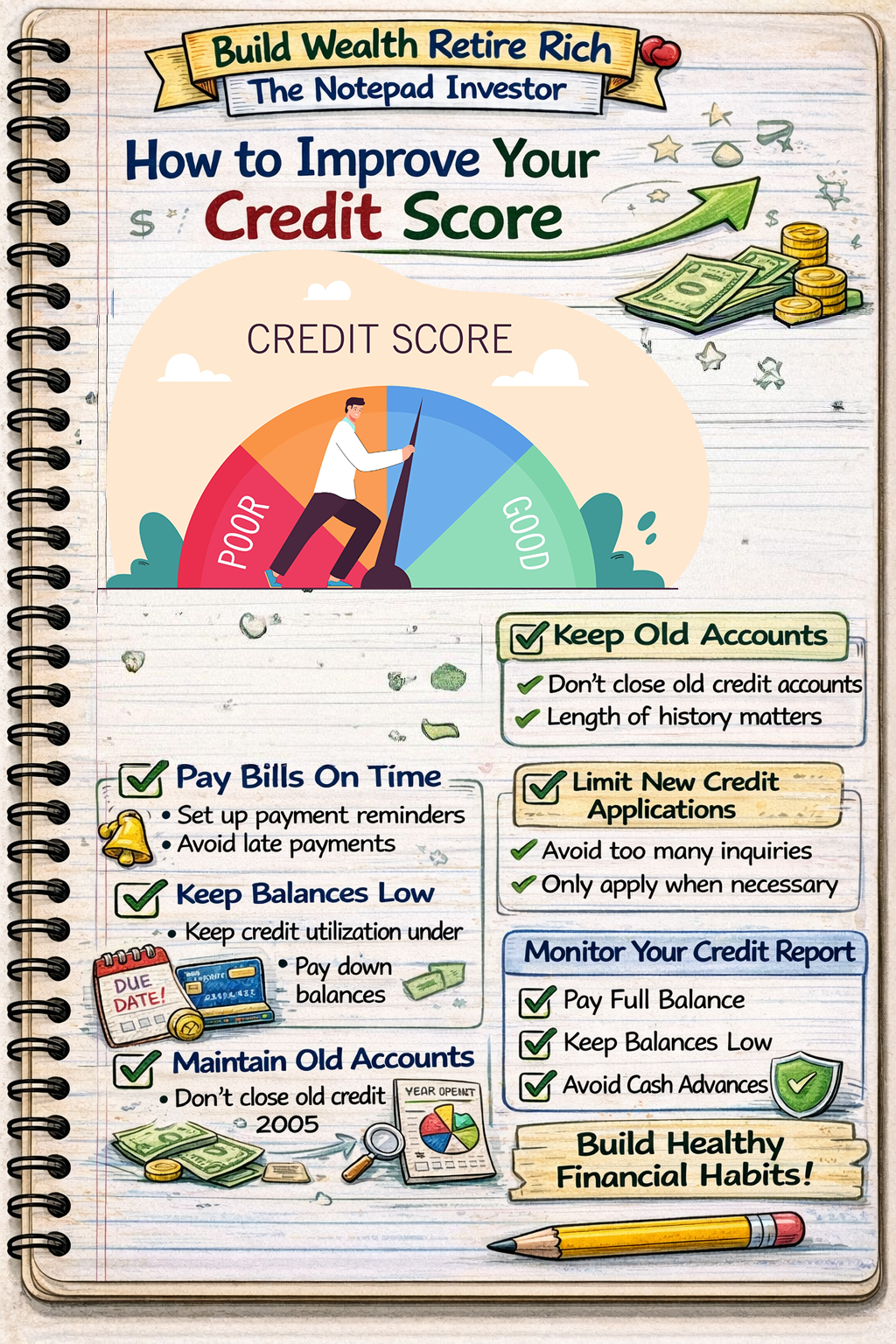
This article is designed for anyone wanting higher credit scores for better loan rates, individuals recovering from credit damage through late payments or collections, or those building credit from scratch or thin files. You do not need perfect financial situations to improve scores—strategic behavior changes produce results regardless of income level or current score, though requires discipline maintaining new habits consistently over months creating gradual improvement through compounding positive behaviors outweighing past negatives, patience understanding that legitimate score improvement takes time not available through quick fixes or credit repair scams promising instant results, and knowledge prioritizing high-impact actions (payment history, utilization) over low-impact factors (credit mix) maximizing improvement per unit effort invested.
Understanding how to improve credit scores matters because even modest increases save thousands in lifetime borrowing costs through lower interest rates, excellent scores enable approval for premium credit products and favorable terms denied to those with fair or poor credit, and strategic improvement prevents wasted effort on low-impact activities while focusing on behaviors producing maximum score gains—while score-improvement-literate individuals achieve 100+ point increases within 12-18 months through targeted utilization reduction and perfect payment records, understand quick timeline expectations by starting point (fair to good faster than poor to fair), and avoid credit repair scams recognizing legitimate improvement requires time and behavior changes not aggressive disputes or payment to third parties, creating efficient score optimization impossible without understanding scoring mechanics and strategic action prioritization.
Educational disclaimer: This article provides general educational information about credit score improvement strategies. Individual score results vary based on complete credit profiles and starting points. Improvement timelines represent typical scenarios with consistent responsible behavior—actual results differ. This is not credit repair services or guarantee of specific score increases. Beware credit repair companies promising guaranteed results or rapid score increases—legitimate improvement requires time and cannot be guaranteed. Consult qualified financial professionals for personalized guidance. Focus on building positive credit behaviors benefiting long-term financial health rather than gaming scoring algorithms or attempting removal of accurate negative information.
Understanding Your Starting Point
Check Your Current Credit Score
Free score sources:
- Credit card issuers: Most provide free FICO scores to cardholders
- Discover Credit Scorecard: Free FICO 8 for everyone (even non-customers)
- Credit Karma: Free VantageScore 3.0 (TransUnion and Equifax)
- Experian app: Free Experian FICO 8
- Your bank or credit union: Many offer free scores
Identify your score range:
- 800-850 (Exceptional): Limited improvement needed, focus on maintenance
- 740-799 (Very Good): Minor optimization possible, already excellent
- 670-739 (Good): Improvement to 740+ achievable in 6-12 months
- 580-669 (Fair): Improvement to 670+ achievable in 12-18 months
- 300-579 (Poor): Improvement to 620+ achievable in 18-24 months
Review Your Credit Reports
Access free reports:
- AnnualCreditReport.com: Official source for free annual reports
- Request from all three bureaus: Equifax, Experian, TransUnion
- Review for errors, fraudulent accounts, inaccuracies
Identify improvement opportunities:
- Payment history issues: Late payments, collections, charge-offs, bankruptcies
- High utilization: Credit card balances near limits (over 30%)
- Short history: Accounts opened recently (under 2 years average age)
- Recent inquiries: Multiple hard pulls in last 6-12 months
- Limited mix: Only credit cards or only loans (not diverse)
- Errors: Accounts not belonging to you, incorrect information
Set Realistic Improvement Goals
Score increase expectations by starting point:
Starting 580-620 (Poor/Fair):
- 6 months: 30-50 point increase to 610-670 range with perfect behavior
- 12 months: 60-80 point increase to 640-700 range
- 24 months: 100-140 point increase to 680-760 range possible
- Requires: Zero late payments, utilization reduction, time passage
Starting 620-670 (Fair/Good):
- 6 months: 40-60 point increase to 660-730 range
- 12 months: 70-100 point increase to 690-770 range
- Requires: Perfect payments, low utilization maintenance
Starting 670-720 (Good):
- 6 months: 20-40 point increase to 690-760 range
- 12 months: 40-70 point increase to 710-790 range
- Diminishing returns at higher scores (less room for improvement)

Priority 1: Perfect Payment History (35% of Score)
Why Payment History Matters Most
Largest scoring factor impact:
- 35% of FICO score from payment history alone
- Single 30-day late payment: 60-110 point drop typical
- Recovery time: 18-24 months to fully recover from one late
- Protection essential: Cannot improve if continuously damaging largest factor
Preventing Late Payments
Strategy 1: Automatic minimum payments (essential safety net)
- Set up automatic minimum payment on ALL credit accounts
- Prevents catastrophic late payment from forgetfulness
- Still manually pay full balances but automatic minimum as backup
- One-time 15-minute setup per account protects 35% of score permanently
Strategy 2: Payment date consolidation
- Call creditors requesting due date changes
- Consolidate all payments to same date or two dates monthly
- Example: All bills due on 1st and 15th (aligned with paychecks)
- Easier tracking and management preventing missed payments
Strategy 3: Calendar reminders and alerts
- Calendar alerts 5 days before each payment due date
- Email/text alerts from creditors when payment due
- Low balance alerts preventing insufficient funds
- Multiple redundancy systems preventing single point of failure
Addressing Existing Late Payments
Recent late payment (under 30 days):
- Pay immediately preventing 30-day reporting threshold
- Call creditor explaining circumstances, request courtesy adjustment
- If first-time late, many creditors offer one-time forgiveness
Reported late payment (30+ days late):
- Cannot remove if accurate but can minimize future damage
- Write goodwill letter to creditor requesting deletion (low success rate but worth trying)
- Focus on perfect payment record going forward
- Impact diminishes over time: Significant first 12 months, minimal after 24 months
Collections or charge-offs:
- Negotiate pay-for-delete before paying (creditor removes from report if paid)
- Get agreement in writing before making payment
- If pay-for-delete rejected, pay anyway (ethical responsibility, helps manual underwriting)
- Paid status better than unpaid though score impact similar on older FICO versions
Priority 2: Reduce Credit Utilization (30% of Score)
Understanding Utilization Impact
Utilization definition:
- Per-card utilization: Balance ÷ credit limit on each card
- Overall utilization: Total balances ÷ total credit limits
- Both matter for scoring algorithms
Utilization thresholds and score impact:
- 1-9% utilization: Optimal for maximum scores (10-20 points higher than 30%)
- 10-29% utilization: Good, minimal score impact
- 30-49% utilization: Fair, noticeable score reduction (20-40 points lower)
- 50-74% utilization: Poor, significant score damage (40-80 points lower)
- 75-100% utilization: Very poor, major score reduction (80-120 points lower)
Example utilization impact on same person:
- $10,000 total credit limits, all other factors constant
- $500 total balances (5% utilization): 760 score
- $3,000 total balances (30% utilization): 730 score (30-point difference)
- $7,000 total balances (70% utilization): 650 score (110-point difference from optimal)
Fast Utilization Reduction Strategies
Strategy 1: Aggressive balance paydown (fastest impact)
- Identify cards over 30% utilization (highest priority)
- Pay down to under 30%, ideally under 10%
- Focuses available payment capacity on highest-utilization cards first
- Results visible within one reporting cycle (30-45 days)
Example paydown plan:
- Card A: $4,500 balance, $5,000 limit (90% utilization) – Priority 1
- Card B: $2,000 balance, $8,000 limit (25% utilization) – Maintain
- Card C: $500 balance, $3,000 limit (17% utilization) – Maintain
- Pay $4,000 to Card A bringing to $500 (10% utilization)
- Score increase: 40-60 points typical from eliminating 90% utilization
Strategy 2: Pay before statement closing date
- Creditors report balance on statement closing date (not payment due date)
- Pay down balances BEFORE statement closes for lower reported utilization
- Example: $5,000 limit card, charge $2,000 monthly but pay $1,500 before statement closing
- Reported balance: $500 (10% utilization) not $2,000 (40% utilization)
- Enables heavy card usage without utilization penalty
Strategy 3: Request credit limit increases
- Call card issuers requesting credit limit increases
- Many approve with soft inquiry (no score impact) for existing good customers
- Increases denominator lowering utilization percentage
- Example: $2,000 balance, $5,000 limit (40%) → limit increased to $8,000 = 25% utilization
- Potential 15-25 point score increase from utilization improvement alone
Strategy 4: Spread balances strategically
- Instead of maxing one card while others sit at zero
- Distribute balances keeping all cards under 30% ideally under 10%
- Example: $6,000 total spending, three $10,000 limit cards
- Bad: $6,000 on Card A (60%), Cards B and C at $0 → overall 20% but per-card 60% damages score
- Good: $2,000 on each card (20% each) → overall 20%, all per-card 20% optimizes score
Maintaining Low Utilization Long-Term
Sustainable practices:
- Pay balances in full monthly (ensures 0% reported if paid before statement)
- Make multiple payments per month if heavy spender
- Set personal utilization alerts (30% threshold warnings)
- Budget ensuring spending doesn’t exceed payment capacity
Priority 3: Build Credit History Length (15% of Score)
How History Length Affects Scores
Age metrics considered:
- Age of oldest account
- Average age of all accounts
- Age of newest account
Optimal age benchmarks:
- 10+ years average: Excellent (maximizes this 15% factor)
- 5-10 years average: Good
- 2-5 years average: Fair (developing history)
- Under 2 years average: Limited history (score ceiling around 680-720)
Building History When Starting from Scratch
Month 0: Open first credit account
- Secured credit card if no approval for regular card ($200-500 deposit)
- Student credit card if in college
- Become authorized user on family member’s old account (instant history)
Month 6: First credit score appears
- Minimum 6 months history required for FICO score
- Typical starting score: 640-680 with perfect payment record
- VantageScore may appear after 1 month but FICO matters more for lending
Month 12-18: Add second account
- Apply for second credit card or small installment loan
- Diversifies credit mix while building history
- Score typically 680-720 range with perfect behavior
Month 24-36: Achieve good-to-excellent scores
- Average account age reaches 2-3 years
- Score potential: 720-760+ with perfect payments and low utilization
Protecting Existing History
Keep old accounts open (critical):
- Closing old accounts eventually lowers average age (after 10 years for FICO)
- Immediately lowers average age for VantageScore
- Reduces total credit limits increasing utilization
- Score impact: 20-40 points from closing oldest account typical
Maintaining unused cards:
- Make small purchase every 6-12 months ($5-10)
- Set up automatic recurring charge (streaming service) and automatic payment
- Prevents issuer closure from inactivity
- Costs zero while preserving account age and credit limits
Authorized User Strategy (Fast History Boost)
How it works:
- Added to someone else’s credit card as authorized user
- Account appears on your credit report with full history
- Inherits account age and payment history
- Instant average age boost if added to old account
Example impact:
- Your accounts: 1 year and 2 years old (average 1.5 years)
- Added as authorized user to parent’s 15-year-old card
- New average: (1 + 2 + 15) ÷ 3 = 6 years
- Score increase: 30-60 points from history length boost
Choosing the right account:
- Old account (7+ years ideal, 10+ years excellent)
- Perfect payment history (zero late payments)
- Low utilization (under 30%, ideally under 10%)
- Trustworthy person (their mismanagement affects your score)
Managing New Credit and Inquiries (10% of Score)
Hard Inquiry Impact
Inquiry effects:
- Each hard inquiry: 5-10 point temporary decrease
- Multiple inquiries compound (3 inquiries = 15-30 point drop)
- Recovery: 3-6 months back to pre-inquiry score
- Remains on report: 2 years but only affects score first 12 months
Strategic application timing:
- Space credit card applications 6+ months apart
- Avoid applications 6-12 months before major borrowing (mortgage, auto)
- Use pre-qualification tools (soft pull, no score impact) before applying
Rate shopping exception:
- Multiple mortgage or auto loan inquiries within 14-45 days count as single inquiry
- Enables rate shopping without penalty
- Does NOT apply to credit cards (each application separate inquiry)
New Account Opening Impact
Effects of new accounts:
- Lowers average account age (adds zero-age account to calculation)
- Creates hard inquiry (5-10 points)
- Signals new credit seeking (10% factor)
- Combined initial impact: 10-25 points typical
- Long-term benefit: Account ages over time, increases total credit limits
Strategic new account approach:
- Only open accounts when genuinely needed or strategically beneficial
- Avoid store card offers at checkout (hard inquiry + minimal benefit)
- Consider 6-12 month waiting period between new accounts
- Recovery timeline: New account impact mostly recovered in 6-12 months as account ages
Optimizing Credit Mix (10% of Score)
Credit Mix Components
Account types:
- Revolving credit: Credit cards, HELOCs, lines of credit
- Installment loans: Mortgages, auto loans, student loans, personal loans
- Mix of both types demonstrates diverse credit management
Optimal mix:
- At least 2-3 credit cards (revolving)
- At least 1-2 installment loans
- Score benefit: 15-25 points from good mix vs credit cards only
Building Mix Strategically
Don’t force it (lowest priority factor):
- Only 10% of score—smallest factor
- Don’t take unnecessary loans just for “credit mix”
- Natural accumulation over time (eventually get auto loan, mortgage)
Credit builder loan option (if building from scratch):
- Small loan ($300-1,000) specifically for credit building
- Low cost, adds installment account to mix
- Payments reported to bureaus building payment history simultaneously
- Available through credit unions, online lenders
Focus priority:
- 80% effort on payment history (35%) and utilization (30%)
- 15% effort on history length (15%)
- 5% effort on new credit (10%) and mix (10%)
Disputing Errors and Inaccuracies
Common Errors Worth Disputing
Account errors:
- Accounts not belonging to you (identity mix-up or fraud)
- Duplicate accounts (same account listed multiple times)
- Incorrect balances or credit limits
- Closed accounts showing as open
Payment history errors:
- Late payments marked incorrectly (you paid on time)
- Payments applied to wrong account
- Late payments exceeding 7-year reporting limit
Personal information errors:
- Wrong addresses creating account confusion
- Incorrect Social Security number
- Accounts from someone with similar name
Dispute Process
Steps to dispute:
- 1. Identify specific error on credit report
- 2. Gather supporting documentation (statements, receipts, correspondence)
- 3. File dispute with bureau(s) showing error (online fastest, mail provides paper trail)
- 4. Bureau investigates (30 days typically)
- 5. Receive results and updated report
What NOT to dispute:
- Accurate negative information (real late payments you made)
- Legitimate collections or charge-offs
- Accurate public records (bankruptcies actually filed)
- Disputes of accurate information waste time and won’t succeed
Expected Results from Error Corrections
Score impact of removals:
- Incorrect late payment removed: 40-80 point increase typical
- Fraudulent account removed: 30-100 points depending on account
- Duplicate account removed: 10-30 points
- Wrong credit limit corrected: 15-40 points if improves utilization
Timeline and Expectations
Realistic Improvement Timelines by Scenario
Scenario 1: Fair credit recovering from late payments
- Starting score: 620
- Issue: 2-3 late payments in last 18 months, 45% utilization
- Actions: Perfect payments from now on, reduce utilization to 8%
- 3 months: 640 score (20-point increase from utilization reduction)
- 6 months: 665 score (45-point increase, late payments aging)
- 12 months: 700 score (80-point increase total)
- 24 months: 740+ score (120+ points, late payments minimal impact)
Scenario 2: Thin file building from scratch
- Starting score: None (no credit history)
- Actions: Open secured card, authorized user on 10-year-old account, perfect payments
- 6 months: 680 score appears (authorized user boost plus own perfect record)
- 12 months: 720 score (established history, perfect behavior)
- 24 months: 750+ score (solid history, multiple accounts)
Scenario 3: Good credit optimizing to excellent
- Starting score: 700
- Issue: 35% utilization, one 60-day late payment 3 years ago
- Actions: Reduce utilization to 5%, request limit increases, maintain perfect payments
- 3 months: 730 score (30-point increase from utilization)
- 6 months: 750 score (50-point increase)
- 12 months: 770 score (70-point increase, old late barely impacting)
What You Can and Cannot Control
Controllable factors (focus here):
- Future payment behavior (can guarantee perfection)
- Credit utilization (can reduce immediately)
- New credit applications (can avoid or space strategically)
- Keeping accounts open (simple decision)
Time-dependent factors (patience required):
- Account age (cannot accelerate, only preserve)
- Negative item aging (7-10 years for removal, impact diminishes over 24 months)
- Inquiry aging (12 months to stop affecting score)
Uncontrollable past (acceptance needed):
- Accurate late payments (cannot remove, only wait for aging)
- Legitimate collections (can pay but reporting remains 7 years)
- Bankruptcies (7-10 years reporting, impact fades over time)
Why Understanding Credit Score Improvement Matters
Without understanding how to improve credit scores, individuals waste effort on low-impact activities while neglecting high-leverage behaviors, fall victim to credit repair scams promising impossible instant results, and miss strategic opportunities like utilization reduction producing 30-60 point increases within weeks—while score-improvement-literate individuals prioritize payment protection (35% of score) and utilization reduction (30%) driving 65% of scores, understand realistic timelines by starting point preventing frustration from unrealistic expectations, and avoid wasted money on credit repair services recognizing legitimate improvement requires time and behavior changes not payment to third parties, creating efficient score optimization saving thousands in lower borrowing costs through strategic factor-weighted approach impossible without understanding scoring mechanics and improvement methodologies.
Understanding how to improve credit scores enables individuals to:
- Achieve 100+ point increases within 12-24 months through strategic behavior targeting
- Prioritize high-impact actions (payment history, utilization) over low-impact factors
- Set realistic expectations preventing frustration from impossible timeline assumptions
- Avoid credit repair scams recognizing legitimate improvement cannot be guaranteed or rushed
- Implement fast-result strategies like utilization reduction producing visible gains within weeks
- Understand time-dependent factors requiring patience not immediate action
- Save thousands in lifetime borrowing costs through excellent score achievement
Credit score improvement knowledge transforms scores from mysterious unchangeable numbers into understood optimizable metrics responding predictably to strategic behaviors enabling deliberate improvement through factor-weighted approach impossible without understanding calculation mechanics and prioritization framework.
Common Misunderstandings
Many people assume credit repair companies can quickly remove accurate negative information for fees. In reality, legitimate companies can only dispute actual errors which consumers can do free themselves, accurate negative information legally reportable cannot be removed despite aggressive disputes, and credit repair scam companies promising guaranteed results or rapid score increases violate federal law (Credit Repair Organizations Act), proving credit repair services offer minimal value over free self-disputing for actual errors while charging $50-150 monthly creating unnecessary expense without guaranteed results.
Another common misconception is closing credit cards improves scores by “reducing available debt.” In practice, closing cards immediately increases utilization (lower total credit limits with same balances) and eventually reduces average account age both damaging scores 20-40 points typically, proving keeping old cards open even if unused superior strategy maintaining high total credit enabling low utilization percentages versus closing based on false belief that unused credit represents risk when algorithms reward available credit not absolute limits.
Some believe checking own credit score damages scores. However, self-checks through official channels (card issuers, Credit Karma, AnnualCreditReport.com) count as soft inquiries with zero score impact ever—only lender credit checks when applying for new credit (hard inquiries) affect scores modestly and temporarily, proving unlimited self-monitoring encouraged for tracking improvement impossible when avoided based on false belief that checking hurts creating vulnerability to undetected score changes or errors.
How Credit Score Improvement Fits Into Financial Success
Credit score improvement enables access to lowest-cost borrowing saving hundreds of thousands in lifetime interest through excellent scores, provides approval for premium opportunities denied to fair or poor credit holders, and creates financial flexibility through credit access at optimal terms—making score optimization essential component of comprehensive financial success requiring understanding of five weighted factors enabling strategic prioritization, realistic timeline expectations preventing frustration, and disciplined execution of high-impact behaviors (payment perfection, utilization reduction) producing measurable results within months creating borrowing cost advantages impossible without score knowledge and strategic improvement implementation.
For example, two individuals both age 28 wanting to buy homes. Person A has 640 score from past financial struggles including late payments 2 years ago and current 55% credit card utilization on $8,000 total balances. Lacks improvement knowledge, continues paying minimums maintaining high utilization, assumes score unchangeable without years of waiting. Applies for mortgage age 30 with 645 score (minimal improvement from time passage only). Approved for $300,000 mortgage at 7.5% APR (subprime rate due to fair credit), monthly payment $2,098, total interest over 30 years $455,163. Person B starts identical situation age 28 with 640 score, same late payment history, same $8,000 balances at 55% utilization. Understands score improvement mechanics, creates strategic plan: Aggressively pays down credit card balances to $800 (10% utilization) over 6 months using side income and spending cuts, sets up automatic payments guaranteeing perfect payment record, requests credit limit increases on all cards further lowering utilization, becomes authorized user on parent’s 12-year-old account boosting average age. Timeline: 3 months score increases to 680 (utilization reduction primary driver), 6 months score reaches 710 (continued perfect payments, utilization maintenance, authorized user boost), 12 months score achieves 735 (combination of all factors plus late payment aging), 18 months score hits 755. Applies for mortgage age 30 with 755 score. Approved for same $300,000 mortgage at 6.25% APR (excellent credit rate), monthly payment $1,847, total interest over 30 years $364,806. Difference from Person A: $251/month lower payment ($2,098 vs $1,847), $90,357 less total interest over 30 years ($455,163 vs $364,806) from 110-point score improvement achieved in 18 months through strategic behavior targeting high-impact factors. Both started identical positions, Person A’s lack of improvement knowledge cost $90,000+ through accepting fair credit as unchangeable, Person B’s score literacy enabled strategic 110-point increase in 18 months saving over $90,000 through understanding utilization reduction (30% of score) and payment protection (35%) driving majority of score calculation making targeted improvement possible versus vague hoping for gradual improvement without strategic action.
Credit score improvement understanding separates strategic optimizers achieving dramatic increases within months through factor-weighted approaches from passive hopers accepting current scores as fixed or falling victim to credit repair scams versus recognizing improvement requires knowledge, discipline, and time but produces measurable results when proper behaviors applied systematically.
Recent Updates and Trends
In recent years, FICO 10T and VantageScore 4.0 have incorporated trended data analyzing 24+ months of balance patterns rewarding those paying down debt and penalizing those building balances monthly, though adoption remains limited with most lenders using older FICO versions making trended data impact minimal for most consumers currently despite algorithmic improvements in newer models.
Credit score transparency has improved with most major credit card issuers now providing free FICO scores to cardholders versus historical paid-only access, enabling better tracking of improvement efforts and earlier detection of score changes though creating confusion about score variations between monitoring and lending decision scores requiring model differentiation education.
Alternative data integration has expanded through programs like Experian Boost allowing consumers to add utility and phone payments to reports potentially improving scores for thin-file consumers, though requiring opt-in and producing modest score impacts (typically 10-20 points) making it supplementary not primary improvement strategy.
Credit repair regulation enforcement has intensified with FTC crackdowns on companies making false promises about guaranteed results or rapid score increases, though scam companies continue proliferating requiring consumer awareness distinguishing legitimate dispute assistance from illegal credit repair schemes.
Fundamental improvement principles remain timeless: payment history (35%) and utilization (30%) drive majority of scores making them primary improvement targets, time heals negative items but strategic behavior accelerates improvement, and legitimate score increases require consistent responsible behavior over months not quick fixes or aggressive disputes—regardless of scoring model evolution, free score proliferation, alternative data expansion, or credit repair scam persistence, understanding five weighted factors, implementing strategic high-impact behaviors, and maintaining realistic timeline expectations produces superior outcomes through efficient improvement targeting highest-leverage factors impossible without scoring mechanics knowledge and disciplined execution.
3 Things You Can Do Today
Ready to improve your credit score? Here are three simple steps you can take right now:
1. Check your current credit utilization and create immediate reduction plan if over 30% – Log into all credit card accounts documenting: Current balance, credit limit, calculate per-card utilization (balance ÷ limit), calculate overall utilization (total balances ÷ total limits). Identify problem areas: Any card over 50% (critical priority representing massive score drag), overall over 30% (action needed). Example current situation: Card A $4,000/$5,000 (80%), Card B $1,500/$8,000 (19%), Card C $500/$3,000 (17%), total $6,000/$16,000 (38% overall). Create paydown plan: Pay $3,500 to Card A bringing to $500 (10%), resulting overall 13% ($2,500/$16,000). Expected score impact: 40-60 points within one reporting cycle (30-45 days) from eliminating 80% utilization and bringing overall under 30%. Bonus strategy: Request limit increases on Cards B and C potentially increasing to $10,000 and $5,000 respectively making limits $21,000 total = 12% utilization even before additional payments. Takes 20 minutes identifying utilization creating concrete action plan producing fastest visible score improvement possible (30-60 points in weeks) versus all other strategies requiring months making utilization reduction highest-ROI immediate action for anyone over 30% utilization.
2. Set up automatic minimum payments on ALL credit accounts preventing catastrophic score damage from missed payments – List every credit account: Credit cards, auto loans, student loans, personal loans, mortgages—everything reporting to credit bureaus. For each account: Log in online, navigate to automatic payment settings, configure automatic MINIMUM payment from checking account (not full payment unless certain balance will always be payable, minimum as safety net), verify checking account linked correctly, set payment date 2-3 days before due date. Enable backup systems: Low checking balance alerts (warns before automatic payment processes), payment confirmation emails (verifies processing), calendar reminders 5 days before payments as additional backup. This protects 35% of credit score (largest single factor) from catastrophic damage—single missed payment drops scores 60-110 points taking 18-24 months recovery versus 30 minutes one-time setup preventing disaster permanently. Still manually pay full balances targeting zero interest but automatic minimums as failsafe preventing human error, forgotten payments, or life disruptions (illness, travel, emergencies) from destroying scores through missed payment. Takes 15 minutes per account (total 60-90 minutes for most people) creating permanent protection of highest-weighted score factor impossible to recover from quickly if damaged making prevention through automation essential.
3. Review credit reports from all three bureaus identifying and disputing any errors within 30 days – Visit AnnualCreditReport.com requesting reports from Equifax, Experian, and TransUnion (all three free annually). Download PDF copies for records. Review systematically: Personal information section (correct name, addresses, SSN?), account section (every account belongs to you? balances accurate? closed accounts not showing as open?), payment history (any late payments incorrectly marked?), inquiries (recognize all hard pulls?), collections and public records (any you don’t recognize or already paid but showing unpaid?). Common errors requiring disputes: Accounts from identity mix-up (similar names/addresses), duplicate accounts (same account listed twice), incorrect late payments (you paid on time but marked late), wrong balances or credit limits (affects utilization), information exceeding reporting limits (7 years most negatives, 10 years bankruptcies). File disputes immediately: Online at bureau websites (fastest), or certified mail (paper trail for serious issues), include supporting documentation (statements, receipts, correspondence). Expected results within 30 days: Error removed = 20-100 point score increase depending on error severity, or investigation confirms accuracy = item remains. Takes 60 minutes reviewing three reports, 15 minutes per dispute filed, potentially 40-100 points recovered if errors found and corrected making annual review essential for score optimization catching errors before they damage scores during loan applications when discovery too late for timely correction.
These actions create immediate score improvement foundation within 2-3 hours—identified and planned utilization reduction producing 40-60 points within weeks (if currently over 30%), implemented automatic payment protection preventing 60-110 point catastrophic drops from missed payments (protecting 35% of score permanently), and reviewed reports filing disputes on any errors potentially recovering 40-100 points from corrections—transforming credit score from mysterious unchangeable number into actively managed optimized metric through strategic high-impact actions targeting largest scoring factors producing measurable improvements impossible without understanding factor weights and prioritization enabling efficient improvement.
Quick FAQ
How long does it take to improve credit score?
Depends on starting point and issues addressed: Utilization reduction (if over 30%) = 30-60 point increase within one reporting cycle (30-45 days), fastest improvement available. New positive account opening = 6 months for first score impact, 12-24 months for solid improvement. Late payment recovery = Significant recovery in 3-6 months with perfect subsequent behavior, full recovery 18-24 months, remains on report 7 years but impact diminishes. Overall timeline by starting score: Fair (620-670) to good (670-740) = 12-18 months with perfect behavior, poor (below 620) to fair = 18-24 months, fair to excellent (740+) = 24-36 months. Key factors: Perfect payment record essential (single late payment sets back months), low utilization maintenance (under 30% ideally under 10%), time passage allowing negative items to age. Realistic expectations: 50-80 point increases achievable in 6-12 months with strategic behavior, 100+ point increases possible in 12-24 months, avoid credit repair promises of guaranteed or rapid increases (scams).
Can credit repair companies really improve my score quickly?
No—legitimate credit repair companies can only dispute errors which you can do free yourself, accurate negative information cannot be removed despite aggressive disputes, and companies promising guaranteed results or rapid score increases violate federal law (Credit Repair Organizations Act prohibiting misleading promises). Reality: Credit repair companies charge $50-150 monthly to submit disputes you could file free at AnnualCreditReport.com or bureau websites directly, success limited to actual errors not legitimate negative items, most consumers can self-dispute effectively without paying services. Legal requirements: Cannot charge fees before services rendered, must provide written contract with cancellation rights, cannot make false claims about capabilities. Red flags indicating scam: Guaranteed score increases, promises to remove accurate negative information, demands upfront payment, suggests creating new credit identity (illegal). Better approach: Check credit reports yourself identifying actual errors (wrong accounts, incorrect payments, outdated information), file free disputes directly with bureaus, implement strategic improvement behaviors (utilization reduction, payment protection) producing legitimate increases versus paying hundreds for minimal value disputing accurate information unsuccessfully.
What’s the fastest way to increase credit score?
Reduce credit card utilization if currently over 30%—typically produces 30-60 point increase within 30-45 days (one reporting cycle): Calculate current utilization (balances ÷ limits), pay down high-utilization cards to under 30% ideally under 10%, request credit limit increases raising denominators, results visible within one statement cycle when lower balances reported. Example: $8,000 balances on $10,000 limits (80% utilization damaging score 60+ points), pay down $6,000 bringing to $2,000 (20% utilization) = 40-60 point increase within 6 weeks. Second fastest: Dispute actual errors on credit reports (wrong accounts, incorrect late payments) = results within 30 days, potential 40-100 point increase if significant errors corrected. Third: Become authorized user on old account with perfect history = immediate history boost, 30-60 point increase within 1-2 reporting cycles. Slowest but essential: Perfect payment record protecting 35% of score (single late payment drops 60-110 points), keeping old accounts open maintaining history length. Time required: Utilization reduction if over 30% produces fastest measurable results (weeks not months), other strategies require 3-24 months depending on starting point and consistency.
Should I close credit cards I’m not using to improve my score?
No—closing cards typically damages scores not improves: Immediately reduces total credit limits increasing utilization percentage (example: $2,000 balances, close $5,000 limit card reducing total limits from $15,000 to $10,000, utilization increases from 13% to 20% potentially dropping score 15-25 points), eventually reduces average account age when closed account falls off report (10 years for FICO, immediate for VantageScore), removes positive payment history contribution. Score impact from closing: 20-40 points typical especially if closing oldest or highest-limit card. Better strategy: Keep old no-annual-fee cards open indefinitely, make small purchase every 6-12 months preventing issuer closure from inactivity ($5-10 charge with automatic payment setup), costs zero while preserving credit limits (enables low utilization) and account ages (maximizes history length). Exception where closing acceptable: High annual fee card ($450+) not providing value justifying cost, multiple similar cards creating unmanageable complexity when have several no-fee alternatives. General rule: Keep old cards open, only close newest cards if absolutely necessary, never close oldest account or highest-limit card as these provide maximum score benefit through history length and utilization optimization.
How much will becoming an authorized user improve my score?
Typically 30-60 points if added to old account with perfect history though varies by starting score and account characteristics: Authorized user strategy adds account to your credit report inheriting full history and payment record instantly. Impact depends on: Account age (adding 10+ year account to thin file creates substantial average age boost versus adding 2-year account minimal impact), your current average age (1-year average boosted to 5-year average = significant vs 8-year average to 9-year average = minimal), payment history (perfect record helps, late payments hurt), utilization on account (low utilization better than high). Example high-impact scenario: Starting thin file with 1-year average age, added to 15-year-old card with perfect history and 10% utilization = 40-60 point increase bringing score from 680 to 720-740 range. Example low-impact scenario: Already established 8-year average age, added to 5-year-old account = 10-20 point increase (account younger than current average, minimal boost). Risks: If authorized user account develops late payments or high utilization, damages your score (choose trustworthy person managing account responsibly), some lenders discount authorized user accounts in manual underwriting (less weight than individually owned accounts). Best practice: Choose oldest account possible (10+ years ideal) with perfect history and low utilization from trustworthy family member for maximum impact.
Explore More in Money Basics
Disclosure
This article provides general educational information about credit score improvement strategies and timelines. Individual score results vary significantly based on complete credit profiles, starting points, consistency of behavior changes, and other factors. Improvement timelines represent typical scenarios with perfect behavior—actual results differ. Score increase ranges represent averages—some individuals experience larger or smaller changes. This is not credit repair services, guarantee of specific score improvements, or financial advice. Credit Repair Organizations Act prohibits companies from making guarantees about score improvements or charging upfront fees. Beware credit repair scams promising guaranteed results or rapid increases—legitimate improvement requires time and consistent behavior changes. Dispute processes and timelines represent general guidelines—actual experiences vary by bureau and situation. Authorized user strategy effectiveness varies—some lenders discount authorized user accounts. Free credit score sources provide monitoring scores potentially differing from lending decision scores. Utilization impact estimates based on research and typical scenarios—individual results vary. Consult qualified financial professionals or credit counselors for personalized guidance matching individual circumstances. Focus on building sustainable positive credit behaviors rather than attempting quick fixes or gaming scoring algorithms. Product recommendations and strategies presented for educational purposes only. Advertisements or sponsored content may appear within or alongside this content. All information presented independently for educational purposes only.