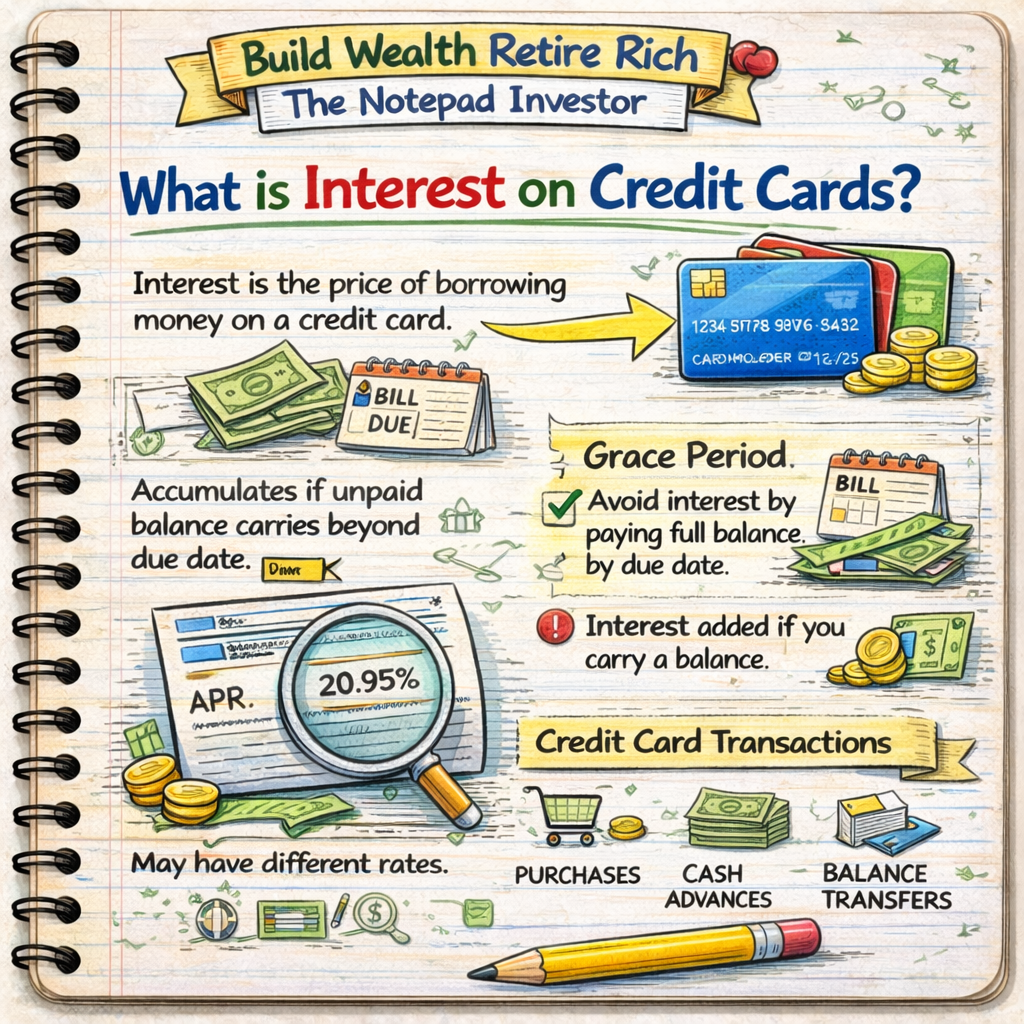
Interest on credit cards represents the cost of borrowing money when balances remain unpaid beyond grace periods—calculated daily through dividing Annual Percentage Rate (APR) by 365 creating daily periodic rate multiplied by average daily balance then compounded continuously resulting in monthly interest charges added to outstanding balances. Ranging typically from 15-29.99% APR depending on creditworthiness and card type, credit card interest rates dramatically exceed other consumer debt (mortgages 6-8%, auto loans 4-12%, personal loans 8-18%) making credit cards most expensive borrowing method when balances carried monthly rather than paid in full during 21-25 day grace periods avoiding interest entirely. Understanding interest mechanics reveals true cost of minimum payments creating debt persistence—$5,000 balance at 18% APR paying only minimums takes 15+ years and $6,000+ total interest versus aggressive $500 monthly payments eliminating debt in 11 months with $500 interest, demonstrating how payment strategy dramatically affects total costs making interest calculation knowledge essential for anyone carrying balances or considering charging purchases beyond immediate payoff capacity.
This article is designed for anyone carrying credit card balances paying interest monthly, individuals wanting to understand true costs of minimum payments, or those seeking strategies eliminating interest charges through payoff acceleration or balance transfers. You do not need mathematical expertise to understand credit card interest—fundamental calculation concepts accessible through clear examples and explanations, though requires attention to compounding mechanics and payment timing revealing how seemingly manageable minimum payments create perpetual debt through interest exceeding principal reduction early in payoff timeline making aggressive payment strategy essential for debt elimination impossible through minimum-only approach maintaining balances indefinitely while enriching card issuers through continuous interest revenue.
Understanding credit card interest matters because minimum payment trap keeps balances persisting for decades costing thousands in total interest, grace period mechanics reveal how to avoid all interest through full monthly payments, and strategic payoff methods (avalanche vs snowball) optimize interest minimization saving hundreds to thousands versus random payment approaches—while interest-literate individuals either avoid interest entirely through disciplined full payments or aggressively eliminate existing balances through understanding true costs and strategic acceleration, creating savings of thousands in avoided interest costs versus those carrying balances indefinitely through minimum payments lacking understanding of compounding mathematics making debt elimination nearly impossible without payment strategy changes addressing root causes of balance accumulation.
Educational disclaimer: This article provides general educational information about credit card interest calculations and costs. Individual card APRs, terms, and calculation methods vary by issuer. Interest rate ranges represent typical market rates—actual rates depend on creditworthiness and card type. This is not financial advice, credit counseling, or debt management services. Consult qualified financial professionals for personalized guidance. Focus on legitimate payoff strategies through increased payments and spending control rather than attempting interest avoidance through payment timing manipulation or balance transfer churning creating additional fees and complexity.
How Credit Card Interest Works
Annual Percentage Rate (APR)
APR definition:
- Yearly cost of borrowing expressed as percentage
- Standard comparison metric across credit products
- Includes interest rate plus some fees (varies by card)
- Not same as interest rate but often used interchangeably for credit cards
Typical APR ranges by creditworthiness:
- Excellent credit (750+ score): 15-18% APR
- Good credit (670-749): 18-22% APR
- Fair credit (580-669): 22-25% APR
- Poor credit (below 580): 25-29.99% APR or denied
Variable vs fixed APR:
- Variable APR (most cards): Prime rate + margin (example: 11% prime + 13% margin = 24% APR), changes when Federal Reserve adjusts rates
- Fixed APR (rare): Doesn’t fluctuate with prime rate but issuer can change with 45-day advance notice
Daily Periodic Rate Calculation
Converting APR to daily rate:
- Formula: APR ÷ 365 days = Daily Periodic Rate (DPR)
- Example: 18% APR ÷ 365 = 0.0493% daily rate
- Expressed as decimal: 0.18 ÷ 365 = 0.000493
Why daily rate matters:
- Credit cards calculate interest daily not monthly
- Each day’s balance × daily rate = that day’s interest charge
- Daily interest added to balance creating compounding
- 30-day month accumulates 30 separate daily interest charges
Average Daily Balance Method
Standard calculation approach used by most issuers:
Step-by-step calculation:
- 1. Track balance each day during billing cycle
- 2. Sum all daily balances
- 3. Divide sum by number of days in cycle = average daily balance
- 4. Multiply average daily balance × daily periodic rate × days in cycle = monthly interest
Example calculation:
- Billing cycle: 30 days
- Starting balance: $2,000 (days 1-15)
- $500 payment made day 15, new balance $1,500 (days 16-30)
- Sum of daily balances: ($2,000 × 15 days) + ($1,500 × 15 days) = $30,000 + $22,500 = $52,500
- Average daily balance: $52,500 ÷ 30 days = $1,750
- APR: 18%, daily rate: 0.000493
- Monthly interest: $1,750 × 0.000493 × 30 = $25.88
Compounding Effect
How interest compounds daily:
- Day 1: $2,000 balance × 0.000493 = $0.99 interest added
- Day 2: $2,000.99 balance × 0.000493 = $0.99 interest (slightly higher from compounding)
- Day 30: Total interest accumulated approximately $30 on $2,000 balance
- Next month: Interest charged on $2,030 balance if not paid, compounding continues
Long-term compounding impact:
- $5,000 balance at 18% APR with no payments
- Year 1: $5,000 grows to $5,978 ($978 interest)
- Year 2: $5,978 grows to $7,053 ($1,075 additional interest)
- Year 5: Original $5,000 becomes $11,423 ($6,423 total interest)
- Demonstrates debt explosion without payments addressing accumulation

Grace Periods and Avoiding Interest
How Grace Periods Work
Grace period definition:
- Time between statement closing date and payment due date
- Typically 21-25 days
- Interest-free period if balance paid in full by due date
- Only applies to purchases (not cash advances or balance transfers)
Example grace period timeline:
- January 1-31: Billing cycle, make purchases totaling $1,500
- January 31: Statement closes showing $1,500 balance
- February 1-25: Grace period (25 days)
- February 25: Payment due date
- If pay $1,500 by February 25: Zero interest charged on purchases
Maintaining Grace Period
Requirements for grace period:
- Pay previous statement balance in full by due date
- Card starts with grace period (some cards for poor credit lack grace periods)
- Not carrying balance from previous cycle
How grace period is lost:
- Carry balance from previous statement (pay less than full amount)
- Grace period lost on new purchases immediately
- Interest begins accruing on new purchases from transaction date
- Remains lost until balance paid to zero and full payment made
Example of losing grace period:
- January statement: $1,500 balance
- Pay $1,000 instead of $1,500 (carry $500 balance)
- February purchases: $800 charged, interest begins immediately
- February interest: Charged on $500 carried + $800 new purchases from transaction dates
- Even though made $1,000 payment, grace period lost by not paying full statement balance
Regaining Grace Period
Steps to restore grace period:
- 1. Pay balance to zero (all charges and interest)
- 2. Pay next statement balance in full by due date
- 3. Grace period restored for following billing cycle
- Typically takes 1-2 billing cycles to fully restore
Zero interest strategy:
- Treat credit card like debit card: Charge only what you can pay in full
- Pay full statement balance every month without exception
- Grace period maintained indefinitely
- Zero interest paid ever while earning rewards
The Minimum Payment Trap
How Minimum Payments Are Calculated
Typical minimum payment formulas:
- Percentage method: 1-3% of balance (whichever greater: percentage or fixed minimum)
- Interest plus percentage: All interest + 1% of principal
- Fixed minimum: $25-$35 if percentage calculation yields less
Example minimum calculation:
- Balance: $3,000
- APR: 18% (1.5% monthly interest = $45)
- Minimum: Greater of 2% of balance ($60) or $25
- Required minimum payment: $60
True Cost of Minimum Payments
$5,000 balance at 18% APR, minimum payments only:
- Minimum payment starts at $125 (2.5% of balance)
- Monthly interest: $75 initially
- Principal reduction: Only $50 first month ($125 – $75 interest)
- Payoff time: 15 years, 3 months
- Total interest paid: $6,068
- Total amount paid: $11,068 ($5,000 + $6,068)
Why minimum payments keep debt persistent:
- Early months: Majority of payment goes to interest not principal
- Example month 1: $125 payment, $75 interest, $50 principal
- Balance reduces slowly: $5,000 → $4,950 after month 1
- As balance decreases, minimum payment decreases proportionally
- Lower payments mean even slower principal reduction
- Creates self-perpetuating cycle keeping debt alive for decades
Aggressive Payment Comparison
Same $5,000 at 18% APR with different payment strategies:
Minimum only ($125 starting, decreasing):
- Time: 15 years, 3 months
- Total interest: $6,068
- Total paid: $11,068
Fixed $150 monthly:
- Time: 4 years, 7 months
- Total interest: $3,148
- Total paid: $8,148
- Savings vs minimum: $2,920 interest, 10+ years faster
Fixed $300 monthly:
- Time: 1 year, 10 months
- Total interest: $888
- Total paid: $5,888
- Savings vs minimum: $5,180 interest, 13+ years faster
Fixed $500 monthly:
- Time: 11 months
- Total interest: $502
- Total paid: $5,502
- Savings vs minimum: $5,566 interest, 14+ years faster
Key insight: Doubling payment more than halves total interest and time
Breaking the Minimum Payment Cycle
Payment acceleration strategies:
- Pay same amount monthly even as minimum decreases
- Add $25-50 to minimum payment creating faster principal reduction
- Make bi-weekly payments (26 half-payments = 13 full payments annually vs 12)
- Apply windfalls (tax refunds, bonuses) directly to principal
- Round up payments (minimum $127 → pay $150 or $200)
Multiple APRs on Single Card
Purchase APR
Standard rate for regular purchases:
- Applies to everyday purchases (groceries, gas, retail)
- Benefits from grace period if balance paid in full
- Typically lowest APR on card (15-25% range)
Cash Advance APR
Higher rate for cash withdrawals:
- Typically 25-30% APR (higher than purchase rate)
- No grace period—interest starts immediately from transaction date
- Cash advance fee: 3-5% of amount or $10 minimum
- Extremely expensive borrowing method
Example cash advance cost:
- Withdraw $500 cash from credit card
- Cash advance fee: $25 (5%)
- APR: 28% (0.0767% daily)
- Interest for 30 days: $500 × 0.000767 × 30 = $11.51
- Total cost in one month: $500 + $25 fee + $11.51 interest = $536.51
- Effective cost: 7.3% for 30-day borrowing, 87% annualized
Balance Transfer APR
Promotional or standard rate for transferred balances:
- Often promotional 0% APR for 12-21 months
- Balance transfer fee: 3-5% of amount transferred
- After promo ends: Reverts to standard APR (often higher than purchase rate)
- Strategic debt payoff tool if used correctly
Example balance transfer:
- Transfer $5,000 from 22% card to 0% promotional card
- Balance transfer fee: $200 (4%)
- 0% APR for 18 months
- Pay $300 monthly = fully paid in 17 months
- Total cost: $5,200 ($5,000 + $200 fee)
- Savings vs keeping on 22% card: $1,200+ in avoided interest
Penalty APR
Punitive rate for late payments or violations:
- Up to 29.99% APR (maximum legal rate)
- Triggered by: 60+ days late payment, returned payments, exceeding credit limit
- Can apply to existing balance plus future purchases
- May be permanent or temporary (6+ months before review)
Penalty APR impact:
- $3,000 balance at 18% APR: $45 monthly interest
- Penalty APR applied, now 29.99%: $75 monthly interest
- Extra $30 monthly ($360 annually) from single late payment trigger
Promotional APR
Temporary introductory rates:
- 0% APR for 12-21 months common on new accounts
- Applies to purchases, balance transfers, or both
- After promo period: Reverts to standard APR (typically 18-25%)
- Deferred interest risk: Some promotions charge ALL interest retroactively if not paid by end
Deferred interest trap:
- Store card: $2,000 purchase, “no interest if paid in full within 12 months”
- Actually deferred interest not true 0% (interest accruing in background)
- Pay $1,999 by month 12 ($1 short of full amount)
- Charged ALL 12 months of interest retroactively ($360+ at 24% APR)
- Must pay ENTIRE balance to avoid this trap
Strategies to Minimize or Eliminate Interest
Strategy 1: Pay in Full Monthly (Zero Interest)
Permanent zero-interest approach:
- Charge only what you can pay from current income
- Pay full statement balance every month
- Maintain grace period indefinitely
- Zero interest paid ever while earning rewards
Implementation:
- Set up automatic full statement balance payment
- Budget ensuring spending doesn’t exceed income
- Use credit card as payment method not credit source
- Maintain checking buffer preventing overdrafts
Strategy 2: Debt Avalanche Method (Minimize Total Interest)
Pay highest APR debt first:
- List all debts from highest to lowest APR
- Pay minimums on all cards
- Apply extra payment to highest APR card
- When paid off, attack next highest APR
- Mathematically optimal for minimizing total interest
Example avalanche approach:
- Card A: $3,000 at 24% APR
- Card B: $5,000 at 18% APR
- Card C: $2,000 at 15% APR
- Available for debt payments: $600 monthly
- Pay minimums on B ($125) and C ($50), $425 to Card A (24%)
- Card A paid in 8 months, then attack Card B
- Total interest: $2,100 avalanche vs $2,600 paying equal amounts
Strategy 3: Debt Snowball Method (Psychological Wins)
Pay smallest balance first:
- List debts smallest to largest balance (ignore APR)
- Pay minimums on all except smallest
- Attack smallest balance aggressively
- When eliminated, roll payment to next smallest
- Creates quick wins and momentum
Avalanche vs snowball trade-off:
- Avalanche: Saves most interest (mathematically optimal)
- Snowball: Better motivation (psychological optimal)
- Interest difference often modest ($200-500 on $10,000 debt)
- Choose based on personality: analytical (avalanche) vs motivation-driven (snowball)
Strategy 4: Balance Transfer to 0% Card
Using promotional rates strategically:
- Transfer high-interest balances to 0% promotional card
- Pay balance transfer fee (3-5%) upfront
- Aggressively pay down during 0% period (12-21 months)
- Eliminate debt before promo ends avoiding high standard APR
Balance transfer calculation:
- $8,000 balance at 22% APR on current card
- Transfer to 0% card (18 months), 4% fee = $320
- Pay $467 monthly for 18 months = $8,406 total vs $10,200+ on original card
- Savings: $1,800 in avoided interest minus $320 fee = $1,480 net savings
Balance transfer warnings:
- Don’t make new purchases on 0% card (may not have grace period during promo)
- Calculate required monthly payment to pay off before promo ends
- One late payment can void 0% rate immediately
- Don’t transfer then continue charging on old card (defeats purpose)
Strategy 5: Negotiate Lower APR
Direct negotiation with issuer:
- Call customer service requesting rate reduction
- Mention: Good payment history, competitive offers from other issuers, financial hardship
- Success rate: 50-70% for customers in good standing
- Typical reduction: 2-5 percentage points
Example negotiation impact:
- $4,000 balance, current 22% APR, negotiated to 18% APR
- Paying $200 monthly at 22%: 25 months, $956 interest
- Same $200 monthly at 18%: 24 months, $763 interest
- Savings: $193 from single phone call negotiation
Interest Calculation Examples
Example 1: Simple Purchase with Full Payment
Scenario:
- Make $1,000 purchase on Day 1 of billing cycle
- Statement closes Day 30 showing $1,000 balance
- Pay $1,000 in full by Day 55 (payment due date)
- Card APR: 18%
Interest charged: $0
- Grace period maintained by paying full statement balance
- No interest despite 30-day billing cycle plus 25-day grace period
Example 2: Carried Balance with Minimum Payment
Scenario:
- Previous balance: $2,500
- APR: 20%
- Daily rate: 20% ÷ 365 = 0.0548% (0.000548 decimal)
- No new charges, no payments during month
- 30-day billing cycle
Interest calculation:
- Average daily balance: $2,500 (constant all month)
- Monthly interest: $2,500 × 0.000548 × 30 days = $41.10
- New balance: $2,500 + $41.10 = $2,541.10
- Minimum payment (2.5%): $63.53
- If pay minimum: $63.53 – $41.10 = $22.43 principal reduction
- Next month balance: $2,541.10 – $63.53 = $2,477.57 (barely decreased)
Example 3: Balance with Mid-Cycle Payment
Scenario:
- Starting balance: $3,000
- Day 15: Make $1,000 payment, new balance $2,000
- APR: 18%, daily rate: 0.000493
- 30-day billing cycle
Interest calculation:
- Days 1-15: $3,000 balance × 15 days = $45,000
- Days 16-30: $2,000 balance × 15 days = $30,000
- Sum: $75,000
- Average daily balance: $75,000 ÷ 30 = $2,500
- Monthly interest: $2,500 × 0.000493 × 30 = $36.98
- Lower than if no payment made (would be $44.37 on $3,000 constant balance)
Example 4: Cash Advance Cost
Scenario:
- Withdraw $1,000 cash from ATM using credit card
- Cash advance fee: 5% or $10 minimum = $50
- Cash advance APR: 28%
- Daily rate: 28% ÷ 365 = 0.0767% (0.000767 decimal)
- No grace period—interest starts immediately
- 30 days before payment made
Cost calculation:
- Immediate fee: $50
- 30-day interest: $1,000 × 0.000767 × 30 = $23.01
- Total cost: $1,000 + $50 + $23.01 = $1,073.01
- Effective cost for 30 days: 7.3%
- Never use cash advances except absolute emergencies
Why Understanding Interest Matters
Without understanding credit card interest mechanics, individuals pay thousands unnecessarily through minimum payments creating perpetual debt, miss grace period opportunities enabling zero-interest card usage through full monthly payments, and lack framework for strategic payoff prioritization optimizing interest minimization—while interest-literate individuals either avoid interest entirely through full payment discipline or aggressively eliminate balances through understanding true minimum payment costs revealing 15+ year timelines and doubled total costs, enabling strategic debt elimination saving thousands in avoided interest through payment acceleration, balance transfers, or avalanche/snowball methodologies impossible without understanding interest calculation mechanics and compounding effects creating debt persistence.
Understanding credit card interest enables individuals to:
- Avoid all interest through grace period maintenance and full monthly payments
- Calculate true costs of minimum payments revealing decade-long timelines
- Compare payment strategies quantifying interest savings from acceleration
- Optimize debt payoff through avalanche or snowball methods minimizing costs
- Evaluate balance transfer opportunities calculating net savings after fees
- Understand compounding mechanics revealing debt growth without payments
- Recognize cash advance costs as extremely expensive emergency borrowing
Interest knowledge transforms credit cards from mysterious expensive debt sources into understood financial tools either used at zero cost through full payments or strategically eliminated through informed payoff acceleration preventing thousands in unnecessary interest costs.
Common Misunderstandings
Many people assume making minimum payments represents responsible debt management. In reality, minimum payments deliberately designed to maximize issuer profits through interest accumulation keeping balances persistent for decades—$5,000 balance takes 15+ years and $6,000+ interest with minimums versus 11 months and $500 interest with aggressive payments, proving minimum payments create illusion of affordability while enriching issuers through compounding interest vastly exceeding principal reduction early in payoff timeline making minimums responsible-appearing trap not sound financial strategy.
Another common misconception is paying balance to zero monthly wastes available credit. In practice, paying in full enables grace period maintenance creating zero interest costs while still building credit and earning rewards—available credit replenishes immediately as payments post allowing continued usage without interest charges, proving full payment superior strategy maximizing credit benefits while minimizing costs versus false belief that utilizing available credit requires carrying balances paying interest benefiting only card issuers not cardholders.
Some believe all credit cards charge interest on all purchases immediately. However, grace periods on most cards provide 21-25 days interest-free if previous balance paid in full—enabling strategic users to borrow money interest-free for up to 55 days (30-day billing cycle plus 25-day grace) when purchases made early in cycle and paid on due date, proving credit cards can function as free short-term loans when used strategically versus assumption that all charging creates immediate interest obligations regardless of payment timing or amount.
How Interest Understanding Fits Into Financial Success
Credit card interest understanding enables either complete interest avoidance through full payment discipline creating zero borrowing costs while capturing rewards or strategic debt elimination through aggressive payoff minimizing total costs saving thousands versus minimum-only approaches—making interest literacy essential component of credit optimization impossible without understanding grace period mechanics enabling zero-interest usage, minimum payment mathematics revealing perpetual debt traps, and strategic payoff methods optimizing interest minimization through avalanche prioritization or snowball motivation, transforming interest from mysterious unavoidable cost into either completely avoided expense through discipline or strategically minimized burden through informed acceleration.
For example, two individuals both age 30 with $8,000 credit card debt at 20% APR. Person A lacks interest understanding, pays only minimums believing this represents responsible approach avoiding “aggressive” strategies risking financial strain. Minimum starts at $200 (2.5% of balance), pays religiously monthly assuming steady progress. Reality: Monthly interest $133 initially, principal reduction only $67 first payment. After 5 years paying minimums: Balance only reduced to $5,800 (paid $12,000 total, $9,800 went to interest, $2,200 to principal), still $5,800 remaining requiring 10+ more years. Total payoff: 17 years age 47, $15,500 total interest paid, $23,500 total paid on original $8,000 debt. Person B understands interest mechanics, calculates minimum payment timeline revealing 17-year trap and $15,500 interest cost. Determines affordable aggressive payment: Can pay $400 monthly through spending cuts and side income. Payoff timeline: 24 months, $1,800 total interest. Strategy: Debt avalanche targeting highest APR cards first (has three cards, attacks 24% card first maximizing interest reduction). After 24 months age 32: Completely debt-free, total paid $9,800 ($8,000 + $1,800 interest). Difference from Person A: Person B saved $13,700 interest ($15,500 – $1,800) and 15 years (debt-free age 32 vs 47) from understanding interest revealing minimum payment trap and choosing strategic acceleration. Both started identical debt positions, Person A believed minimums represented responsibility lacking understanding of compounding mathematics creating perpetual debt, Person B’s interest literacy enabled informed strategic payoff saving $13,700 and 15 years achieving financial freedom decades earlier.
Interest understanding separates strategic optimizers either avoiding interest entirely or minimizing through informed acceleration from minimum-payment perpetual debtors unknowingly enriching issuers through lack of compounding mathematics knowledge enabling informed decision-making impossible without interest calculation literacy.
Recent Updates and Trends
In recent years, CARD Act reforms (2009) have provided protections including: mandatory interest calculation disclosure on statements showing payoff timelines and costs, 21-day minimum payment periods, restrictions on penalty APR triggers, and limitations on rate increases on existing balances, though credit card interest rates themselves have increased over time following Federal Reserve rate adjustments with average APRs rising from 12-15% pre-2008 to 18-22% currently creating higher interest costs for balance-carriers despite consumer protection improvements.
Credit card statements now include minimum payment warnings showing “if you make only the minimum payment each month, you will pay off the balance shown on this statement in about X years” plus total interest amount, enabling informed decision-making through transparency previously absent creating awareness of minimum payment traps though many consumers continue paying minimums despite stark warnings demonstrating information availability not sufficient without financial literacy enabling comprehension.
Balance transfer offers have proliferated with 0% promotional periods extending to 18-21 months versus historical 6-12 months creating enhanced debt payoff opportunities for strategic users, though balance transfer fees have increased from 2-3% to 3-5% partially offsetting longer promotional periods requiring careful cost-benefit analysis calculating net savings after fees.
Alternative credit products including buy-now-pay-later services have grown offering 0% short-term financing as traditional credit card alternative appealing to consumers wary of credit card interest, though creating similar debt risks without credit building benefits when payments missed or balances carried beyond promotional periods reverting to high rates comparable to credit cards.
Fundamental interest principles remain timeless: daily compounding creates exponential debt growth without payments, minimum payments deliberately maximize interest through perpetual balance maintenance, grace periods enable zero-interest usage when balances paid in full, and aggressive payment dramatically reduces total interest versus minimum-only approaches—regardless of regulatory reforms, statement disclosure requirements, promotional period extensions, or alternative product proliferation, understanding interest calculation mechanics, avoiding minimum payment traps, and either maintaining zero balances or aggressively eliminating debt produces superior financial outcomes through interest cost minimization or complete avoidance impossible without mathematical literacy enabling informed strategic decision-making.
3 Things You Can Do Today
Ready to minimize or eliminate credit card interest? Here are three simple steps you can take right now:
1. Calculate your exact minimum payment timeline and total interest cost using online payoff calculator creating urgency for acceleration – For each credit card balance, gather: Current balance, APR (annual percentage rate from statement), minimum payment amount or percentage. Visit free online credit card payoff calculator (multiple available, search “credit card payoff calculator”). Input balance, APR, minimum payment for each card. Review shocking results typically showing: Payoff time 10-20+ years for minimum-only payments, total interest often 100-150% of original balance, total amount paid 2-3x original debt. Example eye-opening calculation: $6,000 balance at 19% APR paying $150 minimums = 6 years 8 months payoff, $5,100 total interest, $11,100 total paid (nearly doubled debt). Write down totals making invisible costs visible: “Current minimum path: X years, $Y total interest, $Z total paid.” Calculate aggressive alternative: How much can you actually pay monthly? Example: $300 monthly instead of $150 minimums = 2 years 2 months, $1,300 interest, $7,300 total paid (saves $3,800 and 4+ years). Creates concrete motivation: Seeing “$5,100 wasted interest over 6 years” versus “$1,300 interest over 2 years” provides compelling case for payment acceleration impossible without quantifying actual costs making abstract interest concrete and actionable. Takes 15 minutes revealing true costs creating urgency for strategic action.
2. If carrying balances, implement debt avalanche method paying minimums on all cards while attacking highest APR aggressively – List all credit card balances with: Card name, balance, APR, minimum payment. Sort by APR highest to lowest. Example: Card A $3,000 at 24% APR minimum $75, Card B $5,000 at 18% APR minimum $125, Card C $2,000 at 15% APR minimum $50, total debt $10,000 total minimums $250. Calculate affordable total payment: Determine realistically sustainable monthly amount (example: $600 through budget cuts, side income, or reallocation from other spending). Apply avalanche formula: Pay minimums on all except highest APR ($125 to B, $50 to C), apply remaining to highest APR Card A ($600 – $125 – $50 = $425 to Card A). Track progress: Card A paid off in 8 months, then roll $425 + $75 = $500 to Card B (next highest), Card B paid off in additional 12 months, finally Card C paid quickly. Total timeline: 24-26 months debt-free, total interest ~$2,100. Compare alternative equal payment approach ($200 each card): 28-30 months payoff, ~$2,600 interest, demonstrating avalanche saves $500+ and 4+ months through strategic APR targeting. Critical: No new charges during payoff period (use debit temporarily), maintain minimum payments preventing late fees and penalty APR triggers, automate minimums as backup ensuring nothing missed. Takes 20 minutes implementing mathematically optimal debt elimination saving hundreds to thousands versus random payment allocation lacking strategic APR prioritization.
3. If no current balances, set up automatic full statement balance payment from checking preventing future interest charges forever – Log into credit card account online, navigate to automatic payment settings. Configure FULL STATEMENT BALANCE automatic payment (not minimum, not fixed amount, specifically “full statement balance”). Link checking account for automatic withdrawal. Set payment date 2-3 days before due date ensuring processing time. Verify checking account buffer: Maintain $500-1,000 extra preventing overdrafts when payment processes (if can’t maintain buffer, reduce credit card spending to levels sustainable within income). Enable alerts: Low checking balance warnings (before automatic payment processes), payment confirmation (verifying successful processing), unusual activity detection. This single setup guarantees: Zero interest paid ever on purchases (grace period maintained indefinitely), zero late payment fees (automatic payment never forgets), perfect payment history building excellent credit score (35% of score from on-time payments), maximum rewards capture without interest costs negating benefits. Monitor first 2-3 months ensuring: Payments processing correctly, checking balance sufficient for automatic withdrawals, no overdrafts or issues. Critical requirement: Budget discipline ensuring spending not exceeding income—automatic full payment only works when charges affordable, requires treating credit card as payment method not income supplement. Takes 15 minutes one-time setup creating permanent zero-interest operation impossible through manual payments risking occasional forgotten payment losing grace period or discipline failures carrying balances “just this month” becoming perpetual interest-bearing debt.
These actions create interest optimization within 60 minutes—calculated true minimum payment costs revealing urgency ($5,000+ typical savings from acceleration), implemented avalanche strategy minimizing total interest through APR prioritization (saves $500-1,000+ versus random payments), and established automatic full payments preventing future interest charges forever (enables zero-cost credit card usage maximizing benefits)—transforming interest from mysterious unavoidable cost or perpetual burden into either completely avoided expense through automation or strategically minimized through informed aggressive payoff impossible without calculation literacy and strategic implementation.
Quick FAQ
How is credit card interest calculated?
Daily compounding method: APR ÷ 365 = daily periodic rate (example: 18% ÷ 365 = 0.0493% daily), daily rate × average daily balance × days in billing cycle = monthly interest. Average daily balance: Sum of each day’s balance ÷ days in cycle accounting for payments and charges throughout month not just end balance. Interest added to balance daily creating compounding (interest on interest), charges appear on monthly statement. Example: $2,000 balance at 18% APR = approximately $30 monthly interest ($0.99 daily × 30 days), if paying $100 monthly only $70 reduces principal ($30 goes to interest) demonstrating why balances persist with small payments. Critical: Interest calculated on average daily balance throughout cycle not statement balance on closing date, so mid-cycle payments reduce interest by lowering average even if balance still exists at statement closing.
Can I avoid credit card interest completely?
Yes—pay full statement balance every month by due date maintaining grace period: Make purchases during billing cycle, statement closes showing total charges, pay FULL statement balance (not minimum, not partial) by payment due date 21-25 days later, grace period maintained for next cycle, zero interest charged on purchases. Requirements: Card must have grace period (most do, some for poor credit don’t), must pay previous balance in full (carrying any balance loses grace period), applies only to purchases (cash advances and balance transfers have no grace period). Strategy: Treat credit card like debit card charging only what you can pay from current income, set up automatic full statement balance payment ensuring never partial payments, maintain budget preventing spending exceeding income. Millions of credit card users pay zero interest ever while earning rewards through disciplined full payment approach proving interest completely avoidable not inevitable cost of card usage.
What happens if I only pay the minimum payment?
Debt persists for decades costing thousands in interest: Minimum typically 1-3% of balance (example: $100 on $5,000 debt), monthly interest often exceeds half of minimum payment (18% on $5,000 = $75 interest vs $100 minimum = only $25 principal reduction), as balance slowly decreases minimum payment also decreases creating perpetual debt cycle. Real example: $5,000 at 18% APR paying minimums only = 15+ years payoff, $6,000+ total interest, $11,000+ total paid (debt more than doubled). Why issuers love minimums: Maximum interest revenue from customers while appearing “affordable” enabling continued spending, creates persistent profitable relationships lasting decades. Breaking cycle requires: Payment significantly exceeding minimums (2-3x minimum minimum), commitment to no new charges during payoff, understanding minimum payment deliberately designed to maximize issuer profits not help consumers eliminate debt efficiently. Minimum payment responsible for preventing default not for achieving debt freedom requiring aggressive payments addressing principal meaningfully.
Should I do a balance transfer to a 0% APR card?
Often yes if done strategically with disciplined payoff plan: Benefits—0% APR for 12-21 months (saves hundreds to thousands in interest), provides focused payoff window creating deadline motivation, breaks compounding interest cycle. Costs—balance transfer fee 3-5% upfront (example: $300 on $10,000 transfer), potentially high standard APR after promo (22-25% typical). Calculation: $8,000 at 20% APR paying $400 monthly on current card = 24 months, $1,900 interest. Transfer to 0% for 18 months with 4% fee ($320): Pay $467 monthly = paid off in 18 months, total cost $8,320 ($8,000 + $320 fee), saves $1,580 versus original card. Requirements for success: Calculate required monthly payment to eliminate before promo ends ($8,000 ÷ 18 months = $445 minimum), commit to no new purchases on new card (focus on payoff only), don’t transfer then continue charging on old cards (defeats purpose), have discipline making required payments or risk debt remaining when 0% ends reverting to high standard rate. Strategy: Only transfer if can realistically pay off during promo period, compare total costs including fees versus current situation, treat as one-time debt elimination tool not perpetual balance transfer churning creating multiple fees.
Does paying more than the minimum really make a big difference?
Massive difference often saving thousands and years: $5,000 balance at 18% APR comparison—Minimum only ($125 starting): 15 years 3 months, $6,068 interest, $11,068 total. Double minimum ($250 fixed): 2 years 2 months, $970 interest, $5,970 total, saves $5,098 interest and 13 years. Triple minimum ($375 fixed): 1 year 3 months, $590 interest, $5,590 total, saves $5,478 interest and 14 years. Why dramatic difference: Extra payment attacks principal directly not just covering interest, reduced principal means less interest accruing next month creating accelerating payoff (snowball effect), breaking minimum payment trap designed to maximize interest through minimal principal reduction. Even small increases matter: Adding just $50 to minimum payments typically cuts payoff time by 30-50% and interest by similar proportion. Key insight: First dollars of payment go to interest (wasted covering borrowing cost), only dollars exceeding interest reduce principal (progress toward elimination), higher payments mean more dollars attacking principal versus covering interest demonstrating why aggressive payments dramatically superior to minimums regardless of balance size or APR creating exponential improvement through breaking designed-in debt persistence mechanism.
Explore More in Money Basics
Disclosure
This article provides general educational information about credit card interest calculations and costs. Individual card APRs, terms, minimum payment formulas, and calculation methods vary by issuer. Interest rate ranges, payoff timelines, and total cost examples represent typical scenarios using standard calculation methods—actual results vary based on specific card terms, payment patterns, and balance fluctuations. This is not financial advice, credit counseling, debt management services, or recommendation of specific payoff strategies. Online calculator results approximate—verify calculations with card statements. Grace period availability, length, and terms vary by card—some cards lack grace periods entirely. Penalty APR triggers, amounts, and durations vary by issuer. Balance transfer offers including promotional periods, fees, and terms subject to credit approval and change. Debt avalanche and snowball methods represent general strategies—individual optimization depends on complete financial circumstances including all debts, income, and expenses. Consult qualified financial professionals or credit counselors for personalized guidance. Focus on legitimate debt elimination through increased payments and spending control rather than payment timing manipulation or dispute tactics. APR changes subject to market conditions and issuer policies with required advance notice. CARD Act protections current as of publication but subject to regulatory modification. Advertisements or sponsored content may appear within or alongside this content. All information presented independently for educational purposes only.