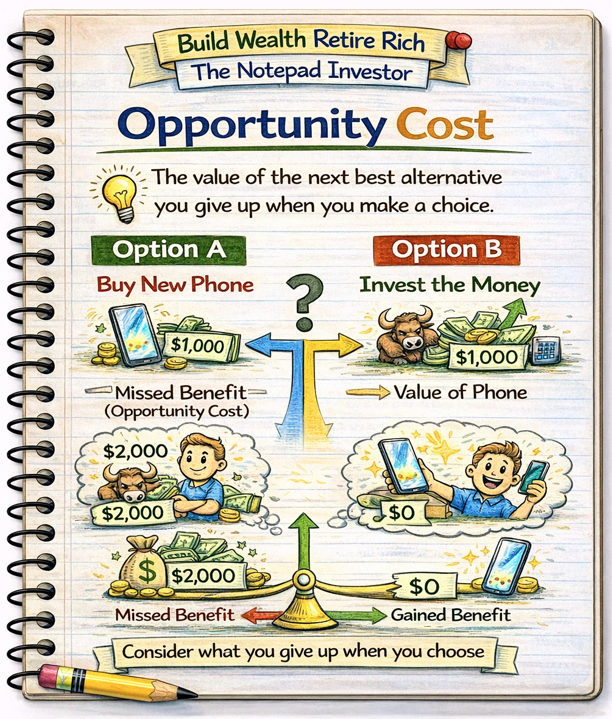
Opportunity cost is the value of the next best alternative you give up when making a choice—representing benefits, experiences, or financial gains sacrificed when selecting one option over another. Unlike focusing solely on what you gain from decisions, opportunity cost acknowledges that every choice involves trade-offs, with spending $100 on dining out meaning $100 not invested potentially growing to $200+ over a decade, taking a vacation meaning time not spent on side hustles earning income, or buying a luxury car meaning money not available for home down payment or retirement savings.
This article is designed for anyone making financial decisions, individuals seeking to improve money management, or those wanting to understand true costs of choices beyond price tags. You do not need economics degrees, complex calculations, or advanced financial knowledge to apply opportunity cost thinking—simple awareness that every choice excludes alternatives transforms decision-making from impulsive to strategic, from short-term focused to long-term oriented.
Understanding opportunity cost matters because ignoring forgone alternatives leads to poor financial decisions focusing only on immediate satisfaction, unconscious spending patterns waste resources on low-value choices when higher-value alternatives exist, and failure to consider long-term investment opportunities costs hundreds of thousands in wealth accumulation over lifetimes—yet most people make financial decisions considering only direct costs, not what they’re sacrificing by choosing one option over another.
Educational disclaimer: This article provides general educational information about opportunity cost concepts. Individual circumstances, priorities, and values vary significantly affecting optimal choices. This is not financial, investment, or life advice. Consult qualified financial professionals for personalized guidance based on specific situations.
Understanding Opportunity Cost
What Is Opportunity Cost?
Definition: The value of the best alternative forgone when making a choice—what you give up to get something else
Key principle: Every decision involves trade-offs. Resources (money, time, energy) are limited. Choosing one option means not choosing others.
Formal economics definition: The loss of potential gain from other alternatives when one alternative is chosen
Simplified: What you could have done instead with the same resources
Why Opportunity Cost Matters
Resources are finite:
- Limited money available for spending, saving, investing
- Limited time in days, weeks, years, lifetimes
- Limited energy and attention
- Every choice directs resources to one path, excluding others
True cost includes what’s sacrificed:
- Direct cost: Price tag or visible expense
- Opportunity cost: Value of alternative not chosen
- Total cost = Direct cost + Opportunity cost
Example:
- Buy $30,000 luxury car vs $15,000 reliable car
- Direct cost difference: $15,000
- Opportunity cost: $15,000 not invested at 8% annual return = $32,383.87 in 10 years, $69,914.36 in 20 years
- True cost of luxury upgrade: $15,000 plus $32,000-$70,000 in forgone investment growth
Visible Costs vs Hidden Opportunity Costs
Visible costs (what people naturally consider):
- Purchase price of items
- Monthly subscription fees
- Explicit expenses
- Immediate sacrifices
Hidden opportunity costs (often ignored):
- Investment returns not earned
- Debt interest accumulated instead of savings interest earned
- Time spent that could generate income
- Skills not developed while pursuing other activities
- Relationships not built while focused elsewhere
Why opportunity costs are overlooked:
- Invisible and abstract vs concrete prices
- Require imagination of alternatives
- Long-term vs immediate
- Psychological easier to ignore what you don’t see
Financial Opportunity Cost Examples
Spending vs Investing
Scenario: Daily $5 coffee
- Direct cost: $5 × 250 workdays = $1,250 annually
- Opportunity cost (if invested instead at 8% annual return):
- 10 years: $18,000+
- 20 years: $57,000+
- 30 years: $140,000+
- 40 years: $323,000+
- Choice: $5 daily enjoyment now vs $323,000+ wealth later
Scenario: New car vs used car
- New car: $35,000
- Reliable used car: $15,000
- Direct savings: $20,000
- Opportunity cost of new car: $20,000 not invested
- 10 years at 8%: $43,000+
- 20 years at 8%: $93,000+
- 30 years at 8%: $201,000+
- True cost of “treating yourself” to new car: $20,000 plus $43,000-$201,000 in forgone wealth
Scenario: Carrying credit card balance
- $5,000 credit card balance at 20% APR
- Minimum payments extending 13+ years
- Total interest paid: $6,000+
- Direct cost: $6,000 in interest
- Opportunity cost: $6,000 not earning investment returns (could have grown to $13,000+ over same period)
- Total cost: $5,000 + $6,000 interest + $13,000 opportunity cost = $24,000 true cost
Time Opportunity Costs
Scenario: Watching TV vs side hustle
- Choice: 2 hours daily watching TV
- Alternative: 2 hours daily freelancing at $25/hour
- Opportunity cost: $50 daily = $18,000+ annually not earned
- Compounded over 10 years invested: $260,000+
Scenario: Long commute
- Job A: 60-minute commute each way, $70,000 salary
- Job B: 20-minute commute each way, $65,000 salary
- Time difference: 80 minutes daily = 333 hours annually
- Analysis: Is $5,000 more worth 333 hours? ($15/hour effective rate for commute time)
- Opportunity cost: 333 hours could be spent with family, exercising, side hustle ($8,000+ at $25/hour), or sleeping (health value)
Scenario: DIY vs hiring professionals
- Home repair: 10 hours DIY saving $300 vs hiring professional
- Effective rate: $30/hour saved
- Opportunity cost: If your skills earn $50+/hour, economically better to work and hire
- Non-financial factors: Enjoyment of DIY, learning value, quality differences
Career and Education Opportunity Costs
Scenario: College vs immediate work
- College: 4 years, $100,000 total cost (tuition, room, board)
- Opportunity cost: 4 years not working (forgone income ~$120,000 at $30K/year)
- Total investment: $220,000 (direct cost + opportunity cost)
- Return: Higher lifetime earnings (average $1M+ more over career)
- Break-even: Typically 10-15 years post-graduation
Scenario: Job change for passion vs income
- Current job: $90,000, unfulfilling
- Dream job: $60,000, passion work
- Opportunity cost: $30,000 annually = $600,000 over 20 years (not including raises)
- Trade-off: Life satisfaction and happiness vs financial security
- No “right” answer—values-dependent decision requiring conscious choice
Lifestyle Opportunity Costs
Scenario: Housing choices
- Option A: $2,000 rent downtown, walkable, social
- Option B: $1,200 rent suburbs, 30-minute commute
- Direct savings: $800 monthly = $9,600 annually
- Opportunity cost of downtown: $9,600 not saved/invested = $440,000+ over 30 years
- Counter-opportunity cost of suburbs: Time commuting, reduced social connections, gas costs
- Balance: Quality of life considerations with financial impact
Scenario: Wedding expenses
- Average wedding: $30,000
- Simple wedding: $5,000
- Difference: $25,000
- Opportunity cost: $25,000 toward home down payment (reduces mortgage interest by $50,000+ over 30 years) OR invested grows to $172,000 over 30 years
- Choice: One-day event vs lifetime financial impact
Scenario: Children
- Average cost raising child to 18: $300,000+
- Opportunity cost: $300,000 not invested grows to $1,500,000+ over 30 years
- Income opportunity cost: Career interruptions, reduced earning years
- Note: Children provide non-financial value impossible to quantify—this example illustrates concept, not recommendation
Calculating Opportunity Cost
Basic Formula
Opportunity Cost = Value of Next Best Alternative – Value of Chosen Option
Simplified approach: What could you do instead with the same resources that would provide value?
Step-by-Step Process
Step 1: Identify the choice
- What decision are you making?
- What resources are involved? (money, time, energy)
Step 2: List viable alternatives
- What else could you do with same resources?
- Be realistic—focus on likely alternatives, not fantasies
Step 3: Identify the next best alternative
- Of alternatives listed, which provides most value?
- This is your opportunity cost comparison point
Step 4: Compare benefits
- What do you gain from chosen option?
- What would you gain from next best alternative?
- Consider financial returns, time savings, satisfaction, long-term impacts
Step 5: Make informed decision
- Choose option providing greatest value relative to your priorities
- Consciously accept trade-offs involved
Practical Example Walkthrough
Decision: Buy $1,000 designer handbag
Step 1: Identify choice
- Resource: $1,000 cash
Step 2: List alternatives
- Buy functional $100 handbag, invest $900
- Take weekend trip
- Pay extra $1,000 toward debt
- Emergency fund contribution
- Purchase course developing career skills
Step 3: Next best alternative
- Assume: Invest $900 (after $100 functional bag) is highest value alternative
Step 4: Compare benefits
- Designer bag: Status, aesthetic enjoyment, quality
- Investment: $900 at 8% grows to $1,940 in 10 years, $4,200 in 20 years, $9,000 in 30 years
Step 5: Decision
- If status and enjoyment worth more than $9,000 in 30 years, buy bag
- If long-term wealth more valuable, invest
- No “right” answer—depends on values and circumstances
- Critical: Make conscious choice understanding trade-offs, not impulse purchase
Common Opportunity Cost Traps
Sunk Cost Fallacy
Mistake: Continuing investment in something because of money/time already spent
Examples:
- Staying in bad relationship because “invested 5 years already”
- Continuing failed business because “already spent $50,000”
- Finishing unenjoyable movie because “already watched 90 minutes”
Reality: Sunk costs are gone regardless. Future decisions should consider only future costs and benefits, not past investments.
Correct thinking: “Given where I am now, what’s the best use of my next dollar/hour/year?”
Focusing Only on Direct Costs
Mistake: Considering only price tags, ignoring forgone alternatives
Example:
- Thinking: “This $200 purchase is affordable”
- Missing: $200 not saved = $800+ in 20 years invested
Solution: Ask “What else could I do with this money/time that would provide value?”
Present Bias (Hyperbolic Discounting)
Mistake: Overvaluing immediate gratification, undervaluing future benefits
Example:
- Choosing $100 spending now over $10,000 wealth in 20 years
- Psychologically, immediate pleasure feels more real than distant future gains
Solution: Visualize future self. Would 65-year-old you prefer you enjoyed $100 now or had $10,000 then?
“Free” Illusion
Mistake: Assuming free things have no opportunity cost
Example:
- Free concert: No money cost
- Opportunity cost: 4 hours not working side hustle ($100 potential), not studying for certification (career advancement), not exercising (health), not spending with family (relationships)
Reality: Time always has opportunity cost even when money doesn’t
Analysis Paralysis
Mistake: Overthinking every small decision calculating infinite opportunity costs
Balance needed:
- Small decisions ($10-50): Quick intuitive assessment
- Medium decisions ($50-500): Brief opportunity cost consideration
- Large decisions ($500+): Thorough opportunity cost analysis
- Life-changing decisions (career, relationships, major purchases): Extensive evaluation
Rule of thumb: Analysis effort should match decision importance
Ignoring Non-Financial Costs and Benefits
Mistake: Calculating only financial opportunity costs, ignoring quality of life impacts
Reality: Some opportunity costs and benefits are non-financial but valuable:
- Health and longevity
- Relationships and social connections
- Personal growth and learning
- Happiness and life satisfaction
- Purpose and meaning
Solution: Consider both financial and life-quality factors in decisions
Applying Opportunity Cost Thinking
Before Major Purchases
Ask:
- What else could I do with this money?
- If invested, what would it grow to over 10, 20, 30 years?
- What future goal am I delaying by spending now?
- Will I remember/value this purchase in 5 years?
- Is immediate gratification worth long-term sacrifice?
Career Decisions
Consider:
- Income differences compounded over career span
- Work-life balance and time with family
- Skill development opportunities affecting future earning
- Job satisfaction and mental health
- Growth potential vs current compensation
Time Management
Evaluate:
- Highest-value use of next hour
- Activities providing most satisfaction per time unit
- Time investments generating future returns (education, networking, health)
- Balance between present enjoyment and future benefit
Investment Decisions
Compare:
- Expected returns of different investment options
- Paying off debt vs investing (guaranteed return vs potential return)
- Tax-advantaged accounts vs taxable accounts
- Real estate vs stock market vs business ownership
Building Wealth Through Opportunity Cost Awareness
The compound effect:
- Small opportunity cost decisions compound dramatically over time
- $200 monthly dining out reduction = $2,400 annually = $110,000+ in 30 years invested
- Conscious opportunity cost thinking = hundreds of thousands in additional lifetime wealth
Strategic approach:
- Not about deprivation—about conscious choice
- Spend on high-value items bringing genuine satisfaction
- Cut low-value spending where opportunity cost exceeds enjoyment
- Direct savings to investments multiplying over time
Why Opportunity Cost Understanding Matters
Without understanding opportunity cost, people make decisions considering only immediate direct costs missing long-term wealth implications, spend unconsciously on low-value items when high-value alternatives exist, and accumulate small poor decisions that compound into hundreds of thousands in forgone wealth over lifetimes—while those understanding opportunity costs make strategic choices building substantial assets through conscious trade-offs.
Understanding opportunity cost enables individuals to:
- Make informed decisions considering full costs including forgone alternatives
- Build wealth through strategic spending and investing choices
- Allocate limited resources (money, time, energy) to highest-value uses
- Avoid impulse decisions by visualizing what’s sacrificed
- Achieve long-term goals by accepting short-term trade-offs consciously
- Create life satisfaction through intentional rather than unconscious choices
Opportunity cost awareness transforms decision-making from reactive to strategic, from short-term to long-term, from unconscious to intentional.
Common Misunderstandings
Many people assume opportunity cost thinking requires calculating exact future values for every decision. In reality, awareness of trade-offs without precise calculations transforms decision quality—simply asking “what else could I do with this money/time?” prevents poor choices even without spreadsheets or complex math.
Another common misconception is that opportunity cost thinking means never spending on wants or enjoyment. In practice, opportunity cost awareness enables better spending on things genuinely valued—by eliminating unconscious low-value spending, more resources become available for high-value wants while simultaneously building wealth, proving deliberate spending more satisfying than unconscious consumption.
Some believe focusing on opportunity costs creates regret about past decisions. However, opportunity cost thinking applies to future decisions only—past choices are sunk costs unchangeable now. Understanding opportunity costs improves future decision-making without dwelling on past, though past patterns may inform better future choices through learning.
How Opportunity Cost Fits Into Financial Success
Opportunity cost awareness provides decision framework for all resource allocation—every spending choice becomes conscious trade-off between immediate gratification and future wealth, time investments balance present enjoyment with future returns, and career decisions weigh income differences against quality of life considerations, enabling systematic optimization toward financial and life goals.
For example, two people earn identical $75,000 salaries. Person A never considers opportunity costs—spends $200 weekly dining out ($10,400 annually), buys new car every 5 years instead of driving reliable used, takes expensive vacations, lives entirely in present. Person B understands opportunity costs—reduces dining to $75 weekly (half), saves $5,200 annually, drives used cars saving $15,000 per purchase cycle, takes budget-conscious trips. Over 30 years: Person A has minimal savings, dependent on continued employment, accumulated no investable assets. Person B invested the differences ($15,000+ annually) growing to $1,700,000+ at 8% return, achieving financial independence enabling early retirement or work flexibility. Same incomes, different opportunity cost awareness, dramatically different outcomes. Understanding forgone alternatives transformed accumulating small conscious choices into life-changing wealth.
Opportunity cost awareness multiplies lifetime wealth through compound effect of strategic decision-making.
Recent Updates and Trends
In recent years, FIRE movement (Financial Independence Retire Early) has popularized extreme opportunity cost awareness—followers rigorously evaluate spending against investment alternatives, achieving 50-70% savings rates enabling retirement in 10-15 years through compound opportunity cost optimization.
Compound interest calculators and visualization tools have made opportunity costs more tangible—apps showing “this $100 purchase costs you $800 in 20 years” make abstract future values concrete and emotionally resonant.
Minimalism and intentional living movements emphasize opportunity cost thinking beyond finances—time and energy opportunity costs receive attention alongside financial considerations in life design decisions.
Economic uncertainty has increased opportunity cost awareness—more people evaluating present spending against future security needs as retirement concerns and economic volatility highlight long-term planning importance.
Fundamental opportunity cost principles remain timeless: every choice involves trade-offs, resources directed to one use cannot serve alternatives simultaneously, long-term compounding makes today’s small decisions tomorrow’s large outcomes, and conscious awareness of forgone alternatives improves decision quality across all life domains regardless of economic conditions or personal circumstances.
3 Things You Can Do Today
Ready to apply opportunity cost thinking? Here are three simple steps you can take right now:
1. Calculate one recurring expense’s 30-year opportunity cost – Choose one regular expense: daily coffee, monthly subscription, weekly dining out. Calculate annual cost. Use online compound interest calculator to see growth over 30 years at 8% return. Example: $150 monthly subscription = $1,800 annually = $204,000 in 30 years. This single calculation makes abstract opportunity costs concrete and motivating. Do this visualization exercise changes perspective on “small” recurring expenses.
2. Pause before next non-essential purchase and ask the opportunity cost question – Before buying anything over $50, stop and ask: “What else could I do with this money that would provide value?” List 3-5 specific alternatives. Compare value received from purchase against best alternative. If purchase still wins, buy guilt-free knowing you made conscious choice. If alternative provides more value, choose that instead. This habit prevents impulse purchases costing thousands annually.
3. Evaluate one upcoming major decision through opportunity cost lens – Identify significant pending decision: job change, major purchase, investment, time commitment. List all viable alternatives. For each alternative, write potential benefits (financial and life quality). Compare honestly. Choose option providing greatest total value aligned with your priorities. Document reasoning. This structured approach improves high-stakes decisions dramatically preventing expensive mistakes.
These actions build opportunity cost awareness muscle transforming unconscious decisions into strategic choices compounding into substantial lifetime benefits.
Quick FAQ
How do I calculate opportunity cost for everyday decisions?
Simple approach: For spending decisions, ask “If I invested this money at 8% annual return, what would it grow to in 20-30 years?” For time decisions, ask “What’s the next best use of this time?” Don’t need exact calculations—awareness of trade-offs is most important. Online compound interest calculators make financial opportunity costs quick to estimate.
Does opportunity cost thinking mean I should never spend money?
No. Opportunity cost awareness enables better spending on things you genuinely value by eliminating unconscious low-value spending. Spend deliberately on high-satisfaction items, cut low-satisfaction spending, invest the difference. This approach increases both present happiness (better spending choices) and future wealth (strategic saving) simultaneously. Balance matters more than extremes.
What if I regret past decisions after learning about opportunity cost?
Don’t dwell on sunk costs—past decisions are unchangeable now. Apply opportunity cost thinking to future decisions only. Every person makes financial mistakes; learning improves future choices without requiring regret about past. Focus forward. Even understanding opportunity costs today versus tomorrow has massive lifetime impact—start now regardless of past.
How do I compare financial opportunity costs to life quality factors?
No perfect formula—values-dependent. Ask: “Will I value the experience/item in 5 years?” and “What life quality am I sacrificing by spending vs saving?” Some spending enhances life dramatically (health, relationships, skills) justifying opportunity costs. Some spending provides minimal lasting value (impulse purchases, status items) making opportunity costs clear losses. Honest self-assessment reveals which is which.
Should I calculate opportunity cost for small purchases like coffee?
Daily recurring small purchases warrant opportunity cost consideration because they compound dramatically—$5 daily = $1,250 annually = $140,000+ in 30 years. One-time small purchases usually don’t merit analysis unless you make dozens monthly (then analyze the pattern, not individual purchases). Reserve detailed analysis for purchases over $100 and recurring expenses over $25 monthly.
Can opportunity cost thinking backfire by causing analysis paralysis?
Yes, if taken to extremes. Balance needed: (1) Small decisions ($0-50): Quick gut check, (2) Medium decisions ($50-500): Brief opportunity cost consideration, (3) Large decisions ($500-5,000): Thorough analysis, (4) Life-changing decisions: Extensive evaluation. Match analysis effort to decision importance. Perfect decisions impossible—good decisions consistently applied create excellent outcomes.
Explore More in Money Basics
Disclosure
This article is provided for educational purposes only and does not constitute financial, investment, or life advice. Opportunity cost calculations are estimates based on assumed investment returns—actual returns vary and are not guaranteed. Investment examples illustrative only—past performance does not guarantee future results. Individual circumstances, priorities, and values vary significantly affecting optimal choices. What represents good value for one person may differ for another based on goals, life stage, and personal preferences. Examples of spending and lifestyle choices are illustrative—no judgment implied about any financial decisions. Consult qualified financial professionals for personalized guidance. Advertisements or sponsored content may appear within or alongside this content. All information is presented independently.
Interactive Quiz: Opportunity Cost
Choose an answer for each question and click Check Answer to learn why it is right or wrong.