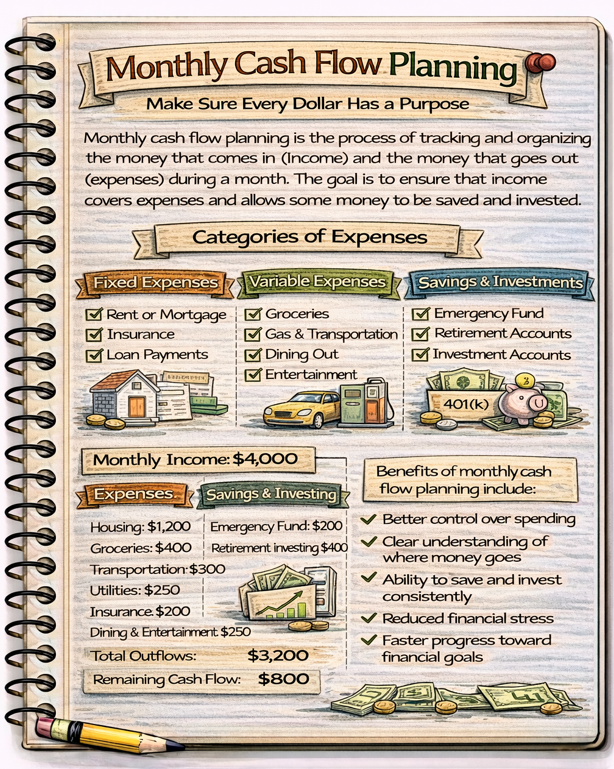
Monthly cash flow planning is the strategic coordination of income receipts and expense payments throughout the month—mapping when money arrives against when bills are due, ensuring sufficient funds available for each payment, and preventing overdrafts or late payments through deliberate timing management. Unlike simple budgeting that tracks total monthly income and expenses without considering timing, cash flow planning addresses the critical when dimension creating detailed calendar showing paycheck dates, bill due dates, and available balances preventing situations where adequate monthly income exists but poor timing creates temporary shortfalls causing overdraft fees, late charges, and financial stress.
This article is designed for anyone experiencing overdrafts despite adequate income, individuals living paycheck-to-paycheck through timing mismatches, or those wanting to eliminate financial stress from bill payment timing. You do not need financial expertise, complex software, or advanced knowledge to plan cash flow effectively—simple calendar listing paydays and bill due dates with basic arithmetic creates powerful coordination preventing costly timing errors, though method works best for those with relatively predictable income and expense timing enabling forward planning.
Understanding monthly cash flow planning matters because adequate total monthly income doesn’t prevent overdrafts when bills due before paychecks arrive, many people experience financial stress not from insufficient total income but from timing mismatches between receipts and payments, and lack of forward calendar awareness creates preventable crises requiring expensive solutions like payday loans or overdraft fees—while cash flow planners coordinate timing deliberately avoiding mismatches, maintain smooth financial operations through strategic scheduling, and eliminate timing-based stress achieving calm confidence impossible through total-only budgeting ignoring when money flows.
Educational disclaimer: This article provides general educational information about cash flow planning concepts. Individual circumstances, income timing, bill schedules, and financial situations vary significantly. Cash flow planning assumes relatively predictable income and expense timing—less applicable for highly irregular situations. This is not financial planning or professional advice. Consult qualified financial professionals for personalized guidance.
Understanding Cash Flow Planning
What Is Cash Flow?
Core definition: The movement of money in and out of accounts over time, with timing being as critical as total amounts
Cash inflows (money in):
- Paychecks (salary, wages)
- Side income and freelance payments
- Investment income (dividends, interest)
- Bonuses and commissions
- Tax refunds
- Any money depositing to accounts
Cash outflows (money out):
- Fixed bills (rent, car payment, insurance)
- Variable expenses (utilities, groceries, gas)
- Debt payments
- Savings transfers
- Discretionary spending
- Any money leaving accounts
Positive cash flow: More money coming in than going out during period
Negative cash flow: More money going out than coming in during period
Timing gaps: Period between when money needed and when money available
Why Timing Matters
The paycheck-to-paycheck timing trap:
Example scenario:
- Monthly income: $4,000 (paid on 1st and 15th, $2,000 each)
- Monthly expenses: $3,800 (plenty of income to cover)
- Bill schedule: Rent $1,200 due 5th, Car $350 due 8th, Insurance $200 due 10th, Utilities $150 due 12th
- Problem: Total bills due 5th-12th = $1,900, but only $2,000 available from first paycheck
- After rent and bills: $100 remaining until 15th (two weeks away)
- Need groceries, gas, other necessities = overdrafts despite adequate monthly income
The overdraft despite positive budget:
- Total monthly income exceeds expenses—should work fine
- But timing mismatch creates temporary shortfalls
- Overdraft fees ($35 each) compound problem
- Stress and scrambling despite being “on budget” overall
Cash Flow vs Budgeting
Budget (what and how much):
- Income: $4,000
- Rent: $1,200
- Food: $500
- Transportation: $400
- Etc.
- Totals match—budget balanced
Cash flow (when):
- March 1: Receive $2,000
- March 5: Pay rent $1,200 (balance $800)
- March 8-14: Pay other bills $700 (balance $100)
- March 15: Receive $2,000 (balance $2,100)
- March 16-31: Remaining expenses
Integration: Budget tells you what to spend, cash flow tells you when you can spend it

Creating a Monthly Cash Flow Plan
Step 1: List All Income and Dates
Create income calendar:
Example:
- March 1: Paycheck $2,000
- March 15: Paycheck $2,000
- March 20: Freelance payment $500 (estimated)
- Total monthly income: $4,500
For irregular income:
- Use conservative estimates (lower end of typical range)
- Note estimated/uncertain amounts differently
- Plan primary expenses around guaranteed income only
Step 2: List All Expenses and Due Dates
Fixed bills with specific due dates:
- March 1: Rent $1,200
- March 5: Car payment $350
- March 10: Insurance $200
- March 15: Credit card minimum $100
- March 20: Student loan $250
- March 25: Phone bill $85
Variable expenses (estimate timing):
- Groceries: $125 weekly (roughly March 7, 14, 21, 28)
- Gas: $80 every 2 weeks (March 10, 24)
- Utilities: $150 (due March 12)
Discretionary spending (distribute):
- Dining out: $200 total (allocate $50 per week)
- Entertainment: $100 total (spread throughout month)
Step 3: Create Cash Flow Calendar
Month-at-a-glance format:
March 2026 Cash Flow Plan:
Week 1 (March 1-7):
- 3/1: Income $2,000 | Starting balance: $200 | New balance: $2,200
- 3/1: Rent -$1,200 | Balance: $1,000
- 3/5: Car payment -$350 | Balance: $650
- 3/7: Groceries -$125 | Balance: $525
Week 2 (March 8-14):
- 3/10: Insurance -$200 | Balance: $325
- 3/10: Gas -$80 | Balance: $245
- 3/12: Utilities -$150 | Balance: $95
- 3/14: Groceries -$125 | Balance: -$30 ⚠️ PROBLEM IDENTIFIED
Week 3 (March 15-21):
- 3/15: Income $2,000 | Balance: $1,970
- 3/15: Credit card -$100 | Balance: $1,870
- 3/20: Student loan -$250 | Balance: $1,620
- 3/20: Freelance income $500 | Balance: $2,120
- 3/21: Groceries -$125 | Balance: $1,995
Week 4 (March 22-31):
- 3/24: Gas -$80 | Balance: $1,915
- 3/25: Phone -$85 | Balance: $1,830
- 3/28: Groceries -$125 | Balance: $1,705
- 3/31: End of month carryover | Balance: $1,705
Analysis: Identified negative balance week 2—need to adjust timing or build buffer
Step 4: Identify and Fix Timing Gaps
Problem identified: Week 2 goes negative by $30
Solutions:
Option 1: Adjust bill due dates
- Call insurance company requesting due date change from 10th to 20th
- Spreads expenses more evenly across pay periods
- Many companies accommodate reasonable due date requests
Option 2: Build buffer in checking
- Temporarily reduce discretionary spending or savings
- Build $500-1,000 cushion in checking account
- Prevents timing gaps from causing overdrafts
- Once established, maintain as minimum balance
Option 3: Reduce variable expenses in tight weeks
- Delay 3/14 grocery trip to 3/16 (after paycheck)
- Or reduce 3/7 and 3/14 groceries to $100 each, shop larger 3/21
- Strategic timing of controllable expenses around fixed obligations
Option 4: Split automatic savings between paychecks
- If automatically saving $500 monthly all on 1st, creates tighter first half
- Split to $250 on 1st and $250 on 15th balancing cash availability
Step 5: Monitor and Adjust Weekly
Weekly check-in process:
- Sunday or Monday: Review upcoming week’s planned cash flow
- Compare actual balance to planned balance
- Identify any discrepancies or upcoming tight periods
- Adjust variable spending if needed
End-of-month review:
- Compare actual cash flow to plan
- Note where predictions were off
- Adjust next month’s plan based on learnings
- Improve accuracy over time
Common Cash Flow Challenges
Challenge 1: Bill Stacking (Multiple Bills Due Same Week)
Problem:
- Rent, car payment, and insurance all due first week of month
- $1,750 total bills before first paycheck covers them
- Creates tight second half of previous month
Solutions:
- Stagger due dates: Request companies move payment dates spreading across month
- Build buffer: Maintain balance covering largest bill cluster
- Pay early strategically: If financially ahead, pay next month’s clustered bills early spreading workload
Challenge 2: Bi-Weekly Pay with Monthly Bills
Problem:
- Paid every 2 weeks (26 paychecks annually)
- Bills monthly (12 payment cycles annually)
- Some months get 2 paychecks, some get 3 (2 months per year)
- Payday dates shift relative to bill due dates monthly
Solutions:
- Budget based on 2 paychecks: Plan each month assuming 2 paychecks only
- Treat 3rd paycheck as bonus: Use extra paychecks for savings, debt payoff, buffer building
- Create detailed annual calendar: Map all 26 paychecks against 12 months identifying potential tight periods
- Build 1-month buffer: Eventually live on previous month’s income eliminating timing stress completely
Challenge 3: Irregular Income
Problem:
- Freelance, commission, or seasonal income varies monthly
- Can’t predict exact amounts or timing
- Fixed bills still due regardless of income receipt
Solutions:
- Conservative baseline planning: Plan bills around minimum expected monthly income only
- Larger buffer essential: Maintain 1-2 months expenses in checking smoothing variability
- Priority-based spending: Pay essentials first when income arrives, discretionary only after secured
- Income smoothing account: Deposit all irregular income to separate account, transfer fixed “salary” to checking monthly creating artificial stability
Challenge 4: Annual or Irregular Bills
Problem:
- Annual insurance premium $1,200 due June 1
- Semi-annual car registration $180 due April and October
- Holiday spending $800 in December
- These irregular expenses disrupt monthly cash flow creating crisis months
Solutions:
- Sinking funds: Calculate annual cost ÷ 12, save monthly amount
- Example: $1,200 insurance ÷ 12 = $100 monthly to dedicated savings
- Include in monthly cash flow: Treat sinking fund transfer as regular monthly bill
- Switch to monthly billing: Some companies offer monthly payment plans avoiding large lump sums
Advanced Cash Flow Strategies
Building the One-Month Buffer
Goal: Maintain full month’s expenses as minimum checking account balance
Benefits:
- Eliminates all timing stress
- Bills can be paid anytime without checking paycheck date
- Essentially living on last month’s income
- Ultimate cash flow smoothness
Building process:
- Calculate monthly expenses: $3,500
- Current checking balance: $800
- Need to build: $2,700
- Temporarily reduce discretionary spending and/or pause savings contributions
- Build $300-500 monthly until reaching $3,500 minimum
- Takes 6-9 months but transforms financial stability
- Once built, never let balance drop below this amount
Strategic Bill Date Management
Optimize due dates around pay schedule:
Example for bi-weekly pay (1st and 15th):
First paycheck period (1st-14th) bills:
- Rent: 5th
- Phone: 8th
- Car insurance: 12th
Second paycheck period (15th-31st) bills:
- Car payment: 18th
- Credit card: 20th
- Utilities: 25th
Result: Balanced cash flow with similar obligations each pay period
Variable Expense Smoothing
Strategy: Convert irregular expenses to consistent monthly amounts
Example—Utilities varying $100-250 monthly:
- Calculate 12-month average: $175
- Budget $175 every month
- Low months ($100 bill): Keep $75 in checking building reserve
- High months ($250 bill): Use $75 from reserves covering gap
- Over year, smooths to consistent $175 monthly cash flow impact
Income Forecasting
For variable income earners:
Create 3-scenario plan:
- Minimum scenario: Lowest realistic monthly income ($3,000)
- Expected scenario: Typical average income ($4,500)
- Strong scenario: Higher-end income ($6,000)
Tiered expense plan:
- Tier 1 ($3,000): Essential bills only, minimal discretionary
- Tier 2 ($4,500): All bills, normal discretionary, some savings
- Tier 3 ($6,000): Everything plus aggressive savings/debt payoff
Flexible execution: Adjust spending month-to-month based on actual income while ensuring essentials always covered
Cash Flow Planning Tools
Spreadsheet Template
Simple cash flow tracker:
- Column A: Date
- Column B: Description (paycheck, bill name)
- Column C: Income (if applicable)
- Column D: Expense (if applicable)
- Column E: Balance (running total)
Formula in Column E: Previous balance + Income – Expense
Benefit: See projected balance for every day of month
Calendar-Based Planning
Physical or digital calendar:
- Mark payday dates in green
- Mark bill due dates in red with amounts
- Visual overview of cash flow peaks and valleys
- Easy to spot potential problem weeks
Budgeting Apps with Cash Flow Features
YNAB (You Need A Budget):
- Age of Money metric (measures cash flow buffer)
- Category-based budgeting with timing awareness
Simplifi by Quicken:
- Cash flow projection feature
- Alerts for upcoming low balances
Monarch Money:
- Cash flow dashboard
- Income vs expense timing visualization
Bank Tools
Low balance alerts:
- Set notification when balance drops below threshold ($500)
- Warns of potential timing issues before overdraft
Transaction scheduling:
- Some banks show pending scheduled payments
- Available balance vs actual balance visibility
Why Monthly Cash Flow Planning Matters
Without cash flow planning, adequate total monthly income doesn’t prevent overdrafts when timing mismatches create temporary shortfalls, many people experience preventable financial stress from bills due before paychecks arrive despite having sufficient funds overall, and lack of forward timing awareness leads to costly overdraft fees, late payment penalties, and constant scrambling—while cash flow planners coordinate receipts and payments deliberately avoiding timing gaps, maintain smooth operations through strategic due date management, and achieve financial calm impossible through total-only budgeting ignoring critical when dimension of money management.
Understanding and implementing monthly cash flow planning enables individuals to:
- Eliminate overdraft fees through strategic timing coordination
- Reduce financial stress by preventing paycheck-to-paycheck timing gaps
- Optimize bill due dates creating balanced cash flow across pay periods
- Identify and fix timing problems before they cause crises
- Build appropriate buffers smoothing natural income-expense variations
- Achieve financial calm and control impossible through timing-blind budgeting
Monthly cash flow planning transforms timing chaos into coordinated smooth operations eliminating preventable crises through forward calendar awareness and strategic scheduling.
Common Misunderstandings
Many people assume having adequate total monthly income eliminates need for cash flow planning since money eventually covers expenses. In reality, timing gaps between when bills due and when paychecks arrive create temporary shortfalls causing overdrafts despite sufficient monthly totals, proving timing coordination as critical as amount adequacy for smooth financial operations requiring both budgeting and cash flow planning together.
Another common misconception is that cash flow planning only matters for those living paycheck-to-paycheck making it irrelevant for higher earners with surplus. In practice, anyone can experience timing mismatches—someone earning $150,000 with all bills due early month and paychecks mid-month faces identical timing gaps as someone earning $40,000, proving principle applies universally across income levels when payment timing misaligned with receipt timing regardless of absolute amounts.
Some believe building one-month buffer solves all cash flow issues permanently eliminating need for ongoing planning. However, buffer provides cushion not automatic optimization—without continued awareness, spending can drift consuming buffer requiring rebuilding, and life changes alter timing patterns requiring planning updates, proving buffer helps tremendously but doesn’t eliminate value of ongoing cash flow coordination and awareness.
How Monthly Cash Flow Planning Fits Into Financial Success
Monthly cash flow planning provides essential timing coordination complementing budget amount planning, prevents costly overdrafts and late fees through forward awareness and strategic scheduling, and eliminates timing-based financial stress enabling calm confident money management impossible when considering totals without timing, making cash flow planning critical operational component of complete financial system working alongside budgeting and savings strategies.
For example, two people both earn $4,000 monthly with identical $3,800 expenses and budgets—both should succeed financially. Person A budgets carefully tracking totals but ignores timing—rent $1,200 due 1st, major bills totaling $1,400 due 5th-10th, receives paychecks 15th and 30th ($2,000 each). Month after month: Scrambles paying rent from previous month’s remainder (barely works), bills early month create repeated overdrafts (3-4 monthly at $35 each = $105-140 fees), constant stress wondering if money available, occasionally pays bills late incurring $25-40 penalties. Annual cost: $1,500+ in overdraft fees, $300+ in late fees, chronic anxiety despite adequate income. Person B implements cash flow planning—creates monthly calendar showing all paydays and bills, identifies timing gap in early month, requests insurance company move due date from 8th to 20th balancing expense timing across pay periods, builds $800 buffer over 3 months providing cushion, reviews weekly ensuring coordination. Result: Zero overdrafts (saves $1,500+ annually), zero late fees (saves $300+ annually), calm confidence knowing timing coordinated, same budget as Person A but dramatically better execution. Difference: Person B added timing dimension to amount budgeting creating smooth operations impossible for Person A focusing only on totals.
Monthly cash flow planning separates smooth operators from stressed scramblers through timing coordination preventing crises predictable through forward calendar awareness but invisible without deliberate coordination planning.
Recent Updates and Trends
In recent years, earned wage access programs have emerged—apps like Earnin and Dave allowing workers accessing earned wages before payday, addressing cash flow gaps though potentially creating dependency and fees requiring careful evaluation versus traditional cash flow planning solving root cause.
Banking innovation has helped—real-time payment systems and instant transfers between accounts enabling faster correction of timing mismatches versus previous 2-3 day delays exacerbating gaps, though instant access also enables unconscious spending requiring continued discipline.
Subscription economy has complicated cash flow—dozens of small recurring charges spread throughout month creating unpredictable daily cash flow versus historical larger monthly bills enabling simpler planning, requiring more frequent monitoring and awareness preventing surprise deductions.
Gig economy prevalence has increased irregular income situations—more people facing variable timing and amounts requiring sophisticated cash flow planning versus predictable biweekly paychecks enabling simpler coordination, making planning skills more critical than ever.
Fundamental cash flow planning principles remain timeless: timing coordination as critical as total amounts, forward calendar awareness prevents predictable crises, strategic bill scheduling balances cash availability across periods, and buffer building provides cushion smoothing natural variations—regardless of earned wage access, instant transfers, subscription complexity, or income irregularity, deliberate timing coordination through monthly planning produces superior financial operations versus timing-blind approaches focusing solely on totals.
3 Things You Can Do Today
Ready to implement cash flow planning? Here are three simple steps you can take right now:
1. Create next month’s cash flow calendar listing all paydays and bill due dates – Get calendar or open spreadsheet for next month. List every payday with amount and date. List every bill with amount and due date—rent, car, insurance, utilities, subscriptions, loan payments, everything. Include estimated variable expenses like groceries distributed weekly. Calculate running balance after each transaction showing daily projected balance throughout month. Takes 30-45 minutes creating complete visibility. This reveals timing gaps immediately—days when balance goes negative despite adequate monthly income identifying problems before they occur.
2. Identify your tightest cash flow week and create solution – Review cash flow calendar from step 1. Which week has lowest projected balance or goes negative? This is your problem week. Solutions: (1) Call 1-2 companies whose bills due that week requesting due date changes to spread more evenly (many accommodate), (2) Delay controllable expenses (groceries, gas fill-up) to after next paycheck if possible, (3) If repeatedly tight, commit to building $500-1,000 buffer over next 3 months preventing timing stress. Implement one solution this week preventing next month’s crisis. Takes 15-30 minutes identifying and addressing timing gap.
3. Set up weekly 10-minute cash flow review ritual – Choose day (recommend Sunday or Monday) and time for weekly check-in. Add recurring calendar reminder: “Cash flow check.” Each week spend 10 minutes: Review current balance, compare to plan, check upcoming week’s bills and paydays, ensure sufficient funds available, adjust variable spending if needed. This weekly touchpoint catches problems early preventing crisis scrambling. First month requires more attention establishing rhythm, becomes quick routine by month 2-3. Takes 10 minutes weekly preventing hours of stress and costly mistakes. Consistency matters more than perfection—weekly awareness dramatically improves coordination.
These actions create functional cash flow planning system within one day—complete monthly calendar showing timing, identified solution for tightest period, and weekly review ritual maintaining coordination—eliminating timing-based overdrafts and stress starting immediately.
Quick FAQ
What’s the difference between budgeting and cash flow planning?
Budgeting = totals and categories (income $4,000, rent $1,200, food $500). Cash flow planning = timing (rent due 5th, paycheck arrives 15th, balance after bills). Budget tells you WHAT to spend and HOW MUCH. Cash flow tells you WHEN you can spend it based on WHEN money arrives. Need both: Budget for amounts, cash flow for timing. Many people budget well but experience overdrafts from poor timing—adequate monthly income but bills due before paychecks arrive. Cash flow planning prevents this.
How much buffer should I maintain in my checking account?
Minimum: $500-1,000 preventing most timing gaps. Comfortable: One month’s expenses ($3,000-5,000 typical) eliminating all timing stress. Building process: Start with $500 goal (achievable in 2-3 months), increase to $1,000 over 6 months, eventually build to full month over 1-2 years. Buffer amount depends on income regularity—irregular income needs larger buffer (1-2 months), stable biweekly paycheck needs less (2-4 weeks). Don’t let perfect be enemy of good—$500 buffer dramatically better than $0 even if $3,000 ideal.
Can I do cash flow planning with irregular freelance income?
Yes but requires adaptation: (1) Conservative planning—base bills on minimum expected monthly income only, (2) Larger buffer essential—maintain 1-2 months expenses in checking smoothing variability, (3) Tier spending—pay essentials when income arrives, discretionary only after essentials secured, (4) Annual calendar—track typical income patterns identifying predictable slow/strong periods planning accordingly. More challenging than regular paycheck but more important—irregular income makes timing coordination critical not optional. Many freelancers successfully use separate account depositing all income then transferring fixed monthly “salary” creating artificial stability.
What if my bills are all due around the same time creating cash flow problems?
Three solutions: (1) Request due date changes—call companies asking to move payment dates spreading across month, most accommodate reasonable requests, (2) Build buffer—one month expenses in checking eliminates timing sensitivity, pay bills whenever without checking paycheck date, (3) Strategic payment timing—if financially ahead, pay next month’s clustered bills early from previous month spreading load. Best approach: Combine all three—request date changes for better distribution, maintain buffer providing cushion, pay strategically when able. Bills clustering common problem with simple solutions.
How do I handle annual or semi-annual bills in monthly cash flow planning?
Sinking funds: Calculate annual cost ÷ 12 = monthly amount. Example: $1,200 annual insurance ÷ 12 = $100 monthly. Include $100 in every month’s cash flow plan as regular “bill” transferring to dedicated savings. When annual bill arrives, pay from accumulated sinking fund not disrupting monthly cash flow. Alternative: Request monthly payment plans if available (some companies offer). Key: Convert irregular large bills to consistent monthly amounts preventing crisis months when lump sums due. Track sinking funds separately ensuring money reserved when needed.
Is cash flow planning worth the time if I’m not living paycheck-to-paycheck?
Yes—prevents unnecessary fees and stress at any income level. Someone earning $150,000 with poor timing still experiences overdrafts if all bills due before paycheck arrives. Cash flow planning provides: (1) Overdraft prevention (saves $35 per occurrence), (2) Late fee avoidance (saves $25-40 each), (3) Stress reduction (knowing timing coordinated), (4) Strategic timing optimization (paying bills when most advantageous). Time investment: 30-45 minutes monthly setup, 10 minutes weekly review. Payoff: $200-500+ annual fee savings, eliminated timing anxiety, smooth operations. Worth it regardless of income level or financial position.
Explore More in Money Basics
Disclosure
This article is provided for educational purposes only and does not constitute financial planning or professional advice. Cash flow planning strategies assume relatively predictable income and expense timing—less applicable for highly irregular situations. Individual circumstances vary significantly—appropriate buffer amounts, timing coordination strategies, and planning approaches differ by situation. Examples use simplified scenarios—actual cash flows more complex. Bank features, app capabilities, and bill payment flexibility vary by institution and provider. Building buffers assumes available income margin—those unable to meet basic needs require different interventions. Consult qualified financial planners and advisors for personalized guidance. Advertisements or sponsored content may appear within or alongside this content. All information is presented independently.