Author name: Amit Bansal

Budgeting & Cash Flow Management, Personal Finance Course

2.3 Expense Categories Explained: Where Your Money Really Goes Each Month

Expense categories are groupings of similar spending types used to organize, track, and analyze money flowing out—ranging from housing, transportation, and food to detailed subcategories enabling spending pattern recognition. Learn category types (fixed, variable, essential, discretionary), standard categories with typical percentages, creating customized systems, using category data for budgeting and optimization, common mistakes, and transforming transaction chaos into actionable financial insights.

Budgeting & Cash Flow Management, Personal Finance Course

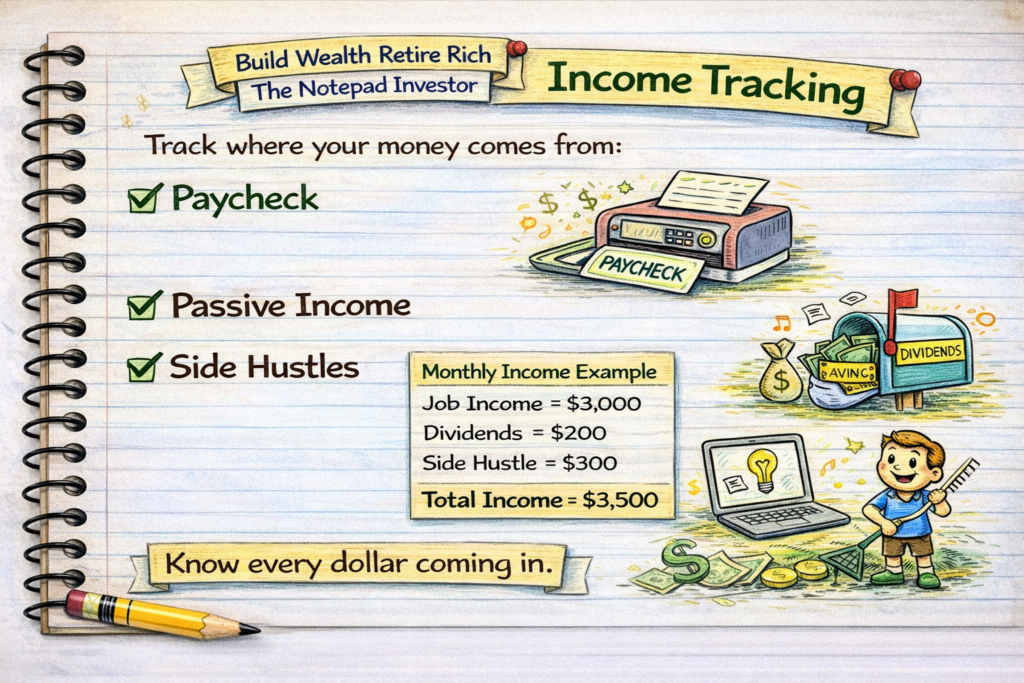
2.2 How to Track Your Income (And Know Exactly Where Your Money Comes From)

Income tracking is systematic recording and monitoring of all money flowing into accounts from employment, investments, side hustles, and other sources—providing complete earnings visibility enabling accurate budgeting, tax preparation, and financial planning. Learn income categories (earned, passive, benefits), tracking methods (spreadsheet, apps, accounting software), creating tracking systems, using income data, common mistakes, and transforming vague awareness into precise documentation.

Budgeting & Cash Flow Management, Personal Finance Course

2.1 What Is a Budget? The Simple System to Take Control of Your Money

A budget is a financial plan allocating expected income across expense categories and savings goals, typically monthly—serving as spending roadmap ensuring money flows intentionally toward priorities. Learn budget definition, types (traditional, 50/30/20, zero-based, envelope, pay yourself first), creating your first budget, common mistakes, automation strategies, and transforming chaotic spending into intentional wealth building through systematic allocation.

Foundations of Personal Finance, Personal Finance Course

1.10 The Ultimate Personal Finance Roadmap: From Broke to Financially Free

The personal finance roadmap is a sequential framework outlining essential steps from foundational stability through wealth building to financial independence—progressing systematically through emergency fund establishment, debt elimination, retirement savings, goal funding, and wealth accumulation. Learn the 10-step roadmap, why sequence matters, timeline examples, common questions, modifications for different situations, and achieving sustainable financial progress through prioritized execution.

Foundations of Personal Finance, Personal Finance Course

1.9 What Is Financial Independence? The Step-by-Step Path to Freedom

Financial independence is having sufficient wealth and passive income covering living expenses indefinitely without requiring active employment—achieved when investment returns generate enough to fund desired lifestyle making work optional at any age. Learn FI definition, 4% rule, FIRE movement variations, path to FI (calculating FI number, maximizing savings rate, optimizing expenses, strategic investing), timelines, post-FI life, common mistakes, and achieving freedom through systematic wealth building.

Foundations of Personal Finance, Personal Finance Course

1.8 Short-Term vs Long-Term Financial Goals: What You Should Focus on First

Short-term vs long-term goals distinguish financial objectives by timeframe—short-term (0-2 years) requires liquid savings avoiding market risk for emergency funds and near-term needs, while long-term (10+ years) enables aggressive stock investing accepting volatility for compound growth in retirement and wealth building. Learn goal categories, appropriate strategies, risk tolerance by timeframe, balancing multiple horizons, common mistakes, and optimizing each goal for its specific timeline.

Foundations of Personal Finance, Personal Finance Course

1.7 How to Set Financial Goals That Actually Work (Step-by-Step Guide)

Financial goals are specific, measurable targets for achieving desired financial outcomes within defined timeframes—from building emergency funds to accumulating retirement savings. Learn goal definition (SMART framework), types (short/medium/long-term, foundation/growth/lifestyle), effective goal-setting process, prioritization strategies, common mistakes, tracking and adjustment, and transforming aspirations into systematic wealth building through focused action.

Foundations of Personal Finance, Personal Finance Course

1.6 How Inflation Is Quietly Destroying Your Money (And What You Can Do)

Inflation and purchasing power represent inverse relationships—inflation measures annual price increases (typically 2-3%) while purchasing power describes how much money can buy, declining as prices rise. Learn inflation fundamentals (CPI, causes, historical rates), purchasing power erosion, real vs nominal values, impacts on retirement/savings/debt, protection strategies (stocks, TIPS, I Bonds, real estate), and preserving wealth against systematic value erosion.

Foundations of Personal Finance, Personal Finance Course

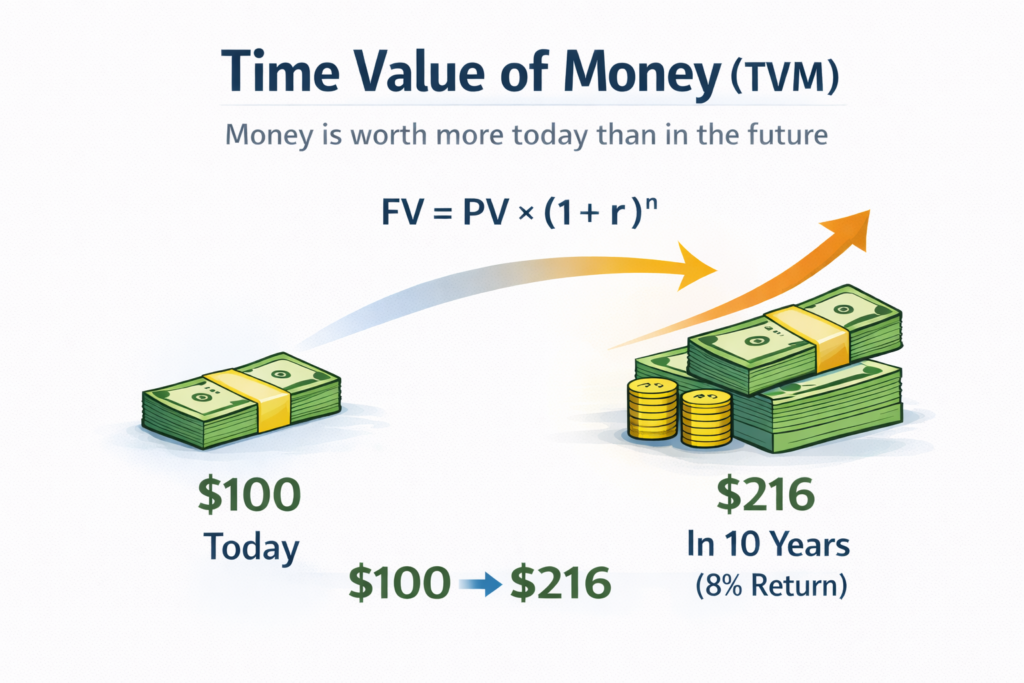
1.5 Time Value of Money Explained: Why $100 Today Is Worth More Than Tomorrow

Time value of money is the principle that money available now is worth more than the same amount in the future due to earning potential—$1,000 today can grow through investment while future money remains static, making present money more valuable. Learn time value fundamentals, compound interest power, Rule of 72, practical applications (retirement planning, debt decisions, savings timing), common mistakes, and building wealth through strategic timing and compound growth.

Foundations of Personal Finance, Personal Finance Course

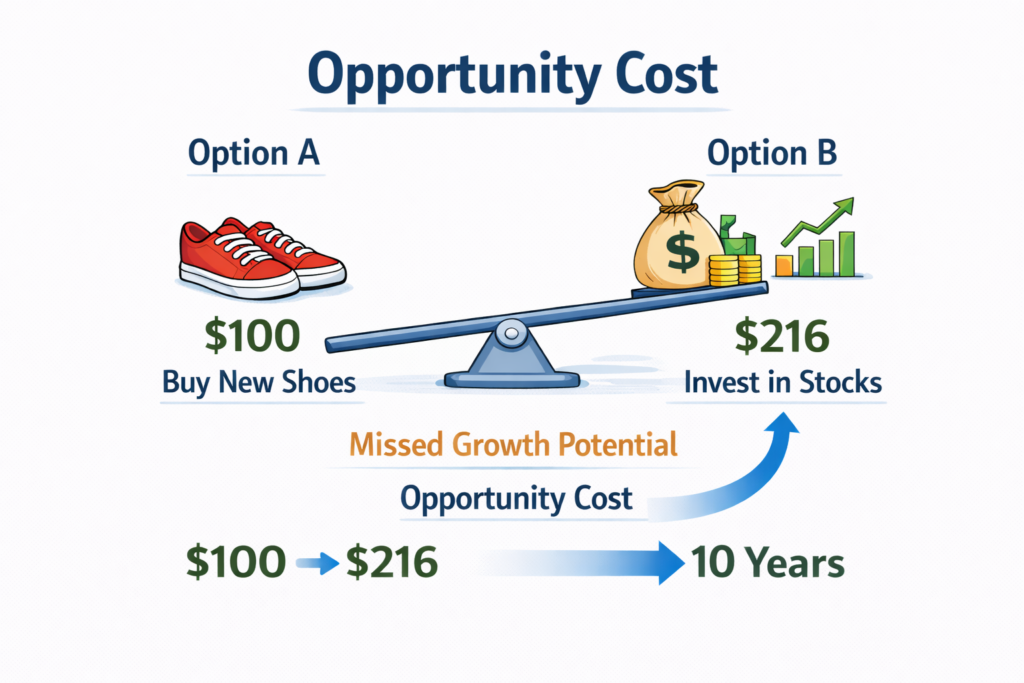
1.4 Opportunity Cost Explained: The Hidden Cost of Every Money Decision

Opportunity cost is the value of the next best alternative sacrificed when making a choice—every spending decision means money not invested, time spent means activities not pursued, career choices trade income against quality of life. Learn opportunity cost definition, financial examples (spending vs investing, time costs, lifestyle choices), calculating opportunity costs, common traps (sunk cost fallacy, present bias), practical applications, and building wealth through strategic decision-making.

Scroll to Top