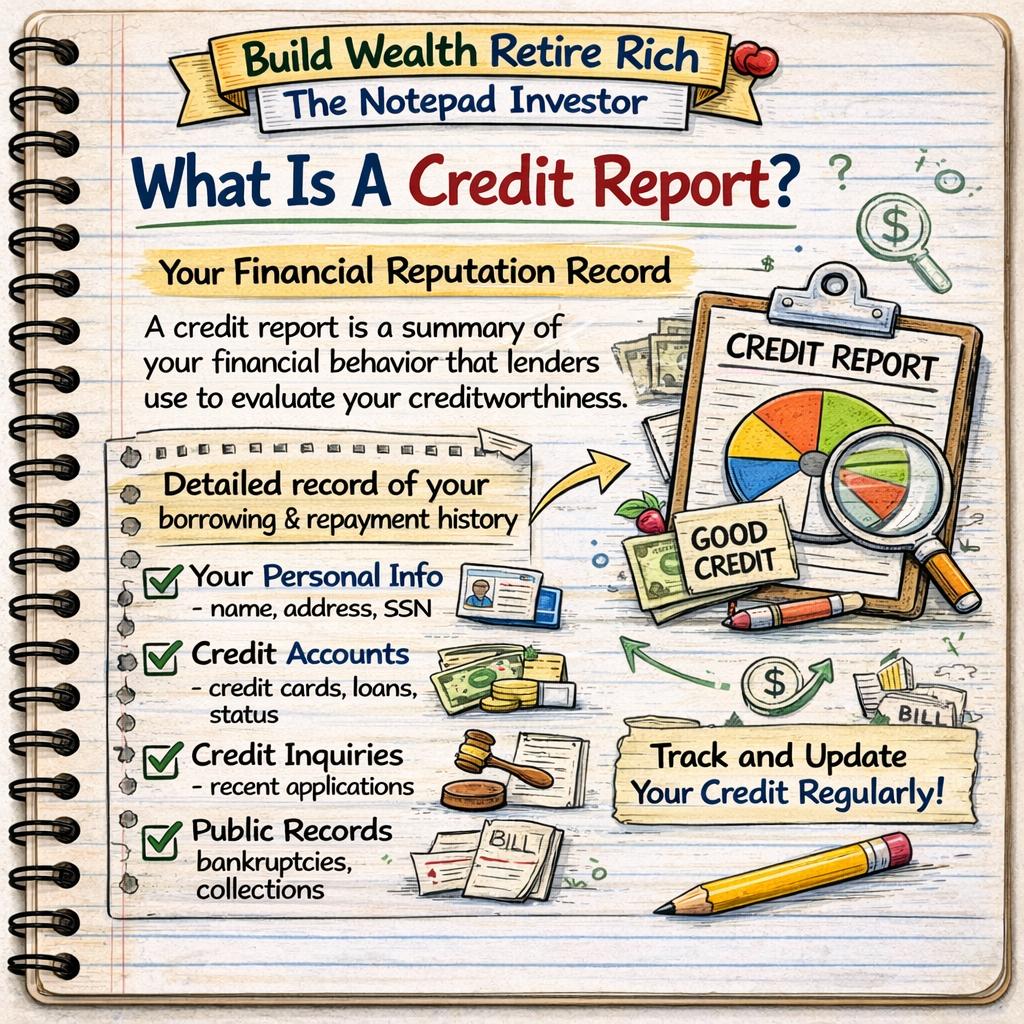
Credit reports are detailed records of credit history maintained by three major credit bureaus (Equifax, Experian, TransUnion) containing personal information, account details, payment histories, credit inquiries, and public records—serving as comprehensive documentation of borrowing behavior from which credit scores are calculated and lenders evaluate creditworthiness for lending decisions. Unlike credit scores which condense credit data into single three-digit number (300-850 range), credit reports provide granular account-by-account information showing every credit card, loan, mortgage, and payment over time including specific late payment dates, current balances, credit limits, account opening dates, and derogatory marks like collections or bankruptcies creating full picture of credit management spanning years or decades. Understanding credit reports matters because errors appearing on reports (affecting 20% of consumers according to FTC studies) can damage scores unnecessarily until corrected through disputes, identity theft often first detected through unauthorized accounts on reports, and report content directly feeds score calculations making report accuracy essential for optimal creditworthiness impossible to verify without regular report review enabling error detection and correction protecting financial standing.
This article is designed for anyone wanting comprehensive credit report understanding, individuals needing to check reports for errors or fraud, or those preparing for major borrowing requiring report accuracy verification. You do not need credit expertise to understand credit reports—fundamental concepts accessible through clear explanations of report sections and content, though requires attention to detail reviewing reports thoroughly identifying errors, fraudulent accounts, or inaccuracies requiring dispute processes correcting report content impossible without systematic review methodology understanding report structure and common error types enabling effective monitoring and correction.
Understanding credit reports matters because regular report review catches errors before they damage scores during loan applications, identity theft detection through unauthorized accounts prevents fraud escalation, and report accuracy verification ensures credit scores reflect actual credit behavior not reporting mistakes—while report-literate individuals check reports annually from all three bureaus identifying errors and disputing immediately, monitor for fraud through unauthorized accounts or inquiries, and understand report content feeding score calculations enabling strategic credit management, creating protection and optimization impossible for those ignoring reports until loan application discovering errors too late for timely correction or missing fraud allowing damage accumulation over months or years undetected.
Educational disclaimer: This article provides general educational information about credit reports. Individual credit report content varies based on personal credit history. Dispute processes and timelines represent general guidelines—actual experiences vary. This is not credit repair services, legal advice, or guarantee of dispute outcomes. Consult qualified professionals for personalized guidance. Focus on legitimate dispute of actual errors rather than attempting removal of accurate negative information through aggressive dispute tactics unlikely to succeed and potentially problematic.
What Credit Reports Contain
Personal Information Section
Identifying information:
- Full name (current and previous names, aliases)
- Current and previous addresses (typically last 7-10 years)
- Date of birth
- Social Security number (full or partial depending on requesting party)
- Current and previous employers (if reported by creditors)
- Telephone numbers associated with accounts
Important notes:
- Personal information does NOT affect credit scores
- Used for identity verification and report matching
- Inaccuracies should be corrected but don’t directly impact scores
- Multiple name variations or addresses normal (reflects history)
Credit Account Information (Trade Lines)
Account details for each credit account:
Basic account information:
- Creditor name and account number
- Account type (credit card, mortgage, auto loan, student loan, personal loan)
- Account status (open, closed, paid, charged off, collection)
- Date opened
- Date of last activity
- Date closed (if applicable)
Financial details:
- Credit limit (credit cards) or original loan amount (installment loans)
- Current balance
- Highest balance ever carried
- Monthly payment amount
- Account responsibility (individual, joint, authorized user, cosigner)
Payment history:
- Payment status each month (typically 24-84 months displayed)
- On-time payments marked (OK, Current, Paid as Agreed)
- Late payments marked with severity (30, 60, 90, 120+ days)
- Date of last payment
- Number of payments made
Credit Inquiries
Hard inquiries (affect credit scores):
- Result from credit applications (cards, loans, mortgages)
- Include creditor name and inquiry date
- Remain on report 2 years
- Affect scores first 12 months only
- Visible to other lenders reviewing report
Soft inquiries (do NOT affect scores):
- Checking own credit
- Pre-qualification or pre-approval offers
- Existing creditor account reviews
- Employer background checks
- Visible only to consumer (not other lenders on most report versions)
Public Records and Collections
Public records (severe negatives):
- Bankruptcies (Chapter 7: 10 years, Chapter 13: 7 years)
- Tax liens (7 years from payment date, though reporting practices changed 2018)
- Civil judgments (7 years, though removed from major bureau reports 2018)
- Foreclosures (7 years)
Collection accounts:
- Accounts sent to third-party collection agencies
- Original creditor information
- Collection agency name
- Date account went to collections
- Collection amount
- Payment status (unpaid, paid, settled)
- Remain 7 years from original delinquency date
Consumer Statements
Optional 100-word statement:
- Consumer can add explanatory statement to report
- Explains circumstances of negative items (job loss, medical emergency, divorce)
- Limited practical value (lenders rarely read, doesn’t improve scores)
- May help in manual underwriting situations

The Three Credit Bureaus
Bureau Overview
Equifax:
- Headquarters: Atlanta, Georgia
- Founded: 1899
- One of largest consumer credit bureaus
- Website: equifax.com
Experian:
- Headquarters: Dublin, Ireland (global), Costa Mesa, California (North America)
- Founded: 1996 (roots to 1803)
- Largest global credit bureau
- Website: experian.com
TransUnion:
- Headquarters: Chicago, Illinois
- Founded: 1968
- Third major U.S. credit bureau
- Website: transunion.com
Why Three Separate Bureaus
Independent data collection:
- Each bureau independently collects data from creditors
- Not all creditors report to all three bureaus
- Creates data discrepancies between reports
- No legal requirement for creditors to report to any or all bureaus
Reporting variations:
- Credit card reported to Experian and TransUnion but not Equifax
- Student loan reported to all three but with different balance update dates
- Collections account appears on Equifax only
- Creates three potentially different credit reports for same person
How Bureaus Collect Information
Data furnishers (creditors) voluntarily report:
- Banks, credit card companies, auto lenders, mortgage lenders
- Student loan servicers
- Collection agencies
- Public records (courts, government agencies)
Reporting frequency:
- Most creditors report monthly (typically on statement closing date)
- Timing varies by creditor
- Updates not instantaneous (may lag days or weeks)
What’s typically NOT reported:
- Income or salary
- Bank account balances
- Investment accounts
- Debit card transactions
- Utility payments (unless in collections or using special programs)
- Rent payments (unless using reporting service or in collections)
- Medical bills under $500 (recent policy change)
How to Get Your Credit Reports Free
Annual Free Credit Reports (Federal Right)
AnnualCreditReport.com (ONLY official free source):
- Federally mandated free annual report from each bureau
- One report per bureau per 12 months (3 total annually)
- Website: AnnualCreditReport.com (no other sites are official)
- Phone: 1-877-322-8228
- Mail: Request form available on website
Important warnings:
- AnnualCreditReport.com is ONLY legitimate free source authorized by federal law
- FreeCreditReport.com, FreeCreditScore.com are NOT official (paid services with free trials)
- Watch for upsells on AnnualCreditReport.com (credit scores, monitoring services)
- Reports are free, but credit scores may require payment
Strategic Report Checking Schedule
Option 1: All three at once annually
- Request all three reports same day once per year
- Comprehensive annual review
- Compare all three for discrepancies
- Good for: Annual deep-dive review
Option 2: Staggered every 4 months (recommended)
- Request one bureau every 4 months rotating through year
- Example: Equifax in January, Experian in May, TransUnion in September
- Provides continuous monitoring throughout year
- Catches errors and fraud faster
- Good for: Ongoing fraud monitoring
Additional Free Report Situations
Special circumstances entitling additional free reports:
- Victim of identity theft
- Fraud alert on file
- Credit freeze in place
- Denied credit, employment, insurance, or housing based on credit report (within 60 days)
- Unemployed and job seeking
- Receiving public assistance
- Reasonably believe report contains errors due to fraud
Credit Monitoring Services
Free monitoring options:
- Credit Karma: TransUnion and Equifax reports plus VantageScore 3.0 (ad-supported free)
- Credit Sesame: Similar free monitoring
- Many credit card issuers: Free monitoring for cardholders
- Experian app: Free Experian report and FICO 8 score
Paid monitoring services ($10-30 monthly):
- All three bureau monitoring simultaneously
- Daily or weekly updates
- Alert notifications for changes
- Identity theft insurance (some services)
- Credit score tracking across multiple models
Reading and Understanding Your Credit Report
Report Format and Organization
Typical report sections in order:
- Personal information summary
- Credit score (if purchased, not included in free report)
- Credit summary (total accounts, balances, available credit)
- Account details (all credit accounts listed individually)
- Credit inquiries (hard and soft)
- Public records and collections
- Dispute instructions
Understanding Account Status Codes
Positive status indicators:
- “Current” or “Pays as Agreed”: Account in good standing
- “OK” or “On Time”: Payments made on time
- “Closed” or “Paid”: Account closed or paid off (can be positive if paid as agreed)
Negative status indicators:
- “30/60/90/120”: Days past due
- “Charge-off”: Account written off as loss (severe negative)
- “Collection”: Sent to collection agency
- “Bankruptcy”: Included in bankruptcy filing
- “Foreclosure”: Property foreclosed
- “Repossession”: Vehicle or property repossessed
Payment History Grid
Monthly payment status display:
- Grid showing 24-84 months of payment history
- Each column represents one month
- Codes indicate payment status that month
- Example: OK OK OK 30 OK OK = one 30-day late payment among otherwise on-time payments
Account Ownership Indicators
Responsibility types:
- Individual: You alone responsible for account
- Joint: Shared responsibility with another person (spouse, cosigner)
- Authorized user: Can use account but not legally responsible (inherits account history)
- Cosigner: Legally responsible if primary borrower defaults
Common Credit Report Errors
Error Prevalence
FTC study findings:
- 20% of consumers have errors on at least one credit report
- 5% have errors serious enough to affect lending decisions
- Errors range from minor (misspelled name) to severe (fraudulent accounts)
Types of Errors
Account information errors:
- Accounts not belonging to you (identity mix-up or fraud)
- Closed accounts showing as open
- Incorrect account balances
- Wrong credit limits (affects utilization calculations)
- Duplicate accounts (same account listed twice)
Payment history errors:
- Late payments incorrectly reported (paid on time but marked late)
- Old late payments exceeding 7-year reporting limit
- Payments applied to wrong account
- Incorrect dates for late payments
Personal information errors:
- Wrong name or name variations
- Incorrect addresses
- Wrong Social Security number
- Employment information inaccuracies
- Accounts from person with similar name
Status errors:
- Discharged bankruptcy debts showing balance due
- Paid collections showing unpaid
- Settled accounts showing wrong status
- Accounts past 7-10 year reporting limits still appearing
Identity Theft Red Flags
Warning signs on credit report:
- Accounts you didn’t open
- Inquiries you didn’t authorize
- Addresses you never lived at
- Employers you never worked for
- Collections for debts you don’t recognize
- Sudden increase in number of accounts
Disputing Credit Report Errors
Dispute Process Overview
Steps to dispute errors:
1. Identify error clearly:
- Document specific inaccuracy
- Gather supporting documentation (statements, receipts, correspondence)
- Be specific about what’s wrong and what should be correct
2. File dispute with credit bureau:
- Online: Bureau website dispute centers (fastest, recommended)
- Phone: Call bureau dispute department
- Mail: Send dispute letter with documentation (provides paper trail)
3. Bureau investigates:
- Contacts data furnisher (creditor who reported information)
- Requests verification of disputed information
- Timeline: 30 days typically (45 days if additional information provided)
4. Receive results:
- Bureau sends investigation results
- Updated credit report if changes made
- Explanation if dispute rejected
Dispute Methods
Online disputes (recommended for speed):
- Equifax: equifax.com/personal/credit-report-services
- Experian: experian.com/disputes
- TransUnion: transunion.com/credit-disputes
- Fastest processing (often resolved in 2-3 weeks)
- Upload supporting documents
- Track dispute status online
Mail disputes (recommended for serious issues):
- Send certified mail with return receipt
- Creates paper trail and proof of dispute
- Include copies (not originals) of supporting documents
- Write clear dispute letter identifying errors specifically
Dispute Letter Components
Effective dispute letter includes:
- Your full name, current address, date of birth, Social Security number
- Credit report confirmation number (from report)
- Specific item being disputed (account name, number, dates)
- Clear explanation of error and why it’s wrong
- What the correct information should be
- Request for deletion or correction
- Copies of supporting documents
- Your signature and date
Dispute Outcomes
Possible results:
- Verified accurate: Disputed item confirmed correct, remains on report
- Updated: Information corrected to accurate version
- Deleted: Item removed from report (cannot be verified or confirmed inaccurate)
- Notation added: Dispute noted on report but item remains
If Dispute Rejected
Next steps when dispute unsuccessful:
- Request method of verification (how bureau confirmed accuracy)
- Contact creditor directly disputing with data furnisher
- File dispute with other bureaus (information may differ)
- Add 100-word consumer statement explaining your side
- Consider CFPB complaint (Consumer Financial Protection Bureau)
- Consult consumer law attorney for serious issues
Credit Report vs Credit Score
Key Differences
Credit report (detailed history):
- Comprehensive account-by-account information
- Payment history details for each account
- Personal information, addresses, employment
- Inquiries, public records, collections
- Free annually from AnnualCreditReport.com
- Does NOT include credit score (unless purchased separately)
Credit score (numerical summary):
- Single three-digit number (300-850)
- Calculated from credit report data
- Summarizes creditworthiness into one metric
- Not included in free annual report
- Available free through credit card issuers, monitoring services
- Multiple scores exist (FICO, VantageScore, different versions)
Relationship Between Reports and Scores
Reports feed scores:
- Credit report data is input for score calculations
- Changes to report affect scores
- Error corrections on report improve scores if negative items removed
- Each bureau’s report generates separate score (three scores minimum)
Why both matter:
- Reports: Detailed accuracy verification, error identification, comprehensive history
- Scores: Quick creditworthiness indicator, lending decision metric, improvement tracking
- Need both: Reports for accuracy, scores for monitoring results
Why Understanding Credit Reports Matters
Without understanding credit reports, individuals miss errors affecting 20% of consumers until loan applications discovering problems too late for timely correction, identity theft remains undetected allowing fraud escalation damaging credit over months or years, and report content driving score calculations goes unverified despite inaccuracies potentially reducing scores unnecessarily—while report-literate individuals check reports annually from all three bureaus identifying errors immediately, dispute inaccuracies through proper channels correcting reports within 30 days, and monitor for fraud through unauthorized accounts or inquiries preventing damage accumulation, creating protection and accuracy impossible for those ignoring reports treating credit as invisible system until needing borrowing discovering report problems creating application delays or denials from preventable errors correctable through regular review.
Understanding credit reports enables individuals to:
- Access free reports annually avoiding paid monitoring unnecessary expense
- Identify errors early through systematic review before loan applications
- Dispute inaccuracies through proper channels achieving corrections within 30 days
- Detect identity theft through unauthorized accounts preventing fraud escalation
- Understand report content feeding score calculations enabling strategic optimization
- Compare three bureau reports identifying discrepancies requiring correction
- Monitor report changes tracking credit management results over time
Credit report knowledge transforms reports from ignored documents into actively monitored records enabling error detection, fraud prevention, and accuracy verification protecting creditworthiness through regular systematic review impossible without understanding report structure, content, access methods, and dispute processes.
Common Misunderstandings
Many people assume checking own credit report damages credit scores. In reality, checking own reports through AnnualCreditReport.com or monitoring services counts as soft inquiry with zero score impact, unlimited self-checks permitted and encouraged for fraud detection and accuracy verification, proving self-monitoring beneficial not harmful enabling regular review impossible when avoided based on false belief that checking hurts scores creating vulnerability to undetected errors and fraud.
Another common misconception is credit reports and credit scores are same thing. In practice, credit reports provide detailed account-by-account history and personal information while credit scores condense report data into single number, reports free annually but don’t include scores, scores calculated from report data but available separately, proving reports and scores distinct with different purposes requiring both for complete credit understanding versus treating them as interchangeable when reports provide detail enabling error detection while scores provide monitoring metric.
Some believe disputing accurate negative information removes it from reports. However, bureaus investigate disputes by verifying accuracy with creditors, legitimate negative items (actual late payments, collections, bankruptcies) remain on reports if verified accurate despite dispute attempts, and only actual errors removable through dispute process, proving disputes effective for correcting inaccuracies but not removing accurate negatives regardless of inconvenience requiring realistic expectations about dispute outcomes versus assumption that aggressive disputing removes any unwanted item.
How Credit Report Understanding Fits Into Financial Success
Credit report understanding enables error detection preventing score damage from reporting mistakes affecting loan approvals and interest rates, provides fraud detection through regular monitoring catching identity theft before damage escalates, and creates accuracy foundation ensuring credit scores reflect actual behavior not data errors—making report literacy essential component of credit management impossible without knowing how to access reports free, review systematically identifying errors, and dispute effectively correcting inaccuracies, transforming reports from ignored background system into actively monitored records protecting creditworthiness through regular verification enabling optimal credit standing.
For example, two individuals both applying for mortgages. Person A never checks credit reports assuming scores sufficient monitoring, relies exclusively on Credit Karma VantageScore tracking trends. Applies for $350,000 mortgage, lender pulls credit reports discovering: 30-day late payment on credit card Person A doesn’t recognize (identity mix-up, belongs to person with similar name and address), collection account from medical bill Person A paid but creditor failed to update, closed credit card showing as open with $5,000 balance (account actually paid and closed 2 years ago). FICO scores impacted by errors: 685 actual vs 740 potential without errors. Offered 7.25% rate based on 685 score = $2,027 monthly payment. Disputes errors at application but 30-day investigation delays closing, creates stress, rate lock expires requiring relock at potentially higher rate. After corrections (45 days): Score rises to 738, refinances within year to better rate but pays closing costs again ($8,000). Total damage from undetected errors: 45-day closing delay, potential rate relock costs, stress, extra refinance closing costs. Person B understands report importance, checks all three reports annually via AnnualCreditReport.com every January. During routine review January 2025 discovers same three errors Person A encountered: Identity mix-up late payment, paid collection showing unpaid, closed account showing open. Immediately files disputes with all three bureaus (online and certified mail): Identity mix-up resolved (person has different SSN, removed from report), collection updated to paid status, closed account corrected. Within 30 days all corrections complete. Monitors Credit Karma score increase from 685 to 735 reflecting corrections. Six months later applies for mortgage with clean accurate reports, FICO scores 738, approved 6.5% rate = $1,896 monthly payment. Smooth application process, no delays, no surprises. Difference: Person A’s report ignorance created errors accumulating undetected until mortgage application causing 45-day delay, potential rate issues, extra $8,000 refinance costs, stress from unexpected problems. Person B’s annual report review caught identical errors early enabling correction 6 months before borrowing creating clean application, better rate ($131 monthly savings = $47,160 over 30 years), zero delays or complications. Same errors, $47,000+ difference from report monitoring enabling early detection and correction versus reactive discovery during application.
Credit report understanding separates proactive monitors catching and correcting errors before they matter from reactive discoverers finding problems during applications creating delays, costs, and stress from preventable issues detectable through simple annual free report review.
Recent Updates and Trends
In recent years, medical debt reporting restrictions have tightened—paid medical collections removed from reports (2022), medical collections under $500 no longer reported (2023), one-year waiting period before unpaid medical debt appears on reports, reducing medical debt credit impact though remaining medical collections still affect scores if over $500 and unpaid beyond waiting period.
Tax lien and civil judgment removal from major bureau reports occurred 2018—Equifax, Experian, TransUnion stopped including most tax liens and civil judgments due to accuracy concerns, improving scores for millions but reducing comprehensive public record visibility creating data gaps in credit histories versus historical full public record inclusion.
Free weekly credit reports temporarily available during COVID pandemic (2020-2023) through AnnualCreditReport.com enabling weekly monitoring, program ended 2023 returning to annual free reports though provided consumers extended monitoring period during economic uncertainty demonstrating bureau capacity for more frequent free access.
Alternative data credit reporting has expanded—services like Experian Boost allowing consumers to add utility and phone payments to reports, rent reporting services enabling rent payment credit building, though requiring opt-in and limited lender consideration creating uneven benefit despite theoretical credit access improvements for thin-file consumers.
Fundamental report principles remain timeless: three bureaus maintain separate reports with potential discrepancies, consumers entitled free annual reports from each bureau via AnnualCreditReport.com, errors affecting 20% of consumers require regular review and dispute, and report accuracy directly impacts credit scores making verification essential—regardless of medical debt restrictions, public record changes, temporary free report programs, or alternative data expansion, understanding how to access reports free, review systematically, identify errors, and dispute effectively produces superior outcomes through report accuracy protection versus ignoring reports until problems discovered during borrowing applications.
3 Things You Can Do Today
Ready to take control of your credit reports? Here are three simple steps you can take right now:
1. Request all three free credit reports from AnnualCreditReport.com and schedule annual review reminder – Visit AnnualCreditReport.com (ONLY official free source, avoid FreeCreditReport.com and similar paid services). Request reports from all three bureaus: Equifax, Experian, TransUnion (three separate reports). Download and save PDFs for records. Review each report section: Personal information (check accuracy of name, address, SSN), accounts (verify every account belongs to you and balances correct), payment history (confirm no incorrect late payments), inquiries (recognize all hard inquiries), collections/public records (dispute any you don’t recognize). Common errors to identify: Accounts not yours (identity mix-up or fraud), closed accounts showing open, incorrect balances or credit limits, late payments marked incorrectly, duplicate accounts, information exceeding reporting limits (7 years most items, 10 years bankruptcies). Set annual calendar reminder: Same date yearly (example: every January 15) to request and review reports systematically. Alternative staggered approach: Request one bureau every 4 months (Equifax January, Experian May, TransUnion September) for continuous monitoring. Takes 45-60 minutes initial review establishing baseline, 30 minutes annually ongoing protecting against errors and fraud through systematic verification impossible without regular report access and review.
2. If errors found, file disputes immediately with affected bureaus documenting everything – For each error identified, gather supporting documentation: Account statements proving payment made on time, correspondence with creditors, receipts, identity documents if mix-up. File dispute with bureau(s) showing error (may need to dispute with all three if error appears on multiple reports). Online dispute (recommended for speed): Visit bureau dispute centers (equifax.com, experian.com, transunion.com), create account, select disputed items, upload supporting documents, submit. Track confirmation number and status. Mail dispute (recommended for serious issues): Write letter including: full name, address, SSN, date of birth, report confirmation number, specific items disputed with account numbers, clear explanation of error and correct information, request for deletion or correction, copies (not originals) of supporting documents, signature and date. Send certified mail return receipt requested: Creates proof of dispute and timeline. Follow up 30 days: Check dispute status, receive results, verify corrections on updated report. If rejected: Contact creditor directly, dispute with other bureaus, add consumer statement, file CFPB complaint if appropriate. Takes 20-30 minutes per error filing disputes, 30 days investigation period, potentially significant score improvement if negative errors removed making immediate action essential versus delaying allowing errors to continue damaging credit scores unnecessarily.
3. Set up free credit monitoring through Credit Karma or credit card issuer for ongoing fraud detection between annual reports – Choose free monitoring service: Credit Karma (TransUnion and Equifax VantageScore 3.0), credit card issuer monitoring (check if your cards offer free monitoring, many do), Experian app (free Experian report and FICO 8 score). Create account providing required information, link to credit reports. Configure alert preferences: New accounts opened, hard inquiries, significant balance changes, potential fraud indicators. Check monthly minimally: Review account list (new accounts you didn’t open?), inquiry list (applications you didn’t make?), balance changes (unusual activity?), alerts received. Between annual full report reviews, monitoring catches: Identity theft through unauthorized new accounts, fraudulent inquiries, unexpected score changes indicating reporting issues. Monitoring supplements not replaces annual full report review from AnnualCreditReport.com (monitoring shows trends, annual reports show comprehensive detail enabling thorough error checking). Takes 15 minutes setup, 5 minutes monthly monitoring creating ongoing fraud detection and trend awareness impossible without systematic monitoring between comprehensive annual reviews protecting against identity theft and providing early warning of credit changes requiring investigation.
These actions create comprehensive credit report protection within 90 minutes initial investment plus minimal ongoing maintenance—accessed free annual reports establishing baseline and identifying errors, disputed any inaccuracies through proper channels achieving corrections, and established ongoing monitoring detecting fraud between annual reviews—transforming credit reports from ignored background system into actively monitored records protecting creditworthiness through regular verification and fraud detection impossible without systematic access, review, and monitoring creating error protection and identity theft prevention worth thousands through score damage prevention.
Quick FAQ
How often should I check my credit reports?
Minimum annually from all three bureaus via AnnualCreditReport.com (federal right to free reports). Recommended approach: Staggered checking every 4 months rotating bureaus (Equifax January, Experian May, TransUnion September) providing year-round monitoring versus single annual check. Before major borrowing: Check all three 3-6 months before mortgage or auto loan application allowing time to identify and correct errors. Identity theft victims or fraud concerns: More frequent checking justified, consider paid monitoring ($10-20 monthly) for daily updates. Free ongoing monitoring: Credit Karma, credit card issuer monitoring supplements annual comprehensive reviews providing alert-based fraud detection between detailed annual report checking. Don’t obsess daily: Monthly monitoring sufficient for most people unless specific fraud concerns, annual thorough review of full reports from AnnualCreditReport.com essential baseline everyone should maintain.
Will checking my own credit report hurt my credit score?
No—complete myth preventing beneficial monitoring. Checking own credit through AnnualCreditReport.com, Credit Karma, credit card monitoring, or direct bureau requests counts as soft inquiry with ZERO score impact ever. Unlimited self-checks permitted and encouraged for error detection and fraud monitoring. Hard inquiries (affecting scores 5-10 points temporarily) only occur when LENDERS check credit for YOUR APPLICATIONS—you applying for credit card, mortgage, auto loan. Confusion source: People see inquiries on reports and assume all hurt but reports show both soft (no impact) and hard (small impact) separately. Check freely and frequently: Fraud protection, error identification, credit awareness all beneficial without scoring penalty. Monitoring own credit encouraged by consumer protection agencies and credit bureaus as identity theft prevention and accuracy verification best practice.
Why are my three credit reports different from each other?
Normal variation from independent data collection: Each bureau (Equifax, Experian, TransUnion) maintains separate database, not all creditors report to all three bureaus creating data discrepancies, reporting timing varies (one bureau updated, others lag days or weeks), account opening/closing dates may differ slightly. Common differences: Credit card appears on two bureaus not third (creditor only reports to two), balances differ (different update dates this month), closed account shows different dates (creditor reported closing to bureaus on different days). Identical reports unusual: Most people have slight variations across three reports, major discrepancies indicate potential errors requiring investigation. What to do: Review all three reports annually, identify significant discrepancies (not minor date/balance variations), dispute errors with bureau showing incorrect information. Don’t expect perfect alignment: Three independent systems create natural variation, focus on correcting material errors not minor administrative differences.
How long do negative items stay on my credit report?
Standard reporting timelines: Late payments 7 years from delinquency date, collections 7 years from original delinquency date (not collection date or payment date—clock starts when account first became late leading to collection), charge-offs 7 years from charge-off date, Chapter 13 bankruptcy 7 years from filing date, Chapter 7 bankruptcy 10 years from filing date, foreclosures 7 years, repossessions 7 years, hard inquiries 2 years (affect scores first 12 months only). Timeline clock: Starts from original delinquency or event date NOT from payment date or discovery date. Example: Account became 120 days late January 2020 then sent to collections, collection appears until January 2027 (7 years from original delinquency) regardless when paid. Paid vs unpaid: Timeline identical—paying collection doesn’t restart clock or extend reporting period but updates status to “paid” which newer scoring models (FICO 9, VantageScore 3.0/4.0) ignore though most lenders use older models still counting paid collections. After timeline: Items automatically removed, no action required though monitoring report confirming removal recommended.
Can I dispute accurate negative information to get it removed?
No—disputes designed for correcting inaccuracies not removing accurate negatives. Legitimate negative items (actual late payments you made, real collections, bankruptcies filed, accounts genuinely charged off) remain on reports if verified accurate during dispute investigation regardless of inconvenience. Bureau investigation process: Contacts creditor requesting verification of disputed information, creditor confirms accuracy with documentation, item remains on report with “verified” notation. Frivolous disputes: Attempting removal of accurate information wastes time, may be noted on report, doesn’t achieve removal if information legitimate. What works: Disputing actual errors (late payment marked incorrectly when paid on time, account not belonging to you, information exceeding reporting limits), requesting goodwill deletions directly from creditors for isolated late payments (hit-or-miss success), waiting for automatic removal after reporting period expires. Focus effort: Build positive history outweighing negatives over time, dispute genuine errors only, understand accurate negatives remain until timeline expires creating realistic expectations versus false hope that aggressive disputing removes any unwanted item.
Explore More in Money Basics
Disclosure
This article provides general educational information about credit reports. Individual credit report content, error prevalence, and dispute outcomes vary significantly based on personal circumstances. AnnualCreditReport.com is the only official source authorized by federal law for free annual credit reports—other sites may charge fees or require subscriptions. Dispute timelines represent general guidelines—actual investigation periods vary. FTC error prevalence statistics based on 2012 study—current rates may differ. This is not credit repair services, legal advice, or guarantee of dispute success. Legitimate disputes address actual errors—attempting removal of accurate negative information unlikely to succeed and potentially problematic. Bureau contact information, dispute processes, and websites current as of publication but subject to change. Free monitoring services business models may change affecting availability. Paid monitoring services pricing varies. Medical debt reporting changes and public record removal policies subject to modification. Consult qualified professionals including consumer law attorneys for serious credit report disputes or identity theft situations. Focus on building positive credit history and maintaining accurate reports rather than attempting removal of legitimate negative information. Advertisements or sponsored content may appear within or alongside this content. All information presented independently for educational purposes only.