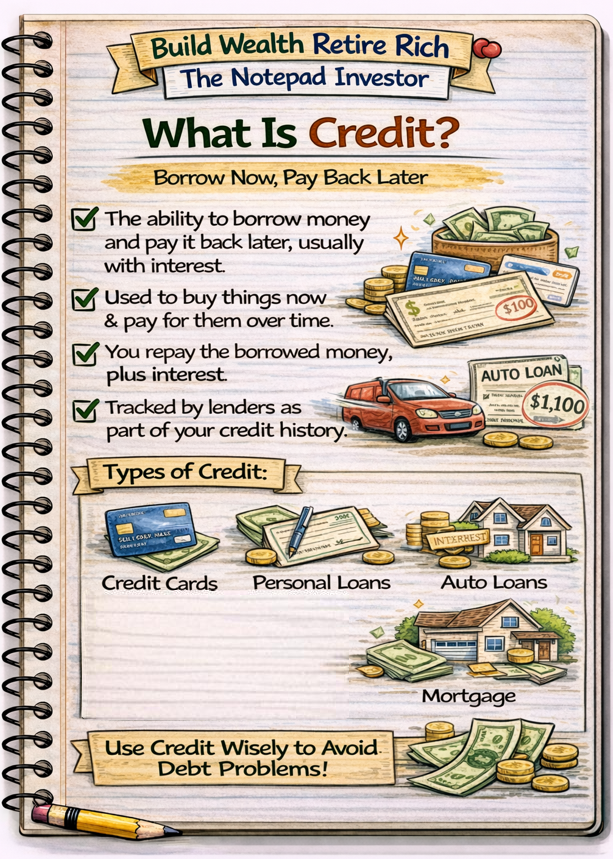
Credit is the ability to borrow money or access goods and services with the understanding that payment will be made later—a contractual promise to repay borrowed funds plus any agreed-upon interest or fees within specified timeframe creating financial flexibility enabling major purchases, emergency coverage, and strategic cash flow management when used responsibly. Unlike cash transactions requiring immediate full payment or debit transactions drawing directly from existing bank balances, credit creates temporary debt obligation allowing consumption before payment through lender trust in borrower’s future repayment based on creditworthiness assessment, making credit simultaneously powerful financial tool enabling opportunities impossible through cash-only approaches and potentially dangerous trap creating unsustainable debt when misused or misunderstood resulting in long-term financial damage from compounding interest and damaged credit standing affecting future borrowing costs and approval possibilities.
This article is designed for anyone new to credit concepts, individuals wanting comprehensive credit understanding, or those seeking to use credit effectively while avoiding common pitfalls. You do not need financial expertise or prior credit experience to understand credit fundamentals—basic concepts accessible to everyone regardless of background, though requires careful attention to terms, costs, and responsible usage principles differentiating wealth-building credit use from debt-trap patterns creating long-term financial harm through misunderstanding or mismanagement of borrowing obligations.
Understanding what credit is matters because modern financial life frequently requires credit access for housing, transportation, and emergency flexibility, misunderstanding credit costs thousands annually through unnecessary interest and fees while damaging future borrowing ability, and appropriate credit use enables wealth building through strategic leverage and credit score optimization—while informed credit users maintain low-cost access to necessary credit enabling major purchases and financial flexibility, optimize credit scores reducing borrowing costs substantially, and avoid debt traps destroying wealth, creating financial success impossible without credit literacy in modern economy requiring credit understanding for full participation and opportunity access.
Educational disclaimer: This article provides general educational information about credit concepts. Individual credit situations, terms, costs, and appropriate usage vary significantly. Credit products carry risks including debt accumulation and credit score damage from mismanagement. This is not financial advice or recommendation of credit usage. Consult qualified financial professionals for personalized guidance. Credit agreements legally binding—understand terms before acceptance.
Understanding Credit Fundamentals
Core Definition
Credit in simple terms:
- Permission to use someone else’s money now
- Promise to pay it back later
- Usually with interest (cost of borrowing)
- Based on lender’s trust in your ability and willingness to repay
The credit transaction:
- Borrower (you): Receives money, goods, or services immediately
- Lender (creditor): Provides money, goods, or services with expectation of future repayment
- Credit agreement: Legal contract specifying terms (amount, interest rate, repayment schedule)
- Interest: Cost paid for privilege of borrowing (lender’s profit)
How Credit Works
Example credit transaction:
- You want $1,000 item but only have $100 cash
- Credit card company lends you $1,000
- You receive item immediately
- You owe credit card company $1,000 plus interest
- You repay over time through monthly payments
- Total paid might be $1,150 ($1,000 principal + $150 interest over repayment period)
Key components of any credit:
- Principal: Original amount borrowed ($1,000 example)
- Interest rate: Annual percentage cost of borrowing (18% APR typical credit card)
- Term: Time period for repayment (varies by credit type)
- Monthly payment: Required periodic payment amount
- Total cost: Principal + all interest and fees
Credit vs Cash vs Debit
Cash transaction:
- Immediate payment from existing funds
- No debt created
- No interest charged
- Transaction complete immediately
- Example: Pay $1,000 cash for item, own it outright, done
Debit card transaction:
- Immediate payment from bank account
- Your existing money, just electronic
- No debt created
- No interest charged
- Example: Pay with debit, $1,000 deducted from checking immediately
Credit transaction:
- Delayed payment using borrowed money
- Debt created (owe lender)
- Interest charged (unless paid immediately)
- Transaction creates obligation requiring future payment
- Example: Charge $1,000 on credit card, pay back $1,150 over 6 months
Why Credit Exists
Benefits for borrowers:
- Make purchases before having full amount saved
- Handle emergencies without sufficient cash reserves
- Smooth income fluctuations or timing mismatches
- Build credit history enabling future borrowing
- Leverage for wealth building (strategic debt use)
Benefits for lenders:
- Earn interest income on money lent
- Profitable business model (banking, credit cards)
- Risk-adjusted returns through interest rates and fees
Economic benefits broadly:
- Enables major purchases (homes, education) impossible through cash-only
- Facilitates commerce and economic activity
- Allows productive investment in assets that appreciate
- Creates economic growth through consumption and investment

Types of Credit
Revolving Credit
Definition: Credit line you can use repeatedly up to limit, paying down and reusing
Credit cards (most common revolving credit):
- Credit limit: Maximum you can borrow (example: $5,000 limit)
- Use repeatedly: Charge purchases, pay down balance, charge again
- Minimum payment required monthly
- Interest charged on unpaid balance (typically 15-25% APR)
- Available credit changes based on current balance
Example revolving credit usage:
- Credit limit: $5,000
- Month 1: Charge $1,000, pay $500, balance $500, available credit $4,500
- Month 2: Charge $2,000, pay $1,500, balance $1,000, available credit $4,000
- Revolves continuously based on usage and payments
Other revolving credit examples:
- Home equity line of credit (HELOC)
- Personal line of credit
- Business line of credit
Installment Credit
Definition: Fixed loan amount repaid in regular installments over set term
Characteristics:
- Borrow specific amount once (example: $20,000 auto loan)
- Fixed monthly payment
- Fixed term (36 months, 60 months, 30 years for mortgages)
- Balance decreases with each payment until zero
- Cannot reborrow after paying down (closed-end credit)
Common installment credit types:
Auto loans:
- Amount: $15,000-$40,000 typical
- Term: 36-72 months usually
- Rate: 4-10% APR depending on credit
- Example: $25,000 car, 60 months, 6% = $483 monthly payment
Mortgages:
- Amount: $150,000-$500,000+ typical
- Term: 15 or 30 years standard
- Rate: 5-8% depending on credit and market
- Example: $300,000 home, 30 years, 6.5% = $1,896 monthly
Student loans:
- Amount: Varies by education cost
- Term: 10-25 years typical
- Rate: 4-8% federal, 7-14% private
Personal loans:
- Amount: $1,000-$50,000 typical
- Term: 12-60 months
- Rate: 6-36% depending on credit
Open Credit
Definition: Balance must be paid in full each period
Examples:
- Charge cards (American Express traditional cards): Full balance due monthly, no revolving
- Utility bills: Borrow service for month, pay in full when bill arrives
- Cell phone service: Use first, pay bill in full monthly
Characteristics:
- Short-term credit only (typically 30 days)
- No option to carry balance (or limited)
- No interest charged if paid by due date
- Late fees if not paid in full
Secured vs Unsecured Credit
Secured credit (backed by collateral):
- Asset pledged guaranteeing repayment
- Lender can seize collateral if default
- Lower interest rates (less lender risk)
- Examples: Mortgages (house collateral), auto loans (vehicle collateral), secured credit cards (cash deposit collateral)
Unsecured credit (no collateral):
- Based solely on creditworthiness and promise to repay
- No specific asset securing loan
- Higher interest rates (greater lender risk)
- Examples: Most credit cards, personal loans, student loans
How Credit Costs Money
Interest Rates and APR
Annual Percentage Rate (APR):
- Yearly cost of borrowing expressed as percentage
- Includes interest rate plus some fees
- Standard comparison metric across credit products
How interest accumulates:
- Credit cards: Daily compounding typically
- APR ÷ 365 = daily rate
- Applied to average daily balance
- Compounds (interest on interest) if not paid
Example: Credit card interest calculation
- Balance: $2,000
- APR: 18%
- Daily rate: 18% ÷ 365 = 0.0493% daily
- Daily interest: $2,000 × 0.000493 = $0.99 per day
- Monthly interest: ~$30 if balance maintained
- Pay $50 monthly: $30 interest, $20 principal reduction
- Time to pay off $2,000 paying $50/month: 62 months (over 5 years!)
- Total paid: $3,100 ($2,000 principal + $1,100 interest)
Fees and Charges
Common credit-related fees:
Credit card fees:
- Annual fee: $0-$550+ (premium cards)
- Late payment fee: $25-$40
- Over-limit fee: $25-$35 (less common now)
- Balance transfer fee: 3-5% of amount transferred
- Cash advance fee: 3-5% plus immediate interest
- Foreign transaction fee: 1-3% of purchase amount
Loan fees:
- Origination fee: 1-8% of loan amount
- Application fee: $25-$100
- Prepayment penalty: Variable (some loans charge for early payoff)
Mortgage fees (one-time):
- Appraisal: $300-$600
- Title insurance: $500-$1,500
- Origination: 0.5-1% of loan amount
- Total closing costs: 2-5% of home price
The True Cost of Credit
Example comparing cash vs credit purchase:
Scenario: $3,000 purchase
Option A: Pay cash
- Total cost: $3,000
- Ownership: Immediate, debt-free
Option B: Credit card, minimum payments, 18% APR
- Monthly payment: $75 (2.5% minimum)
- Time to pay off: 72 months (6 years)
- Total interest paid: $2,441
- Total cost: $5,441 (81% more than cash!)
Option C: Credit card, but aggressive payoff
- Monthly payment: $300
- Time to pay off: 11 months
- Total interest paid: $276
- Total cost: $3,276 (9% more than cash)
Key insight: Repayment speed dramatically affects total cost
Creditworthiness and Credit Decisions
How Lenders Evaluate Borrowers
The Five Cs of Credit:
1. Character (credit history):
- Past repayment behavior
- Credit score (300-850 scale)
- Payment history on previous debts
- Bankruptcies, collections, late payments
2. Capacity (ability to repay):
- Income level and stability
- Employment history
- Debt-to-income ratio (total debt payments ÷ income)
- Other financial obligations
3. Capital (financial resources):
- Savings and assets
- Down payment amount
- Net worth
- Reserve funds
4. Collateral (secured credit only):
- Value of asset securing loan
- Loan-to-value ratio
- Quality and liquidity of collateral
5. Conditions (economic factors):
- Purpose of loan
- Economic environment
- Industry stability
Credit Scores
Definition: Numerical representation of creditworthiness (300-850 scale)
Score ranges and meanings:
- 800-850: Exceptional (best rates, highest approval odds)
- 740-799: Very good (excellent rates, high approval)
- 670-739: Good (favorable rates, good approval)
- 580-669: Fair (higher rates, conditional approval)
- 300-579: Poor (very high rates or denied)
Impact on borrowing costs:
Example: $300,000 mortgage, 30 years
- 760+ score: 6.0% rate → $1,799 monthly, $647,514 total paid
- 680 score: 6.5% rate → $1,896 monthly, $682,632 total paid
- 620 score: 7.5% rate → $2,098 monthly, $755,279 total paid
- Difference 760 vs 620: $299/month, $107,765 over life of loan
Credit score factors (FICO model):
- Payment history: 35% (on-time vs late payments)
- Amounts owed: 30% (utilization, total debt)
- Length of credit history: 15% (age of accounts)
- New credit: 10% (recent applications, new accounts)
- Credit mix: 10% (variety of credit types)
Credit Reports
Definition: Detailed history of credit usage and payment behavior
Information in credit reports:
- Personal information (name, address, SSN)
- Credit accounts (cards, loans, mortgages)
- Payment history (on-time, late, missed)
- Credit inquiries (who checked your credit)
- Public records (bankruptcies, liens, judgments)
- Collections (accounts sent to collections)
Three major credit bureaus:
- Equifax
- Experian
- TransUnion
Access to credit reports:
- Free annual report from each bureau at AnnualCreditReport.com
- Review for errors and accuracy
- Monitor for identity theft signs
Why Understanding Credit Matters
Without credit understanding, people pay thousands unnecessarily through high-interest debt and poor credit decisions, damaged credit scores create years of elevated borrowing costs affecting major purchases like homes and vehicles, and lack of credit literacy prevents strategic credit use for wealth building and financial flexibility—while credit-literate individuals maintain excellent scores enabling lowest-cost borrowing, use credit strategically for benefits and flexibility without accumulating destructive debt, and optimize credit profiles accessing financial opportunities impossible for those lacking credit knowledge or avoiding credit entirely through misconception that all debt harmful regardless of type, terms, or strategic application enabling wealth building.
Understanding what credit is enables individuals to:
- Make informed decisions about when and how to use credit appropriately
- Understand true costs of borrowing avoiding debt traps
- Build and maintain excellent credit scores reducing lifetime borrowing costs
- Distinguish between productive and destructive debt usage
- Access credit when needed for emergencies or opportunities
- Negotiate better terms through credit knowledge and strong creditworthiness
- Avoid common credit mistakes damaging financial health long-term
Credit knowledge transforms borrowing from mysterious potentially dangerous activity into understood financial tool enabling strategic use supporting financial goals while avoiding pitfalls destroying wealth through misunderstanding or mismanagement.
Common Misunderstandings
Many people assume all credit and debt inherently bad requiring complete avoidance. In reality, strategic credit use enables major purchases impossible through cash-only approaches (homes, education, reliable transportation), excellent credit provides financial flexibility for emergencies and opportunities, and maintaining no credit history creates “credit invisible” status preventing approval even when financially qualified, proving appropriate credit use essential component of modern financial success not moral failing or guaranteed path to financial destruction when understood and managed responsibly versus avoided entirely through misconception.
Another common misconception is that carrying credit card balance helps credit scores. In practice, credit scores improve through on-time payments and low utilization regardless of whether balance paid in full monthly—carrying balances costs substantial interest ($1,000 annually on $5,000 average balance at 20% APR) with zero credit score benefit, proving “pay in full monthly” superior to “carry small balance” myth wasting money unnecessarily based on misunderstanding of credit score factors prioritizing payment history and utilization percentage not whether interest paid.
Some believe checking credit score damages credit. However, checking your own credit (soft inquiry) never affects score—only lender credit checks when applying for new credit (hard inquiries) impact scores modestly and temporarily, proving monitoring your own credit encouraged and harmless enabling early error detection and fraud awareness impossible when avoiding credit monitoring based on false belief that checking harms scores creating uninformed vulnerability to identity theft and reporting errors.
How Credit Fits Into Financial Success
Credit provides essential financial infrastructure enabling major purchases and emergency flexibility, strategic credit use accelerates wealth building through leverage (appreciating assets like homes) and optimization (rewards, 0% promotional financing), and excellent credit scores reduce lifetime borrowing costs by tens to hundreds of thousands of dollars through lower interest rates—making credit literacy fundamental component of complete financial success impossible without understanding credit systems, maintaining strong credit standing, and using credit strategically for benefits while avoiding destructive debt patterns creating long-term financial damage through misuse or misunderstanding.
For example, two individuals both age 25 starting careers earning $50,000. Person A avoids all credit based on “debt is bad” philosophy using cash/debit exclusively. Cannot establish credit history, denied apartment due to no credit (cash deposit required), eventually needs car but can’t get loan (no credit history)—pays $8,000 cash for older unreliable vehicle. Wants to buy home age 35 but denied mortgage despite 10 years stable employment and $40,000 saved down payment—no credit history makes them “credit invisible” and higher risk requiring either denied or extremely high rates. After 20 years: Renting due to mortgage denial, owns aging vehicle paid cash, no credit card rewards accumulated, limited financial flexibility, ironically paying higher lifetime costs through rent premiums and inability to access advantageous homeownership despite cash-only “responsible” approach. Person B understands credit from start, uses strategically. Opens credit card age 25, uses for routine spending paying full balance monthly building history and earning 2% cash back. Maintains 750+ credit score through responsible use. Age 28: Approved for auto loan 4% rate buying $22,000 reliable vehicle. Age 30: Approved for mortgage 6% rate buying $250,000 home. Over 15 years: Earned $6,000+ credit card rewards, saved $15,000+ in interest through excellent credit scores enabling lowest rates, built $100,000 home equity through ownership versus rent. After 20 years age 45: Excellent credit enabling best rates and opportunities, substantial home equity wealth, accumulated rewards, financial flexibility through credit access when needed. Difference: $100,000+ home equity wealth, $20,000+ rewards and interest savings, superior financial flexibility and opportunities—all from understanding credit as tool rather than avoiding entirely. Person B not reckless borrower carrying debt irresponsibly but strategic credit user leveraging system benefits while avoiding pitfalls through understanding enabling wealth building impossible for Person A despite arguably more “disciplined” cash-only approach creating paradoxical disadvantage through credit system avoidance.
Credit understanding separates those optimizing modern financial infrastructure from those disadvantaged by credit avoidance or misuse—strategic informed credit use enables wealth building and opportunity access impossible through either complete avoidance based on misconception or destructive overuse from lack of understanding.
Recent Updates and Trends
In recent years, alternative credit scoring models have expanded—FICO 10 and VantageScore considering rent, utility, and phone payments enabling those without traditional credit to establish creditworthiness, reducing “credit invisible” population historically disadvantaged by lack of traditional credit history despite responsible payment behavior in other domains.
Buy-now-pay-later services have proliferated—Affirm, Klarna, Afterpay offering point-of-sale financing for online purchases making credit access frictionless potentially increasing debt accumulation among younger consumers unfamiliar with traditional credit risks while offering alternative to high-interest credit cards for planned purchases when used responsibly.
Credit card rewards have intensified—cards offering 2-5% cash back or valuable travel points making strategic credit use more financially rewarding for those paying balances in full monthly versus historical minimal rewards environment, though simultaneously tempting overspending through rewards psychology potentially negating benefits when balances carried.
Credit freezes have become free and instant—federal law requiring free credit freezes enabling stronger identity theft protection versus historical fees and delays making security measure more accessible, though requiring active management when applying for legitimate credit creating friction potentially causing missed opportunities when forgotten.
Fundamental credit principles remain timeless: credit enables purchases before saving full amount creating flexibility and opportunity access, interest costs money making responsible use requiring discipline and understanding, credit scores dramatically affect borrowing costs justifying maintenance of excellent credit, and strategic credit use accelerates wealth while irresponsible use destroys it—regardless of scoring model evolution, new credit product proliferation, reward intensification, or security measure improvements, understanding credit fundamentals, maintaining strong creditworthiness, and using credit strategically versus destructively produces superior lifetime financial outcomes through appropriate leverage of modern financial infrastructure impossible without credit literacy.
3 Things You Can Do Today
Ready to understand and optimize your credit? Here are three simple steps you can take right now:
1. Request your free credit reports from all three bureaus – Visit AnnualCreditReport.com (only official free source authorized by federal law). Request reports from all three bureaus: Equifax, Experian, TransUnion. Review each carefully: Check all accounts listed are yours (identity theft detection), verify balances and payment history accurate (error detection), confirm personal information correct. Common errors: Accounts not belonging to you, incorrect payment history marking on-time payments as late, outdated negative information exceeding legal reporting periods (7-10 years typically). Dispute any errors directly with bureau through their website. Takes 30 minutes accessing and reviewing establishing baseline credit understanding. Without this review, errors may damage scores unnecessarily or identity theft proceed undetected creating substantial future problems impossible to address without awareness of credit report contents.
2. Check your credit score using free sources and understand factors affecting it – Free score sources: Credit card issuers (most provide free FICO score now), Credit Karma or similar services (VantageScore version, different but similar to FICO), Discover Credit Scorecard (free even without Discover card). Note your current score and range: 300-579 poor, 580-669 fair, 670-739 good, 740-799 very good, 800-850 exceptional. Understand five factors: Payment history 35% (pay everything on time!), amounts owed 30% (keep credit card balances below 30% of limit ideally), length of history 15% (maintain old accounts), new credit 10% (limit applications), credit mix 10% (variety of account types). Identify your weak areas: Late payments → set up automatic payments, high utilization → pay down balances or request limit increases, short history → maintain accounts long-term building age. Takes 15 minutes establishing score awareness and improvement roadmap.
3. If you have credit cards, calculate actual interest costs on any balances and create payoff plan – For each credit card with balance: Note current balance, interest rate (APR), minimum payment. Calculate interest cost: Balance × (APR ÷ 12) = monthly interest charge. Example: $3,000 balance at 18% APR = $3,000 × 0.015 = $45 monthly interest. If paying only minimums: Use online credit card payoff calculator showing total interest and time. Typical $3,000 at 18% paying $75 minimums = 63 months, $1,769 interest, $4,769 total paid. Create aggressive payoff plan: How much can you pay beyond minimum? Example: $300 monthly instead of $75 = 11 months, $276 interest, $3,276 total paid. Difference: $1,493 interest saved, 52 months faster payoff. Write plan: “Pay $300 monthly on card until eliminated, total time 11 months.” Commit to no new charges while paying off. Takes 15 minutes creating concrete escape plan from high-interest debt cycle impossible without calculating actual costs making invisible damage visible and actionable.
These actions create credit awareness and improvement foundation within 60 minutes—reviewed credit reports identifying errors and establishing baseline, checked scores understanding factors requiring improvement, and created specific payoff plans escaping high-cost debt—transforming credit from mysterious potentially dangerous activity into understood manageable aspect of financial life enabling strategic optimization impossible without foundational knowledge and specific action plans addressing individual situations.
Quick FAQ
Is it better to avoid credit entirely and use only cash/debit?
No—strategic credit use provides: (1) Credit history necessary for major purchases (mortgages, auto loans even when you can afford them require credit history), (2) Fraud protection superior to debit cards (credit card liability limited to $50 legally, debit fraud affects actual bank funds), (3) Rewards (2-5% cash back on purchases paid in full), (4) Emergency flexibility when needed, (5) Credit score building enabling lowest rates when borrowing necessary. Cash/debit-only approach creates “credit invisible” status preventing mortgage approval even with large down payment and stable income. Recommended: Use credit cards for routine spending, pay full balance monthly, never carry high-interest debt, build excellent credit enabling opportunities while avoiding interest costs.
Does carrying a small credit card balance help my credit score?
No—complete myth wasting money. Credit scores improve through: (1) On-time payments (happens whether balance paid in full or carried), (2) Low utilization (percentage of limit used, under 30% ideal, actually better at 1-10%), (3) Length of history, (4) Credit mix. Carrying balance costs interest with zero score benefit. Example: $1,000 average balance at 20% APR = $200 annual interest wasted for no credit benefit. Correct approach: Use cards actively (generates payment history), pay full balance monthly (avoids interest), maintain low utilization (shows responsibility), keep accounts open long-term (builds history). This maximizes score while minimizing costs versus “carry balance” myth costing money unnecessarily.
Will checking my own credit score hurt my credit?
No—checking your own credit (soft inquiry) never affects scores. Types of inquiries: Soft inquiries (no impact): Checking your own credit, pre-qualified offers, employer background checks, existing creditor account reviews. Hard inquiries (small temporary impact): Applying for new credit card, applying for loan, applying for mortgage. Hard inquiries: Typically reduce score 5-10 points temporarily, recover within months, shopping for same loan type within 14-45 days counts as single inquiry. Checking own credit encouraged: Monitor for errors, detect fraud early, understand factors affecting score, track improvement progress. Fear of checking based on misunderstanding prevents valuable monitoring making you vulnerable to identity theft and reporting errors impossible to address without awareness.
What is a good credit score and how long does it take to build?
Score ranges: 740+ excellent (best rates, highest approval), 670-739 good (favorable rates), 580-669 fair (higher rates, conditional approval), below 580 poor (very high rates or denied). Building timeline from zero: 6 months: First score appears (need minimum 6 months credit history), 1-2 years: Reach 650-700 range with responsible use, 3-5 years: Reach 740+ with consistent on-time payments and low utilization, 7+ years: Potential for 800+ with perfect history. Faster building: Become authorized user on someone’s old account (inherits account age and history), secured credit card if no approval for regular card ($200-500 deposit becomes credit limit), credit-builder loan through credit unions. Damaged credit rebuilding: Similar timeline but starting from lower point, negative items remain 7 years (bankruptcy 10 years) but impact diminishes over time, consistent positive behavior gradually outweighs old negatives.
What credit utilization ratio should I maintain?
Utilization = current balance ÷ total credit limit across all cards. Ideal: Under 10% for best scores (example: $1,000 balance on $10,000 total limits = 10%), Acceptable: Under 30% (maintains good scores), Problematic: Over 50% (indicates financial stress to lenders, reduces scores), Critical: Over 75% or maxed out (major score damage). Example impact: Same person, $5,000 credit limit: 5% utilization ($250 balance) = 760 score, 50% utilization ($2,500 balance) = 680 score, 90% utilization ($4,500 balance) = 620 score. Strategies maintaining low utilization: Pay before statement closing date (balance reported is statement balance not payment due date), request credit limit increases (larger denominator lowers percentage), spread spending across multiple cards (keeps individual card percentages low), pay multiple times monthly (keeps reported balance minimal). Note: 0% utilization sometimes scores slightly lower than 1-10% (shows lack of usage) so some minimal activity optimal.
Explore More in Money Basics
Disclosure
This article is provided for educational purposes only and does not constitute financial advice, credit counseling, or recommendation of specific credit products or strategies. Credit usage carries risks including debt accumulation, interest costs, and potential credit score damage from mismanagement. Interest rates, fees, terms, and credit score impacts vary significantly by individual circumstances, lender, and credit product. Examples use simplified scenarios—actual costs and outcomes differ. Credit score factors and calculations are proprietary to credit bureaus and scoring models (FICO, VantageScore)—exact impacts vary. Credit decisions should consider individual financial situation, goals, risk tolerance, and ability to repay. Credit agreements are legally binding contracts—read terms carefully before acceptance. Late payments and defaults have serious consequences including credit damage, collections, and legal action. Individual circumstances, credit histories, incomes, and appropriate credit usage vary requiring personalized assessment. This article does not address all credit types, terms, or considerations. Consult qualified financial professionals, credit counselors, or attorneys for personalized guidance. Credit bureau contact information and dispute processes available on bureau websites. Advertisements or sponsored content may appear within or alongside this content. All information presented independently for educational purposes only.